

Darboux-Bäcklund Transformations for Spin-Valued Linear Problems
41
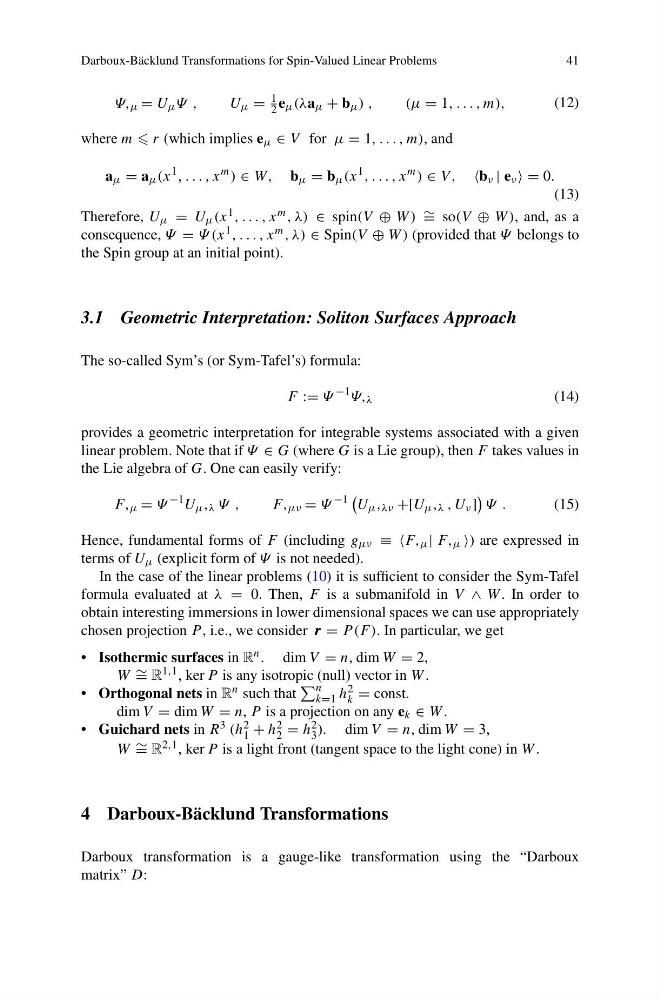
Ψ, μ = U μ Ψ ,
U μ =
1
2 e μ (λa μ + b μ ) ,
(μ = 1, . . . , m),
(12)
where m r (which implies e μ ∈ V for μ = 1, . . . , m), and
a μ = a μ (x
1 , . . . , x
m ) ∈ W, b μ = b μ (x
1 , . . . , x
m ) ∈ V , ν | e ν = 0.
(13)
Therefore, U μ = U μ (x 1 , . . . , x m , λ) ∈ spin(V ⊕ W ) ∼ = so(V ⊕ W ), and, as a
consequence, Ψ = Ψ (x 1 , . . . , x m , λ) ∈ Spin(V ⊕ W ) (provided that Ψ belongs to
the Spin group at an initial point).
3.1 Geometric Interpretation: Soliton Surfaces Approach
The so-called Sym’s (or Sym-Tafel’s) formula:
F := Ψ
−1 Ψ, λ
(14)
provides a geometric interpretation for integrable systems associated with a given
linear problem. Note that if Ψ ∈ G (where G is a Lie group), then F takes values in
the Lie algebra of G. One can easily verify:
F, μ = Ψ
−1 U μ , λ Ψ ,
F, μν = Ψ
−1
U μ , λν +[U μ , λ , U ν ]
Ψ .
(15)
Hence, fundamental forms of F (including g μν ≡ ≡F, μ | F, μ are expressed in
terms of U μ (explicit form of Ψ is not needed).
In the case of the linear problems (10) it is sufficient to consider the Sym-Tafel
formula evaluated at λ = 0. Then, F is a submanifold in V ∧ W . In order to
obtain interesting immersions in lower dimensional spaces we can use appropriately
chosen projection P , i.e., we consider r r r = P (F ). In particular, we get
• Isothermic surfaces in R n . dimV = n, dim W = 2,
W ∼ = R 1,1 , ker P is any isotropic (null) vector in W .
• Orthogonal nets in R n such that
n
k=1 h 2
k = const.
dim V = dim W = n, P is a projection on any e k ∈ W .
• Guichard nets in R 3 (h 2
1 + h 2
2 = h 2
3 ). dim V = n, dim W = 3,
W ∼ = R 2,1 , ker P is a light front (tangent space to the light cone) in W .
4 Darboux-Bäcklund Transformations
Darboux transformation is a gauge-like transformation using the “Darboux
matrix” D:
41
Ψ, μ = U μ Ψ ,
U μ =
1
2 e μ (λa μ + b μ ) ,
(μ = 1, . . . , m),
(12)
where m r (which implies e μ ∈ V for μ = 1, . . . , m), and
a μ = a μ (x
1 , . . . , x
m ) ∈ W, b μ = b μ (x
1 , . . . , x
m ) ∈ V , ν | e ν = 0.
(13)
Therefore, U μ = U μ (x 1 , . . . , x m , λ) ∈ spin(V ⊕ W ) ∼ = so(V ⊕ W ), and, as a
consequence, Ψ = Ψ (x 1 , . . . , x m , λ) ∈ Spin(V ⊕ W ) (provided that Ψ belongs to
the Spin group at an initial point).
3.1 Geometric Interpretation: Soliton Surfaces Approach
The so-called Sym’s (or Sym-Tafel’s) formula:
F := Ψ
−1 Ψ, λ
(14)
provides a geometric interpretation for integrable systems associated with a given
linear problem. Note that if Ψ ∈ G (where G is a Lie group), then F takes values in
the Lie algebra of G. One can easily verify:
F, μ = Ψ
−1 U μ , λ Ψ ,
F, μν = Ψ
−1
U μ , λν +[U μ , λ , U ν ]
Ψ .
(15)
Hence, fundamental forms of F (including g μν ≡ ≡F, μ | F, μ are expressed in
terms of U μ (explicit form of Ψ is not needed).
In the case of the linear problems (10) it is sufficient to consider the Sym-Tafel
formula evaluated at λ = 0. Then, F is a submanifold in V ∧ W . In order to
obtain interesting immersions in lower dimensional spaces we can use appropriately
chosen projection P , i.e., we consider r r r = P (F ). In particular, we get
• Isothermic surfaces in R n . dimV = n, dim W = 2,
W ∼ = R 1,1 , ker P is any isotropic (null) vector in W .
• Orthogonal nets in R n such that
n
k=1 h 2
k = const.
dim V = dim W = n, P is a projection on any e k ∈ W .
• Guichard nets in R 3 (h 2
1 + h 2
2 = h 2
3 ). dim V = n, dim W = 3,
W ∼ = R 2,1 , ker P is a light front (tangent space to the light cone) in W .
4 Darboux-Bäcklund Transformations
Darboux transformation is a gauge-like transformation using the “Darboux
matrix” D: