

562
J. Y. Araz
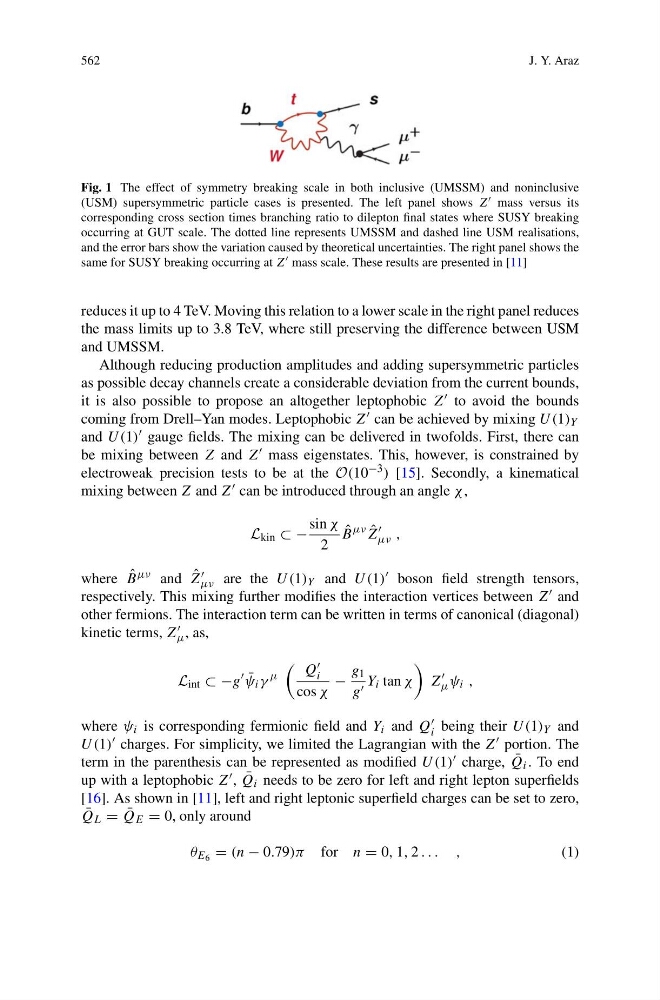
Fig. 1 The effect of symmetry breaking scale in both inclusive (UMSSM) and noninclusive
(USM) supersymmetric particle cases is presented. The left panel shows Z mass versus its
corresponding cross section times branching ratio to dilepton final states where SUSY breaking
occurring at GUT scale. The dotted line represents UMSSM and dashed line USM realisations,
and the error bars show the variation caused by theoretical uncertainties. The right panel shows the
same for SUSY breaking occurring at Z mass scale. These results are presented in [11]
reduces it up to 4 TeV. Moving this relation to a lower scale in the right panel reduces
the mass limits up to 3.8 TeV, where still preserving the difference between USM
and UMSSM.
Although reducing production amplitudes and adding supersymmetric particles
as possible decay channels create a considerable deviation from the current bounds,
it is also possible to propose an altogether leptophobic Z to avoid the bounds
coming from Drell–Yan modes. Leptophobic Z can be achieved by mixing U(1) Y
and U(1) gauge fields. The mixing can be delivered in twofolds. First, there can
be mixing between Z and Z mass eigenstates. This, however, is constrained by
electroweak precision tests to be at the O(10 −3 ) [15]. Secondly, a kinematical
mixing between Z and Z can be introduced through an angle χ ,
L kin ⊂ −
sin χ
2
ˆ
B
μν ˆ
Z
μν ,
where ˆ
B μν and ˆ
Z
μν are the U(1) Y and U(1) boson field strength tensors,
respectively. This mixing further modifies the interaction vertices between Z and
other fermions. The interaction term can be written in terms of canonical (diagonal)
kinetic terms, Z
μ , as,
L int ⊂ −g
¯
ψ i γ
μ
Q
i
cos χ
−
g 1
g Y i tan χ
Z
μ ψ i ,
where ψ i is corresponding fermionic field and Y i and Q
i being their U(1) Y and
U(1) charges. For simplicity, we limited the Lagrangian with the Z portion. The
term in the parenthesis can be represented as modified U(1) charge, ¯
Q i . To end
up with a leptophobic Z , ¯
Q i needs to be zero for left and right lepton superfields
[16]. As shown in [11], left and right leptonic superfield charges can be set to zero,
¯
Q L = ¯
Q E = 0, only around
θ E 6 = (n − 0.79)π for n = 0, 1, 2 . . . ,
(1)
J. Y. Araz
Fig. 1 The effect of symmetry breaking scale in both inclusive (UMSSM) and noninclusive
(USM) supersymmetric particle cases is presented. The left panel shows Z mass versus its
corresponding cross section times branching ratio to dilepton final states where SUSY breaking
occurring at GUT scale. The dotted line represents UMSSM and dashed line USM realisations,
and the error bars show the variation caused by theoretical uncertainties. The right panel shows the
same for SUSY breaking occurring at Z mass scale. These results are presented in [11]
reduces it up to 4 TeV. Moving this relation to a lower scale in the right panel reduces
the mass limits up to 3.8 TeV, where still preserving the difference between USM
and UMSSM.
Although reducing production amplitudes and adding supersymmetric particles
as possible decay channels create a considerable deviation from the current bounds,
it is also possible to propose an altogether leptophobic Z to avoid the bounds
coming from Drell–Yan modes. Leptophobic Z can be achieved by mixing U(1) Y
and U(1) gauge fields. The mixing can be delivered in twofolds. First, there can
be mixing between Z and Z mass eigenstates. This, however, is constrained by
electroweak precision tests to be at the O(10 −3 ) [15]. Secondly, a kinematical
mixing between Z and Z can be introduced through an angle χ ,
L kin ⊂ −
sin χ
2
ˆ
B
μν ˆ
Z
μν ,
where ˆ
B μν and ˆ
Z
μν are the U(1) Y and U(1) boson field strength tensors,
respectively. This mixing further modifies the interaction vertices between Z and
other fermions. The interaction term can be written in terms of canonical (diagonal)
kinetic terms, Z
μ , as,
L int ⊂ −g
¯
ψ i γ
μ
Q
i
cos χ
−
g 1
g Y i tan χ
Z
μ ψ i ,
where ψ i is corresponding fermionic field and Y i and Q
i being their U(1) Y and
U(1) charges. For simplicity, we limited the Lagrangian with the Z portion. The
term in the parenthesis can be represented as modified U(1) charge, ¯
Q i . To end
up with a leptophobic Z , ¯
Q i needs to be zero for left and right lepton superfields
[16]. As shown in [11], left and right leptonic superfield charges can be set to zero,
¯
Q L = ¯
Q E = 0, only around
θ E 6 = (n − 0.79)π for n = 0, 1, 2 . . . ,
(1)