

Three Partial Differential Equations in Curved Space and their Respective Solutions
499
One can now determine through matrix inversion the column vector on the righthand side of (41) as Eqs. (38) and (39) define the left-hand side of Eq. (41) for an
unit charge at − → z =
− →
R .
This is a lengthy calculation that will be pursued in detail elsewhere, but to wrap
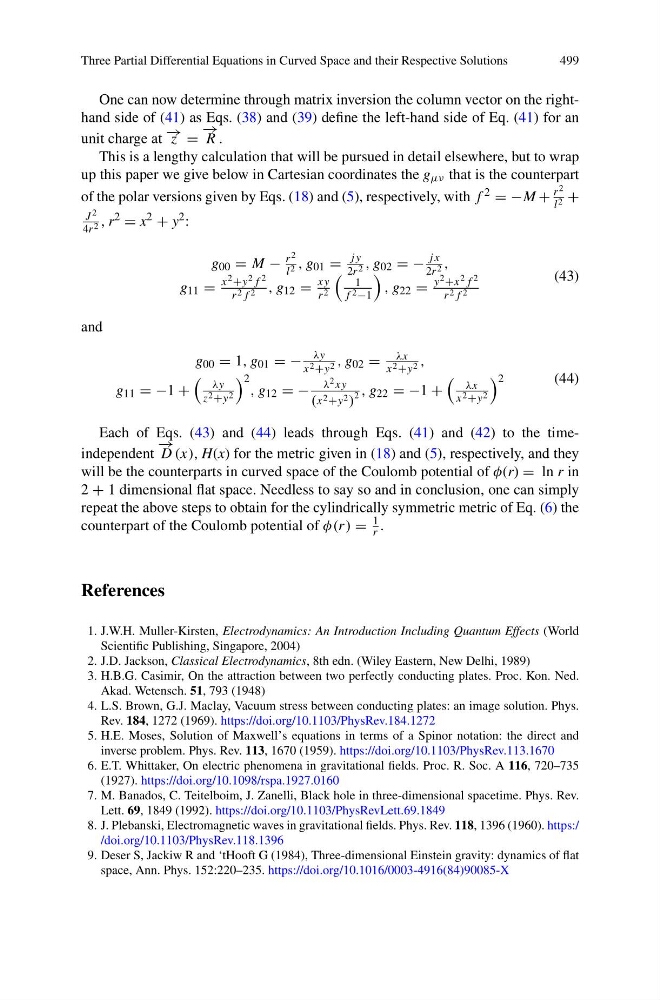
up this paper we give below in Cartesian coordinates the g μν that is the counterpart
of the polar versions given by Eqs. (18) and (5), respectively, with f 2 = −M +
r 2
l 2 +
J 2
4r 2 , r 2 = x 2 + y 2 :
g 00 = M −
r 2
l 2 , g 01 =
jy
2r 2 , g 02 = −
jx
2r 2 ,
g 11 =
x 2 +y 2 f 2
r 2 f 2 , g 12 =
xy
r 2
1
f 2 −1
, g 22 =
y 2 +x 2 f 2
r 2 f 2
(43)
and
g 00 = 1, g 01 = −
λy
x 2 +y 2 , g 02 =
λx
x 2 +y 2 ,
g 11 = −1 +
λy
z 2 +y 2
2
, g 12 = −
λ 2 xy
(x 2 +y 2 )
2 , g 22 = −1 +
λx
x 2 +y 2
2
(44)
Each of Eqs. (43) and (44) leads through Eqs. (41) and (42) to the timeindependent
− →
D (x), H(x) for the metric given in (18) and (5), respectively, and they
will be the counterparts in curved space of the Coulomb potential of φ(r) = ln r in
2 + 1 dimensional flat space. Needless to say so and in conclusion, one can simply
repeat the above steps to obtain for the cylindrically symmetric metric of Eq. (6) the
counterpart of the Coulomb potential of φ(r) =
1
r .
References
1. J.W.H. Muller-Kirsten, Electrodynamics: An Introduction Including Quantum Effects (World
Scientific Publishing, Singapore, 2004)
2. J.D. Jackson, Classical Electrodynamics, 8th edn. (Wiley Eastern, New Delhi, 1989)
3. H.B.G. Casimir, On the attraction between two perfectly conducting plates. Proc. Kon. Ned.
Akad. Wetensch. 51, 793 (1948)
4. L.S. Brown, G.J. Maclay, Vacuum stress between conducting plates: an image solution. Phys.
Rev. 184, 1272 (1969). https://doi.org/10.1103/PhysRev.184.1272
5. H.E. Moses, Solution of Maxwell’s equations in terms of a Spinor notation: the direct and
inverse problem. Phys. Rev. 113, 1670 (1959). https://doi.org/10.1103/PhysRev.113.1670
6. E.T. Whittaker, On electric phenomena in gravitational fields. Proc. R. Soc. A 116, 720–735
(1927). https://doi.org/10.1098/rspa.1927.0160
7. M. Banados, C. Teitelboim, J. Zanelli, Black hole in three-dimensional spacetime. Phys. Rev.
Lett. 69, 1849 (1992). https://doi.org/10.1103/PhysRevLett.69.1849
8. J. Plebanski, Electromagnetic waves in gravitational fields. Phys. Rev. 118, 1396 (1960). https:/
/doi.org/10.1103/PhysRev.118.1396
9. Deser S, Jackiw R and ‘tHooft G (1984), Three-dimensional Einstein gravity: dynamics of flat
space, Ann. Phys. 152:220–235. https://doi.org/10.1016/0003-4916(84)90085-X
499
One can now determine through matrix inversion the column vector on the righthand side of (41) as Eqs. (38) and (39) define the left-hand side of Eq. (41) for an
unit charge at − → z =
− →
R .
This is a lengthy calculation that will be pursued in detail elsewhere, but to wrap
up this paper we give below in Cartesian coordinates the g μν that is the counterpart
of the polar versions given by Eqs. (18) and (5), respectively, with f 2 = −M +
r 2
l 2 +
J 2
4r 2 , r 2 = x 2 + y 2 :
g 00 = M −
r 2
l 2 , g 01 =
jy
2r 2 , g 02 = −
jx
2r 2 ,
g 11 =
x 2 +y 2 f 2
r 2 f 2 , g 12 =
xy
r 2
1
f 2 −1
, g 22 =
y 2 +x 2 f 2
r 2 f 2
(43)
and
g 00 = 1, g 01 = −
λy
x 2 +y 2 , g 02 =
λx
x 2 +y 2 ,
g 11 = −1 +
λy
z 2 +y 2
2
, g 12 = −
λ 2 xy
(x 2 +y 2 )
2 , g 22 = −1 +
λx
x 2 +y 2
2
(44)
Each of Eqs. (43) and (44) leads through Eqs. (41) and (42) to the timeindependent
− →
D (x), H(x) for the metric given in (18) and (5), respectively, and they
will be the counterparts in curved space of the Coulomb potential of φ(r) = ln r in
2 + 1 dimensional flat space. Needless to say so and in conclusion, one can simply
repeat the above steps to obtain for the cylindrically symmetric metric of Eq. (6) the
counterpart of the Coulomb potential of φ(r) =
1
r .
References
1. J.W.H. Muller-Kirsten, Electrodynamics: An Introduction Including Quantum Effects (World
Scientific Publishing, Singapore, 2004)
2. J.D. Jackson, Classical Electrodynamics, 8th edn. (Wiley Eastern, New Delhi, 1989)
3. H.B.G. Casimir, On the attraction between two perfectly conducting plates. Proc. Kon. Ned.
Akad. Wetensch. 51, 793 (1948)
4. L.S. Brown, G.J. Maclay, Vacuum stress between conducting plates: an image solution. Phys.
Rev. 184, 1272 (1969). https://doi.org/10.1103/PhysRev.184.1272
5. H.E. Moses, Solution of Maxwell’s equations in terms of a Spinor notation: the direct and
inverse problem. Phys. Rev. 113, 1670 (1959). https://doi.org/10.1103/PhysRev.113.1670
6. E.T. Whittaker, On electric phenomena in gravitational fields. Proc. R. Soc. A 116, 720–735
(1927). https://doi.org/10.1098/rspa.1927.0160
7. M. Banados, C. Teitelboim, J. Zanelli, Black hole in three-dimensional spacetime. Phys. Rev.
Lett. 69, 1849 (1992). https://doi.org/10.1103/PhysRevLett.69.1849
8. J. Plebanski, Electromagnetic waves in gravitational fields. Phys. Rev. 118, 1396 (1960). https:/
/doi.org/10.1103/PhysRev.118.1396
9. Deser S, Jackiw R and ‘tHooft G (1984), Three-dimensional Einstein gravity: dynamics of flat
space, Ann. Phys. 152:220–235. https://doi.org/10.1016/0003-4916(84)90085-X