

Three Partial Differential Equations in Curved Space and their Respective Solutions
495
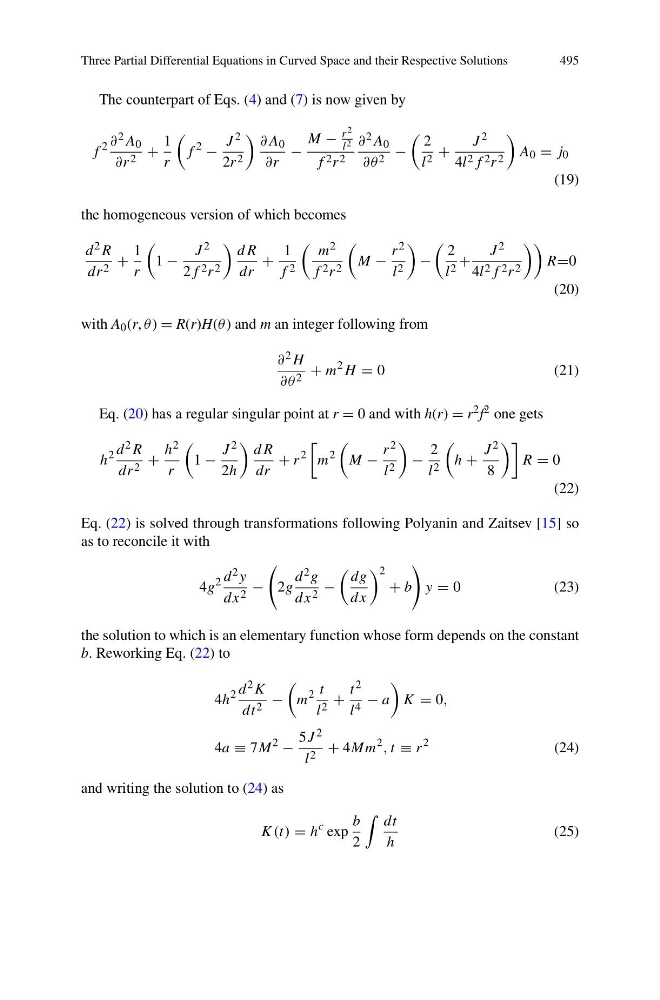
The counterpart of Eqs. (4) and (7) is now given by
f
2 ∂ 2 A 0
∂r 2 +
1
r
f
2
−
J 2
2r 2
∂A 0
∂r
−
M −
r 2
l 2
f 2 r 2
∂ 2 A 0
∂θ 2 −
2
l 2 +
J 2
4l 2 f 2 r 2
A 0 = j 0
(19)
the homogeneous version of which becomes
d 2 R
dr 2 +
1
r
1 −
J 2
2f 2 r 2
dR
dr
+
1
f 2
m 2
f 2 r 2
M −
r 2
l 2
−
2
l 2 +
J 2
4l 2 f 2 r 2
R=0
(20)
with A 0 (r, θ ) = R(r)H(θ ) and m an integer following from
∂ 2 H
∂θ 2 + m
2 H = 0
(21)
Eq. (20) has a regular singular point at r = 0 and with h(r) = r 2 f 2 one gets
h
2 d 2 R
dr 2 +
h 2
r
1 −
J 2
2h
dR
dr
+ r
2
m
2
M −
r 2
l 2
−
2
l 2
h +
J 2
8
R = 0
(22)
Eq. (22) is solved through transformations following Polyanin and Zaitsev [15] so
as to reconcile it with
4g
2 d 2 y
dx 2 −
2g
d 2 g
dx 2 −
dg
dx
2
+ b
y = 0
(23)
the solution to which is an elementary function whose form depends on the constant
b. Reworking Eq. (22) to
4h
2 d 2 K
dt 2 −
m
2 t
l 2 +
t 2
l 4 − a
K = 0,
4a ≡ 7M
2
−
5J 2
l 2 + 4Mm
2 , t ≡ r
2
(24)
and writing the solution to (24) as
K(t) = h
c exp
b
2
dt
h
(25)
495
The counterpart of Eqs. (4) and (7) is now given by
f
2 ∂ 2 A 0
∂r 2 +
1
r
f
2
−
J 2
2r 2
∂A 0
∂r
−
M −
r 2
l 2
f 2 r 2
∂ 2 A 0
∂θ 2 −
2
l 2 +
J 2
4l 2 f 2 r 2
A 0 = j 0
(19)
the homogeneous version of which becomes
d 2 R
dr 2 +
1
r
1 −
J 2
2f 2 r 2
dR
dr
+
1
f 2
m 2
f 2 r 2
M −
r 2
l 2
−
2
l 2 +
J 2
4l 2 f 2 r 2
R=0
(20)
with A 0 (r, θ ) = R(r)H(θ ) and m an integer following from
∂ 2 H
∂θ 2 + m
2 H = 0
(21)
Eq. (20) has a regular singular point at r = 0 and with h(r) = r 2 f 2 one gets
h
2 d 2 R
dr 2 +
h 2
r
1 −
J 2
2h
dR
dr
+ r
2
m
2
M −
r 2
l 2
−
2
l 2
h +
J 2
8
R = 0
(22)
Eq. (22) is solved through transformations following Polyanin and Zaitsev [15] so
as to reconcile it with
4g
2 d 2 y
dx 2 −
2g
d 2 g
dx 2 −
dg
dx
2
+ b
y = 0
(23)
the solution to which is an elementary function whose form depends on the constant
b. Reworking Eq. (22) to
4h
2 d 2 K
dt 2 −
m
2 t
l 2 +
t 2
l 4 − a
K = 0,
4a ≡ 7M
2
−
5J 2
l 2 + 4Mm
2 , t ≡ r
2
(24)
and writing the solution to (24) as
K(t) = h
c exp
b
2
dt
h
(25)