

470
V. Massart and M. B. Paranjape
where α ≡
Δ
R 0
λ1 and v ≡
ωR 0
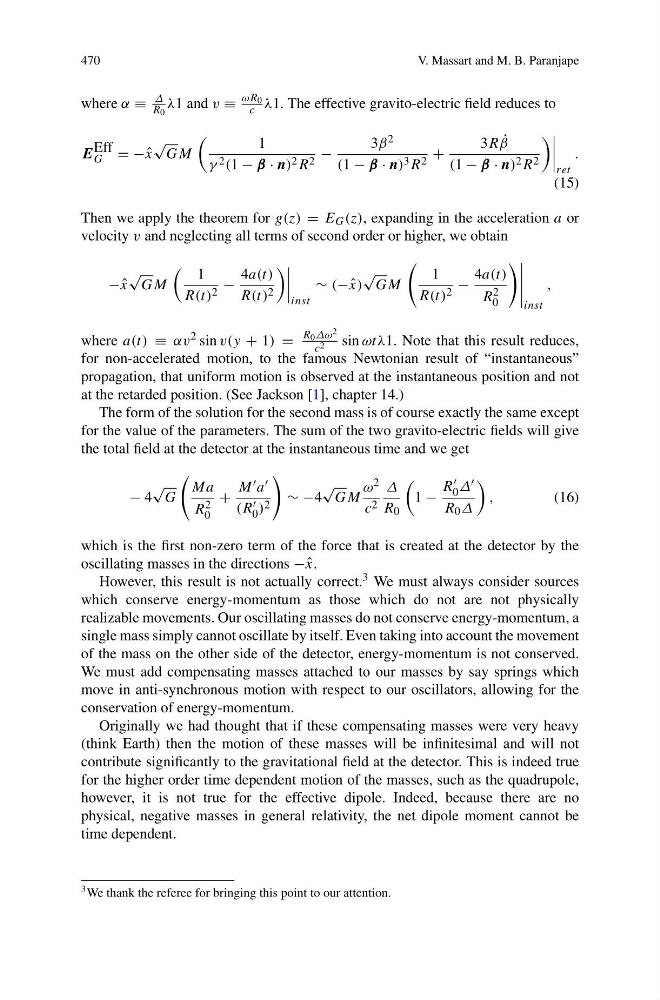
c λ1. The effective gravito-electric field reduces to
E Eff
G = − ˆ
x
√
GM
1
γ 2 (1 − β · n) 2 R 2 −
3β 2
(1 − β · n) 3 R 2 +
3R ˙
β
(1 − β · n) 2 R 2
ret
.
(15)
Then we apply the theorem for g(z) = E G (z), expanding in the acceleration a or
velocity v and neglecting all terms of second order or higher, we obtain
− ˆ
x
√
GM
1
R(t) 2 −
4a(t)
R(t) 2
inst
∼ (− ˆ
x)
√
GM
1
R(t) 2 −
4a(t)
R 2
0
inst
,
where a(t) ≡ αv 2 sin v(y + 1) =
R 0 Δω 2
c 2
sin ωtλ1. Note that this result reduces,
for non-accelerated motion, to the famous Newtonian result of “instantaneous”
propagation, that uniform motion is observed at the instantaneous position and not
at the retarded position. (See Jackson [1], chapter 14.)
The form of the solution for the second mass is of course exactly the same except
for the value of the parameters. The sum of the two gravito-electric fields will give
the total field at the detector at the instantaneous time and we get
− 4
√
G
Ma
R 2
0
+
M a
(R
0 ) 2
∼ −4
√
GM
ω 2
c 2
Δ
R 0
1 −
R
0 Δ
R 0 Δ
,
(16)
which is the first non-zero term of the force that is created at the detector by the
oscillating masses in the directions − ˆ
x.
However, this result is not actually correct. 3 We must always consider sources
which conserve energy-momentum as those which do not are not physically
realizable movements. Our oscillating masses do not conserve energy-momentum, a
single mass simply cannot oscillate by itself. Even taking into account the movement
of the mass on the other side of the detector, energy-momentum is not conserved.
We must add compensating masses attached to our masses by say springs which
move in anti-synchronous motion with respect to our oscillators, allowing for the
conservation of energy-momentum.
Originally we had thought that if these compensating masses were very heavy
(think Earth) then the motion of these masses will be infinitesimal and will not
contribute significantly to the gravitational field at the detector. This is indeed true
for the higher order time dependent motion of the masses, such as the quadrupole,
however, it is not true for the effective dipole. Indeed, because there are no
physical, negative masses in general relativity, the net dipole moment cannot be
time dependent.
3 We thank the referee for bringing this point to our attention.
V. Massart and M. B. Paranjape
where α ≡
Δ
R 0
λ1 and v ≡
ωR 0
c λ1. The effective gravito-electric field reduces to
E Eff
G = − ˆ
x
√
GM
1
γ 2 (1 − β · n) 2 R 2 −
3β 2
(1 − β · n) 3 R 2 +
3R ˙
β
(1 − β · n) 2 R 2
ret
.
(15)
Then we apply the theorem for g(z) = E G (z), expanding in the acceleration a or
velocity v and neglecting all terms of second order or higher, we obtain
− ˆ
x
√
GM
1
R(t) 2 −
4a(t)
R(t) 2
inst
∼ (− ˆ
x)
√
GM
1
R(t) 2 −
4a(t)
R 2
0
inst
,
where a(t) ≡ αv 2 sin v(y + 1) =
R 0 Δω 2
c 2
sin ωtλ1. Note that this result reduces,
for non-accelerated motion, to the famous Newtonian result of “instantaneous”
propagation, that uniform motion is observed at the instantaneous position and not
at the retarded position. (See Jackson [1], chapter 14.)
The form of the solution for the second mass is of course exactly the same except
for the value of the parameters. The sum of the two gravito-electric fields will give
the total field at the detector at the instantaneous time and we get
− 4
√
G
Ma
R 2
0
+
M a
(R
0 ) 2
∼ −4
√
GM
ω 2
c 2
Δ
R 0
1 −
R
0 Δ
R 0 Δ
,
(16)
which is the first non-zero term of the force that is created at the detector by the
oscillating masses in the directions − ˆ
x.
However, this result is not actually correct. 3 We must always consider sources
which conserve energy-momentum as those which do not are not physically
realizable movements. Our oscillating masses do not conserve energy-momentum, a
single mass simply cannot oscillate by itself. Even taking into account the movement
of the mass on the other side of the detector, energy-momentum is not conserved.
We must add compensating masses attached to our masses by say springs which
move in anti-synchronous motion with respect to our oscillators, allowing for the
conservation of energy-momentum.
Originally we had thought that if these compensating masses were very heavy
(think Earth) then the motion of these masses will be infinitesimal and will not
contribute significantly to the gravitational field at the detector. This is indeed true
for the higher order time dependent motion of the masses, such as the quadrupole,
however, it is not true for the effective dipole. Indeed, because there are no
physical, negative masses in general relativity, the net dipole moment cannot be
time dependent.
3 We thank the referee for bringing this point to our attention.