

440
E. G. M. Ferreira
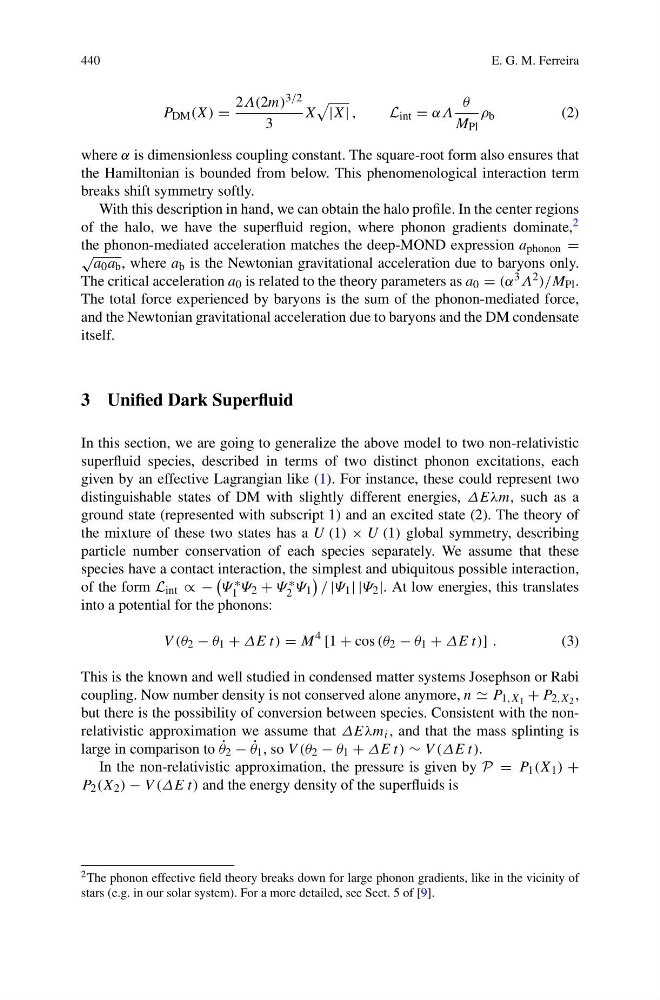
P DM (X) =
2Λ(2m) 3/2
3
X
|X| ,
L int = αΛ
θ
M Pl
ρ b
(2)
where α is dimensionless coupling constant. The square-root form also ensures that
the Hamiltonian is bounded from below. This phenomenological interaction term
breaks shift symmetry softly.
With this description in hand, we can obtain the halo profile. In the center regions
of the halo, we have the superfluid region, where phonon gradients dominate, 2
the phonon-mediated acceleration matches the deep-MOND expression a phonon =
√ a 0 a b , where a b is the Newtonian gravitational acceleration due to baryons only.
The critical acceleration a 0 is related to the theory parameters as a 0 = (α 3 Λ 2 )/M Pl .
The total force experienced by baryons is the sum of the phonon-mediated force,
and the Newtonian gravitational acceleration due to baryons and the DM condensate
itself.
3 Unified Dark Superfluid
In this section, we are going to generalize the above model to two non-relativistic
superfluid species, described in terms of two distinct phonon excitations, each
given by an effective Lagrangian like (1). For instance, these could represent two
distinguishable states of DM with slightly different energies, ΔEλm, such as a
ground state (represented with subscript 1) and an excited state (2). The theory of
the mixture of these two states has a U (1) × U (1) global symmetry, describing
particle number conservation of each species separately. We assume that these
species have a contact interaction, the simplest and ubiquitous possible interaction,
of the form L int ∝ −
Ψ ∗
1 Ψ 2 + Ψ ∗
2 Ψ 1
/ |Ψ 1 | |Ψ 2 |. At low energies, this translates
into a potential for the phonons:
V (θ 2 − θ 1 + ΔE t) = M
4 [1 + cos (θ 2 − θ 1 + ΔE t)] .
(3)
This is the known and well studied in condensed matter systems Josephson or Rabi
coupling. Now number density is not conserved alone anymore, n P 1,X 1 + P 2,X 2 ,
but there is the possibility of conversion between species. Consistent with the nonrelativistic approximation we assume that ΔEλm i , and that the mass splinting is
large in comparison to ˙
θ 2 − ˙
θ 1 , so V (θ 2 − θ 1 + ΔE t) ∼ V (ΔE t).
In the non-relativistic approximation, the pressure is given by P = P 1 (X 1 ) +
P 2 (X 2 ) − V (ΔE t) and the energy density of the superfluids is
2 The phonon effective field theory breaks down for large phonon gradients, like in the vicinity of
stars (e.g. in our solar system). For a more detailed, see Sect. 5 of [9].
E. G. M. Ferreira
P DM (X) =
2Λ(2m) 3/2
3
X
|X| ,
L int = αΛ
θ
M Pl
ρ b
(2)
where α is dimensionless coupling constant. The square-root form also ensures that
the Hamiltonian is bounded from below. This phenomenological interaction term
breaks shift symmetry softly.
With this description in hand, we can obtain the halo profile. In the center regions
of the halo, we have the superfluid region, where phonon gradients dominate, 2
the phonon-mediated acceleration matches the deep-MOND expression a phonon =
√ a 0 a b , where a b is the Newtonian gravitational acceleration due to baryons only.
The critical acceleration a 0 is related to the theory parameters as a 0 = (α 3 Λ 2 )/M Pl .
The total force experienced by baryons is the sum of the phonon-mediated force,
and the Newtonian gravitational acceleration due to baryons and the DM condensate
itself.
3 Unified Dark Superfluid
In this section, we are going to generalize the above model to two non-relativistic
superfluid species, described in terms of two distinct phonon excitations, each
given by an effective Lagrangian like (1). For instance, these could represent two
distinguishable states of DM with slightly different energies, ΔEλm, such as a
ground state (represented with subscript 1) and an excited state (2). The theory of
the mixture of these two states has a U (1) × U (1) global symmetry, describing
particle number conservation of each species separately. We assume that these
species have a contact interaction, the simplest and ubiquitous possible interaction,
of the form L int ∝ −
Ψ ∗
1 Ψ 2 + Ψ ∗
2 Ψ 1
/ |Ψ 1 | |Ψ 2 |. At low energies, this translates
into a potential for the phonons:
V (θ 2 − θ 1 + ΔE t) = M
4 [1 + cos (θ 2 − θ 1 + ΔE t)] .
(3)
This is the known and well studied in condensed matter systems Josephson or Rabi
coupling. Now number density is not conserved alone anymore, n P 1,X 1 + P 2,X 2 ,
but there is the possibility of conversion between species. Consistent with the nonrelativistic approximation we assume that ΔEλm i , and that the mass splinting is
large in comparison to ˙
θ 2 − ˙
θ 1 , so V (θ 2 − θ 1 + ΔE t) ∼ V (ΔE t).
In the non-relativistic approximation, the pressure is given by P = P 1 (X 1 ) +
P 2 (X 2 ) − V (ΔE t) and the energy density of the superfluids is
2 The phonon effective field theory breaks down for large phonon gradients, like in the vicinity of
stars (e.g. in our solar system). For a more detailed, see Sect. 5 of [9].