

Features of Discrete Integrability
27
Σ
Σ’
E
E Q
P
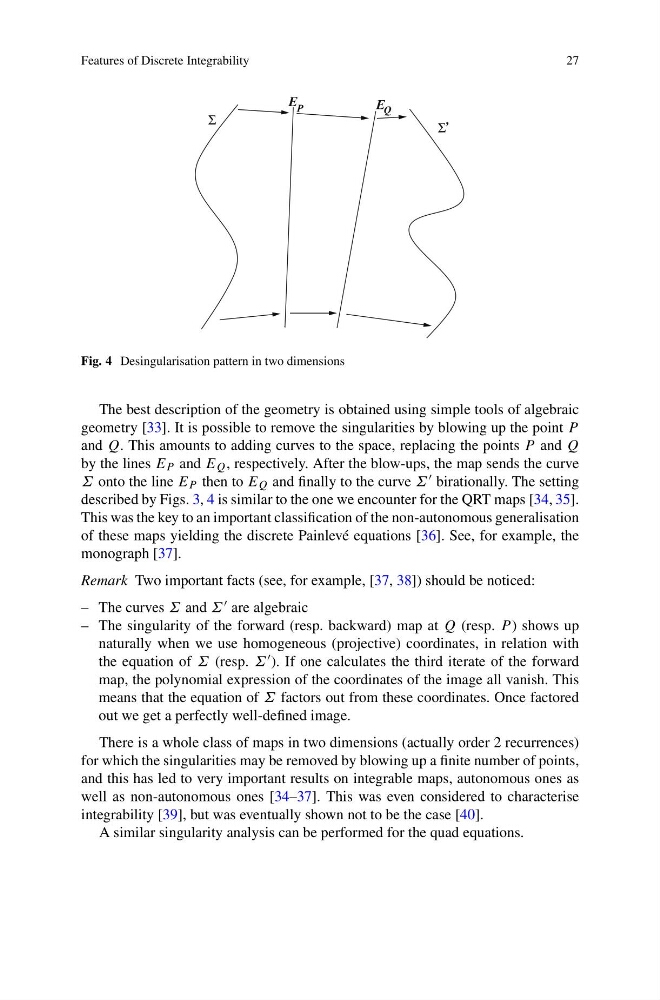
Fig. 4 Desingularisation pattern in two dimensions
The best description of the geometry is obtained using simple tools of algebraic
geometry [33]. It is possible to remove the singularities by blowing up the point P
and Q. This amounts to adding curves to the space, replacing the points P and Q
by the lines E P and E Q , respectively. After the blow-ups, the map sends the curve
Σ onto the line E P then to E Q and finally to the curve Σ birationally. The setting
described by Figs. 3, 4 is similar to the one we encounter for the QRT maps [34, 35].
This was the key to an important classification of the non-autonomous generalisation
of these maps yielding the discrete Painlevé equations [36]. See, for example, the
monograph [37].
Remark Two important facts (see, for example, [37, 38]) should be noticed:
– The curves Σ and Σ are algebraic
– The singularity of the forward (resp. backward) map at Q (resp. P ) shows up
naturally when we use homogeneous (projective) coordinates, in relation with
the equation of Σ (resp. Σ ). If one calculates the third iterate of the forward
map, the polynomial expression of the coordinates of the image all vanish. This
means that the equation of Σ factors out from these coordinates. Once factored
out we get a perfectly well-defined image.
There is a whole class of maps in two dimensions (actually order 2 recurrences)
for which the singularities may be removed by blowing up a finite number of points,
and this has led to very important results on integrable maps, autonomous ones as
well as non-autonomous ones [34–37]. This was even considered to characterise
integrability [39], but was eventually shown not to be the case [40].
A similar singularity analysis can be performed for the quad equations.
27
Σ
Σ’
E
E Q
P
Fig. 4 Desingularisation pattern in two dimensions
The best description of the geometry is obtained using simple tools of algebraic
geometry [33]. It is possible to remove the singularities by blowing up the point P
and Q. This amounts to adding curves to the space, replacing the points P and Q
by the lines E P and E Q , respectively. After the blow-ups, the map sends the curve
Σ onto the line E P then to E Q and finally to the curve Σ birationally. The setting
described by Figs. 3, 4 is similar to the one we encounter for the QRT maps [34, 35].
This was the key to an important classification of the non-autonomous generalisation
of these maps yielding the discrete Painlevé equations [36]. See, for example, the
monograph [37].
Remark Two important facts (see, for example, [37, 38]) should be noticed:
– The curves Σ and Σ are algebraic
– The singularity of the forward (resp. backward) map at Q (resp. P ) shows up
naturally when we use homogeneous (projective) coordinates, in relation with
the equation of Σ (resp. Σ ). If one calculates the third iterate of the forward
map, the polynomial expression of the coordinates of the image all vanish. This
means that the equation of Σ factors out from these coordinates. Once factored
out we get a perfectly well-defined image.
There is a whole class of maps in two dimensions (actually order 2 recurrences)
for which the singularities may be removed by blowing up a finite number of points,
and this has led to very important results on integrable maps, autonomous ones as
well as non-autonomous ones [34–37]. This was even considered to characterise
integrability [39], but was eventually shown not to be the case [40].
A similar singularity analysis can be performed for the quad equations.