

Scale-Invariant Scalar Field Dark Matter Through the Higgs-Portal
421
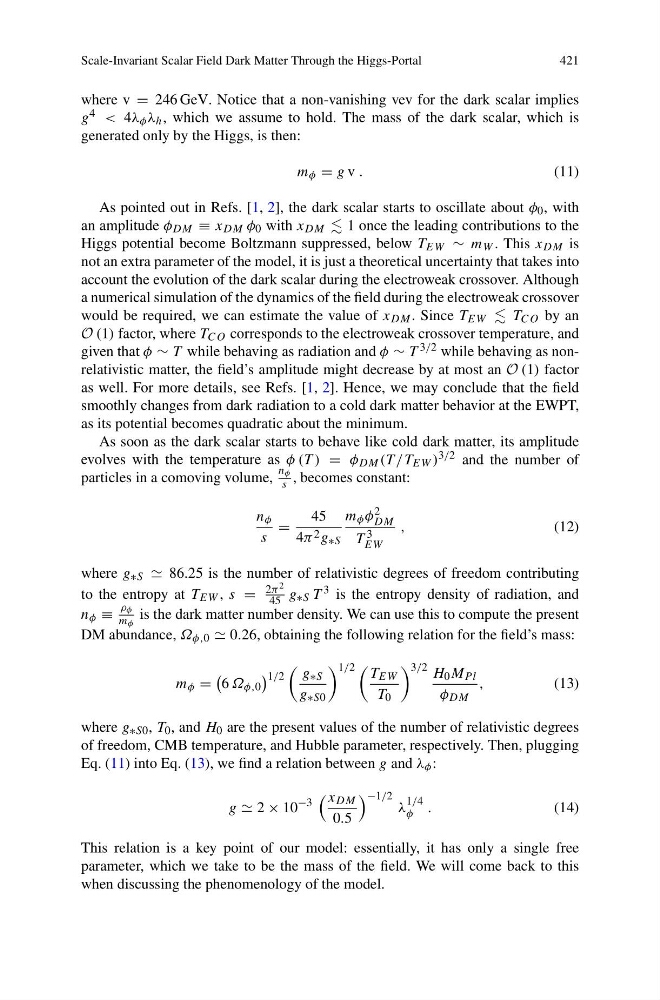
where v = 246 GeV. Notice that a non-vanishing vev for the dark scalar implies
g 4 < 4λ φ λ h , which we assume to hold. The mass of the dark scalar, which is
generated only by the Higgs, is then:
m φ = g v .
(11)
As pointed out in Refs. [1, 2], the dark scalar starts to oscillate about φ 0 , with
an amplitude φ DM ≡ x DM φ 0 with x DM 1 once the leading contributions to the
Higgs potential become Boltzmann suppressed, below T EW ∼ m W . This x DM is
not an extra parameter of the model, it is just a theoretical uncertainty that takes into
account the evolution of the dark scalar during the electroweak crossover. Although
a numerical simulation of the dynamics of the field during the electroweak crossover
would be required, we can estimate the value of x DM . Since T EW T CO by an
O (1) factor, where T CO corresponds to the electroweak crossover temperature, and
given that φ ∼ T while behaving as radiation and φ ∼ T 3/2 while behaving as nonrelativistic matter, the field’s amplitude might decrease by at most an O (1) factor
as well. For more details, see Refs. [1, 2]. Hence, we may conclude that the field
smoothly changes from dark radiation to a cold dark matter behavior at the EWPT,
as its potential becomes quadratic about the minimum.
As soon as the dark scalar starts to behave like cold dark matter, its amplitude
evolves with the temperature as φ (T ) = φ DM (T /T EW ) 3/2 and the number of
particles in a comoving volume,
n φ
s , becomes constant:
n φ
s
=
45
4π 2 g ∗S
m φ φ 2
DM
T 3
EW
,
(12)
where g ∗S 86.25 is the number of relativistic degrees of freedom contributing
to the entropy at T EW , s =
2π 2
45 g ∗S T 3 is the entropy density of radiation, and
n φ ≡
ρ φ
m φ
is the dark matter number density. We can use this to compute the present
DM abundance, Ω φ,0 0.26, obtaining the following relation for the field’s mass:
m φ =
6 Ω φ,0
1/2
g ∗S
g ∗S0
1/2
T EW
T 0
3/2 H 0 M P l
φ DM
,
(13)
where g ∗S0 , T 0 , and H 0 are the present values of the number of relativistic degrees
of freedom, CMB temperature, and Hubble parameter, respectively. Then, plugging
Eq. (11) into Eq. (13), we find a relation between g and λ φ :
g 2 × 10
−3
x DM
0.5
−1/2
λ
1/4
φ .
(14)
This relation is a key point of our model: essentially, it has only a single free
parameter, which we take to be the mass of the field. We will come back to this
when discussing the phenomenology of the model.
421
where v = 246 GeV. Notice that a non-vanishing vev for the dark scalar implies
g 4 < 4λ φ λ h , which we assume to hold. The mass of the dark scalar, which is
generated only by the Higgs, is then:
m φ = g v .
(11)
As pointed out in Refs. [1, 2], the dark scalar starts to oscillate about φ 0 , with
an amplitude φ DM ≡ x DM φ 0 with x DM 1 once the leading contributions to the
Higgs potential become Boltzmann suppressed, below T EW ∼ m W . This x DM is
not an extra parameter of the model, it is just a theoretical uncertainty that takes into
account the evolution of the dark scalar during the electroweak crossover. Although
a numerical simulation of the dynamics of the field during the electroweak crossover
would be required, we can estimate the value of x DM . Since T EW T CO by an
O (1) factor, where T CO corresponds to the electroweak crossover temperature, and
given that φ ∼ T while behaving as radiation and φ ∼ T 3/2 while behaving as nonrelativistic matter, the field’s amplitude might decrease by at most an O (1) factor
as well. For more details, see Refs. [1, 2]. Hence, we may conclude that the field
smoothly changes from dark radiation to a cold dark matter behavior at the EWPT,
as its potential becomes quadratic about the minimum.
As soon as the dark scalar starts to behave like cold dark matter, its amplitude
evolves with the temperature as φ (T ) = φ DM (T /T EW ) 3/2 and the number of
particles in a comoving volume,
n φ
s , becomes constant:
n φ
s
=
45
4π 2 g ∗S
m φ φ 2
DM
T 3
EW
,
(12)
where g ∗S 86.25 is the number of relativistic degrees of freedom contributing
to the entropy at T EW , s =
2π 2
45 g ∗S T 3 is the entropy density of radiation, and
n φ ≡
ρ φ
m φ
is the dark matter number density. We can use this to compute the present
DM abundance, Ω φ,0 0.26, obtaining the following relation for the field’s mass:
m φ =
6 Ω φ,0
1/2
g ∗S
g ∗S0
1/2
T EW
T 0
3/2 H 0 M P l
φ DM
,
(13)
where g ∗S0 , T 0 , and H 0 are the present values of the number of relativistic degrees
of freedom, CMB temperature, and Hubble parameter, respectively. Then, plugging
Eq. (11) into Eq. (13), we find a relation between g and λ φ :
g 2 × 10
−3
x DM
0.5
−1/2
λ
1/4
φ .
(14)
This relation is a key point of our model: essentially, it has only a single free
parameter, which we take to be the mass of the field. We will come back to this
when discussing the phenomenology of the model.