

404
A. Castro
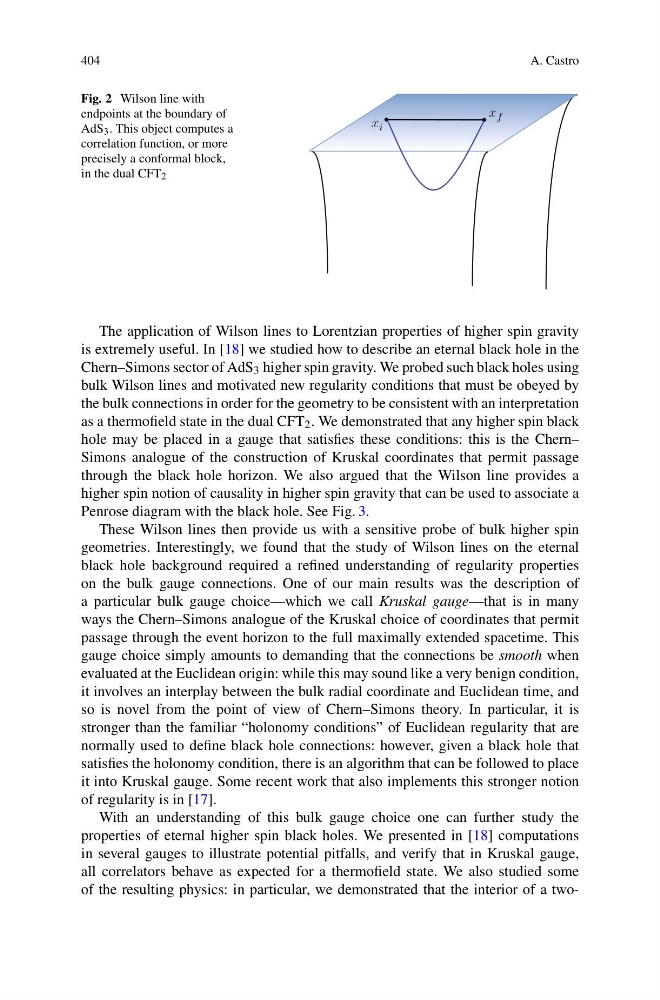
Fig. 2 Wilson line with
endpoints at the boundary of
AdS 3 . This object computes a
correlation function, or more
precisely a conformal block,
in the dual CFT 2
x i
x f
The application of Wilson lines to Lorentzian properties of higher spin gravity
is extremely useful. In [18] we studied how to describe an eternal black hole in the
Chern–Simons sector of AdS 3 higher spin gravity. We probed such black holes using
bulk Wilson lines and motivated new regularity conditions that must be obeyed by
the bulk connections in order for the geometry to be consistent with an interpretation
as a thermofield state in the dual CFT 2 . We demonstrated that any higher spin black
hole may be placed in a gauge that satisfies these conditions: this is the Chern–
Simons analogue of the construction of Kruskal coordinates that permit passage
through the black hole horizon. We also argued that the Wilson line provides a
higher spin notion of causality in higher spin gravity that can be used to associate a
Penrose diagram with the black hole. See Fig. 3.
These Wilson lines then provide us with a sensitive probe of bulk higher spin
geometries. Interestingly, we found that the study of Wilson lines on the eternal
black hole background required a refined understanding of regularity properties
on the bulk gauge connections. One of our main results was the description of
a particular bulk gauge choice—which we call Kruskal gauge—that is in many
ways the Chern–Simons analogue of the Kruskal choice of coordinates that permit
passage through the event horizon to the full maximally extended spacetime. This
gauge choice simply amounts to demanding that the connections be smooth when
evaluated at the Euclidean origin: while this may sound like a very benign condition,
it involves an interplay between the bulk radial coordinate and Euclidean time, and
so is novel from the point of view of Chern–Simons theory. In particular, it is
stronger than the familiar “holonomy conditions” of Euclidean regularity that are
normally used to define black hole connections: however, given a black hole that
satisfies the holonomy condition, there is an algorithm that can be followed to place
it into Kruskal gauge. Some recent work that also implements this stronger notion
of regularity is in [17].
With an understanding of this bulk gauge choice one can further study the
properties of eternal higher spin black holes. We presented in [18] computations
in several gauges to illustrate potential pitfalls, and verify that in Kruskal gauge,
all correlators behave as expected for a thermofield state. We also studied some
of the resulting physics: in particular, we demonstrated that the interior of a two-
A. Castro
Fig. 2 Wilson line with
endpoints at the boundary of
AdS 3 . This object computes a
correlation function, or more
precisely a conformal block,
in the dual CFT 2
x i
x f
The application of Wilson lines to Lorentzian properties of higher spin gravity
is extremely useful. In [18] we studied how to describe an eternal black hole in the
Chern–Simons sector of AdS 3 higher spin gravity. We probed such black holes using
bulk Wilson lines and motivated new regularity conditions that must be obeyed by
the bulk connections in order for the geometry to be consistent with an interpretation
as a thermofield state in the dual CFT 2 . We demonstrated that any higher spin black
hole may be placed in a gauge that satisfies these conditions: this is the Chern–
Simons analogue of the construction of Kruskal coordinates that permit passage
through the black hole horizon. We also argued that the Wilson line provides a
higher spin notion of causality in higher spin gravity that can be used to associate a
Penrose diagram with the black hole. See Fig. 3.
These Wilson lines then provide us with a sensitive probe of bulk higher spin
geometries. Interestingly, we found that the study of Wilson lines on the eternal
black hole background required a refined understanding of regularity properties
on the bulk gauge connections. One of our main results was the description of
a particular bulk gauge choice—which we call Kruskal gauge—that is in many
ways the Chern–Simons analogue of the Kruskal choice of coordinates that permit
passage through the event horizon to the full maximally extended spacetime. This
gauge choice simply amounts to demanding that the connections be smooth when
evaluated at the Euclidean origin: while this may sound like a very benign condition,
it involves an interplay between the bulk radial coordinate and Euclidean time, and
so is novel from the point of view of Chern–Simons theory. In particular, it is
stronger than the familiar “holonomy conditions” of Euclidean regularity that are
normally used to define black hole connections: however, given a black hole that
satisfies the holonomy condition, there is an algorithm that can be followed to place
it into Kruskal gauge. Some recent work that also implements this stronger notion
of regularity is in [17].
With an understanding of this bulk gauge choice one can further study the
properties of eternal higher spin black holes. We presented in [18] computations
in several gauges to illustrate potential pitfalls, and verify that in Kruskal gauge,
all correlators behave as expected for a thermofield state. We also studied some
of the resulting physics: in particular, we demonstrated that the interior of a two-