

394
A. Castro
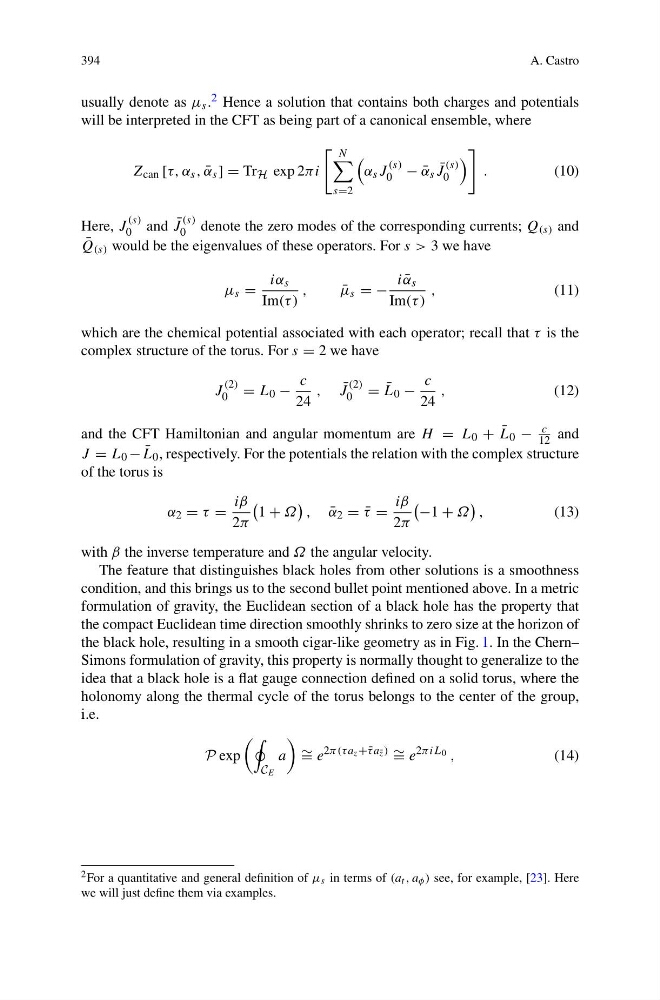
usually denote as μ s . 2 Hence a solution that contains both charges and potentials
will be interpreted in the CFT as being part of a canonical ensemble, where
Z can [τ, α s , ¯
α s ] = Tr H exp 2πi
N
s=2
α s J
(s)
0 − ¯
α s ¯
J
(s)
0
.
(10)
Here, J
(s)
0 and ¯
J
(s)
0 denote the zero modes of the corresponding currents; Q (s) and
¯
Q (s) would be the eigenvalues of these operators. For s > 3 we have
μ s =
iα s
Im(τ )
,
¯
μ s = −
i ¯
α s
Im(τ )
,
(11)
which are the chemical potential associated with each operator; recall that τ is the
complex structure of the torus. For s = 2 we have
J
(2)
0 = L 0 −
c
24
, ¯
J
(2)
0 = ¯
L 0 −
c
24
,
(12)
and the CFT Hamiltonian and angular momentum are H = L 0 + ¯
L 0 −
c
12 and
J = L 0 − ¯
L 0 , respectively. For the potentials the relation with the complex structure
of the torus is
α 2 = τ =
iβ
2π
1 + Ω
, ¯
α 2 = ¯
τ =
iβ
2π
−1 + Ω
,
(13)
with β the inverse temperature and Ω the angular velocity.
The feature that distinguishes black holes from other solutions is a smoothness
condition, and this brings us to the second bullet point mentioned above. In a metric
formulation of gravity, the Euclidean section of a black hole has the property that
the compact Euclidean time direction smoothly shrinks to zero size at the horizon of
the black hole, resulting in a smooth cigar-like geometry as in Fig. 1. In the Chern–
Simons formulation of gravity, this property is normally thought to generalize to the
idea that a black hole is a flat gauge connection defined on a solid torus, where the
holonomy along the thermal cycle of the torus belongs to the center of the group,
i.e.
P exp
C E
a
∼ = e
2π (τ a z + ¯
τ a ¯
z ) ∼ = e
2πiL 0 ,
(14)
2 For a quantitative and general definition of μ s in terms of (a t , a φ ) see, for example, [23]. Here
we will just define them via examples.
A. Castro
usually denote as μ s . 2 Hence a solution that contains both charges and potentials
will be interpreted in the CFT as being part of a canonical ensemble, where
Z can [τ, α s , ¯
α s ] = Tr H exp 2πi
N
s=2
α s J
(s)
0 − ¯
α s ¯
J
(s)
0
.
(10)
Here, J
(s)
0 and ¯
J
(s)
0 denote the zero modes of the corresponding currents; Q (s) and
¯
Q (s) would be the eigenvalues of these operators. For s > 3 we have
μ s =
iα s
Im(τ )
,
¯
μ s = −
i ¯
α s
Im(τ )
,
(11)
which are the chemical potential associated with each operator; recall that τ is the
complex structure of the torus. For s = 2 we have
J
(2)
0 = L 0 −
c
24
, ¯
J
(2)
0 = ¯
L 0 −
c
24
,
(12)
and the CFT Hamiltonian and angular momentum are H = L 0 + ¯
L 0 −
c
12 and
J = L 0 − ¯
L 0 , respectively. For the potentials the relation with the complex structure
of the torus is
α 2 = τ =
iβ
2π
1 + Ω
, ¯
α 2 = ¯
τ =
iβ
2π
−1 + Ω
,
(13)
with β the inverse temperature and Ω the angular velocity.
The feature that distinguishes black holes from other solutions is a smoothness
condition, and this brings us to the second bullet point mentioned above. In a metric
formulation of gravity, the Euclidean section of a black hole has the property that
the compact Euclidean time direction smoothly shrinks to zero size at the horizon of
the black hole, resulting in a smooth cigar-like geometry as in Fig. 1. In the Chern–
Simons formulation of gravity, this property is normally thought to generalize to the
idea that a black hole is a flat gauge connection defined on a solid torus, where the
holonomy along the thermal cycle of the torus belongs to the center of the group,
i.e.
P exp
C E
a
∼ = e
2π (τ a z + ¯
τ a ¯
z ) ∼ = e
2πiL 0 ,
(14)
2 For a quantitative and general definition of μ s in terms of (a t , a φ ) see, for example, [23]. Here
we will just define them via examples.