

392
A. Castro
c = 12kk N =
3
2G
.
(6)
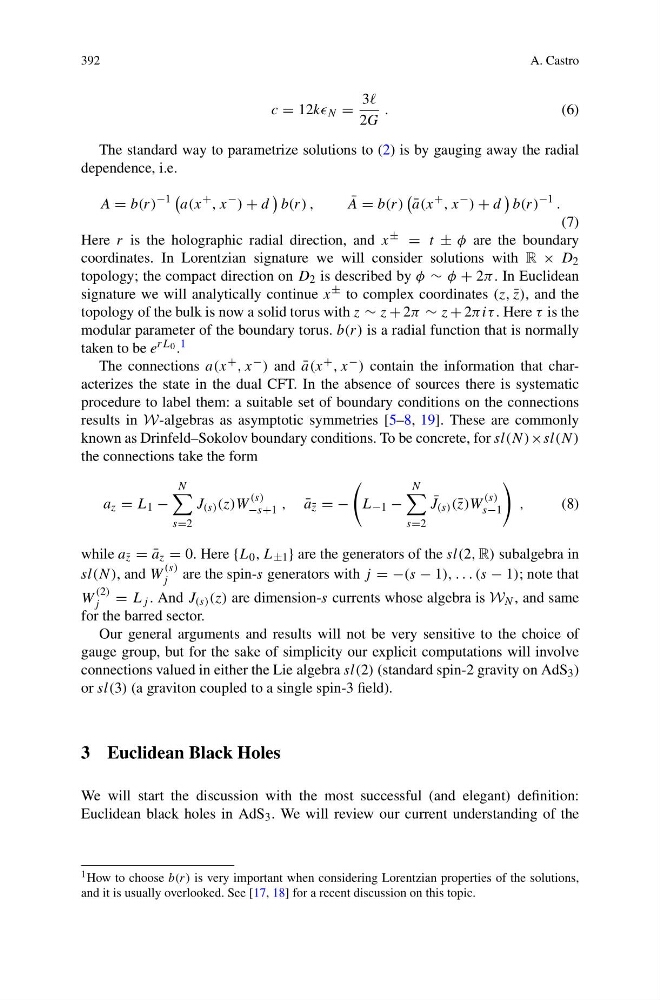
The standard way to parametrize solutions to (2) is by gauging away the radial
dependence, i.e.
A = b(r)
−1
a(x
+ , x
− ) + d
b(r) ,
¯
A = b(r)
¯
a(x
+ , x
− ) + d
b(r)
−1 .
(7)
Here r is the holographic radial direction, and x ± = t ± φ are the boundary
coordinates. In Lorentzian signature we will consider solutions with R × D 2
topology; the compact direction on D 2 is described by φ ∼ φ + 2π . In Euclidean
signature we will analytically continue x ± to complex coordinates (z, ¯
z), and the
topology of the bulk is now a solid torus with z ∼ z + 2π ∼ z + 2πiτ . Here τ is the
modular parameter of the boundary torus. b(r) is a radial function that is normally
taken to be e rL 0 . 1
The connections a(x + , x − ) and ¯
a(x + , x − ) contain the information that characterizes the state in the dual CFT. In the absence of sources there is systematic
procedure to label them: a suitable set of boundary conditions on the connections
results in W-algebras as asymptotic symmetries [5–8, 19]. These are commonly
known as Drinfeld–Sokolov boundary conditions. To be concrete, for sl(N)×sl(N)
the connections take the form
a z = L 1 −
N
s=2
J (s) (z)W
(s)
−s+1 , ¯
a ¯
z = −
L −1 −
N
s=2
¯
J (s) (¯ z)W
(s)
s−1
,
(8)
while a ¯
z = ¯
a z = 0. Here {L 0 , L ±1 } are the generators of the sl(2, R) subalgebra in
sl(N), and W
(s)
j are the spin-s generators with j = −(s − 1), . . . (s − 1); note that
W
(2)
j = L j . And J (s) (z) are dimension-s currents whose algebra is W N , and same
for the barred sector.
Our general arguments and results will not be very sensitive to the choice of
gauge group, but for the sake of simplicity our explicit computations will involve
connections valued in either the Lie algebra sl(2) (standard spin-2 gravity on AdS 3 )
or sl(3) (a graviton coupled to a single spin-3 field).
3 Euclidean Black Holes
We will start the discussion with the most successful (and elegant) definition:
Euclidean black holes in AdS 3 . We will review our current understanding of the
1 How to choose b(r) is very important when considering Lorentzian properties of the solutions,
and it is usually overlooked. See [17, 18] for a recent discussion on this topic.
A. Castro
c = 12kk N =
3
2G
.
(6)
The standard way to parametrize solutions to (2) is by gauging away the radial
dependence, i.e.
A = b(r)
−1
a(x
+ , x
− ) + d
b(r) ,
¯
A = b(r)
¯
a(x
+ , x
− ) + d
b(r)
−1 .
(7)
Here r is the holographic radial direction, and x ± = t ± φ are the boundary
coordinates. In Lorentzian signature we will consider solutions with R × D 2
topology; the compact direction on D 2 is described by φ ∼ φ + 2π . In Euclidean
signature we will analytically continue x ± to complex coordinates (z, ¯
z), and the
topology of the bulk is now a solid torus with z ∼ z + 2π ∼ z + 2πiτ . Here τ is the
modular parameter of the boundary torus. b(r) is a radial function that is normally
taken to be e rL 0 . 1
The connections a(x + , x − ) and ¯
a(x + , x − ) contain the information that characterizes the state in the dual CFT. In the absence of sources there is systematic
procedure to label them: a suitable set of boundary conditions on the connections
results in W-algebras as asymptotic symmetries [5–8, 19]. These are commonly
known as Drinfeld–Sokolov boundary conditions. To be concrete, for sl(N)×sl(N)
the connections take the form
a z = L 1 −
N
s=2
J (s) (z)W
(s)
−s+1 , ¯
a ¯
z = −
L −1 −
N
s=2
¯
J (s) (¯ z)W
(s)
s−1
,
(8)
while a ¯
z = ¯
a z = 0. Here {L 0 , L ±1 } are the generators of the sl(2, R) subalgebra in
sl(N), and W
(s)
j are the spin-s generators with j = −(s − 1), . . . (s − 1); note that
W
(2)
j = L j . And J (s) (z) are dimension-s currents whose algebra is W N , and same
for the barred sector.
Our general arguments and results will not be very sensitive to the choice of
gauge group, but for the sake of simplicity our explicit computations will involve
connections valued in either the Lie algebra sl(2) (standard spin-2 gravity on AdS 3 )
or sl(3) (a graviton coupled to a single spin-3 field).
3 Euclidean Black Holes
We will start the discussion with the most successful (and elegant) definition:
Euclidean black holes in AdS 3 . We will review our current understanding of the
1 How to choose b(r) is very important when considering Lorentzian properties of the solutions,
and it is usually overlooked. See [17, 18] for a recent discussion on this topic.