

22
C. M. Viallet
Furthermore, if a discrete equation is obtained by discretisation of a continuous
one, we would like to preserve as much as possible of the structure of the original
equation, and integrability is a crucial one, since it conditions the fundamental
properties of the solutions.
To get more information on the subject, explore the proceedings of the “SIDE”
conferences, http://side-conferences.net/. It is worth recalling that the first meeting
of this series was organised by the Centre de Recherches Mathématiques in 1994
under the governance of Luc Vinet. The meeting was so successful that it gave
rise to a series under the acronym of SIDE, organised in Europe (x5), Japan (x2),
Australia, China, India, and back to La Belle Province twice (2008 and 2016).
We will avoid giving a precise definition of discrete integrability (see the
monograph [9]) but rather describe some of its features, in the specific case
of discrete partial difference equations (quad equations) on a two-dimensional
square lattice. These are Existence of a Lax pair, Higher dimensional consistency
(consistency around the cube, in short CAC), Symmetries, Singularities, Low
complexity (vanishing algebraic entropy). We will also comment on the respective
merits and limitations of these features.
We will examine one specific example of quad equation.
Warning: We will impose a restriction on the class of evolutions we consider:
there will always be a forward and backward evolution, both given by rational
transformations. One keyword in all parts of our analysis is then birationality.
2 What Is a Quad Equation?
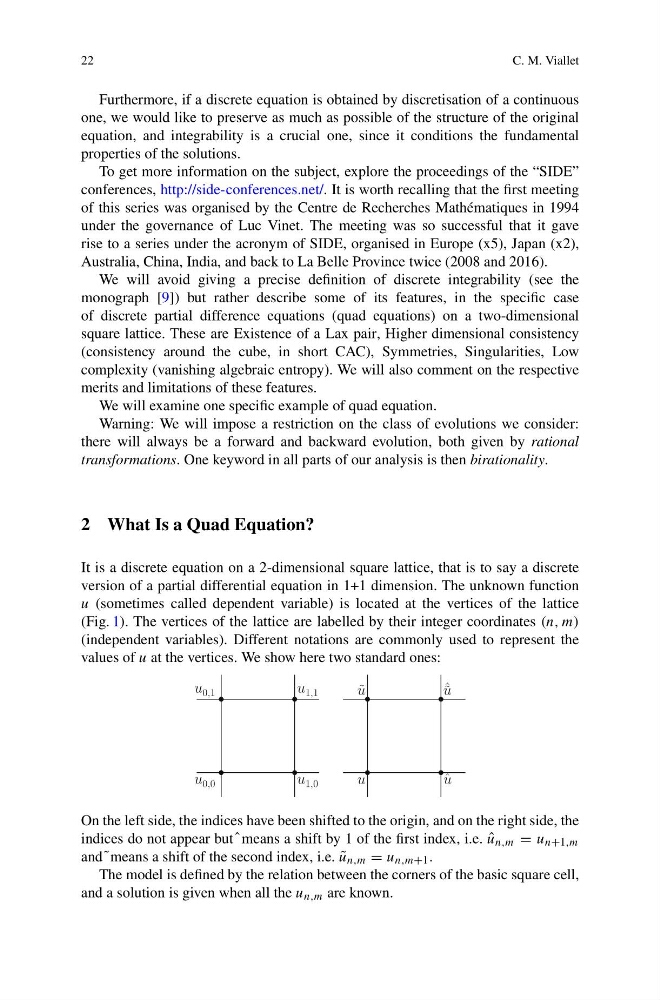
It is a discrete equation on a 2-dimensional square lattice, that is to say a discrete
version of a partial differential equation in 1+1 dimension. The unknown function
u (sometimes called dependent variable) is located at the vertices of the lattice
(Fig. 1). The vertices of the lattice are labelled by their integer coordinates (n, m)
(independent variables). Different notations are commonly used to represent the
values of u at the vertices. We show here two standard ones:
u 1,0
u 0,1
u 0,0
u 1,1
ˆ
u
˜
u
u
ˆ ˜
u
On the left side, the indices have been shifted to the origin, and on the right side, the
indices do not appear but ˆ means a shift by 1 of the first index, i.e. ˆ
u n,m = u n+1,m
and˜means a shift of the second index, i.e. ˜
u n,m = u n,m+1 .
The model is defined by the relation between the corners of the basic square cell,
and a solution is given when all the u n,m are known.
C. M. Viallet
Furthermore, if a discrete equation is obtained by discretisation of a continuous
one, we would like to preserve as much as possible of the structure of the original
equation, and integrability is a crucial one, since it conditions the fundamental
properties of the solutions.
To get more information on the subject, explore the proceedings of the “SIDE”
conferences, http://side-conferences.net/. It is worth recalling that the first meeting
of this series was organised by the Centre de Recherches Mathématiques in 1994
under the governance of Luc Vinet. The meeting was so successful that it gave
rise to a series under the acronym of SIDE, organised in Europe (x5), Japan (x2),
Australia, China, India, and back to La Belle Province twice (2008 and 2016).
We will avoid giving a precise definition of discrete integrability (see the
monograph [9]) but rather describe some of its features, in the specific case
of discrete partial difference equations (quad equations) on a two-dimensional
square lattice. These are Existence of a Lax pair, Higher dimensional consistency
(consistency around the cube, in short CAC), Symmetries, Singularities, Low
complexity (vanishing algebraic entropy). We will also comment on the respective
merits and limitations of these features.
We will examine one specific example of quad equation.
Warning: We will impose a restriction on the class of evolutions we consider:
there will always be a forward and backward evolution, both given by rational
transformations. One keyword in all parts of our analysis is then birationality.
2 What Is a Quad Equation?
It is a discrete equation on a 2-dimensional square lattice, that is to say a discrete
version of a partial differential equation in 1+1 dimension. The unknown function
u (sometimes called dependent variable) is located at the vertices of the lattice
(Fig. 1). The vertices of the lattice are labelled by their integer coordinates (n, m)
(independent variables). Different notations are commonly used to represent the
values of u at the vertices. We show here two standard ones:
u 1,0
u 0,1
u 0,0
u 1,1
ˆ
u
˜
u
u
ˆ ˜
u
On the left side, the indices have been shifted to the origin, and on the right side, the
indices do not appear but ˆ means a shift by 1 of the first index, i.e. ˆ
u n,m = u n+1,m
and˜means a shift of the second index, i.e. ˜
u n,m = u n,m+1 .
The model is defined by the relation between the corners of the basic square cell,
and a solution is given when all the u n,m are known.