

Critical Exponents for the Valence-Bond-Solid Transition in Lattice Quantum. . .
341
between fermions and soft bosonic fluctuations, i.e., the terms in square brackets
in Eq. (8), and can be computed systematically in powers of 1/N f . Conceptually
similar applications of the 1/N f expansion to the chiral Ising and O(3) QED 3 -GN
models can be found in Refs. [18–23] and [10], respectively. To leading (zeroth)
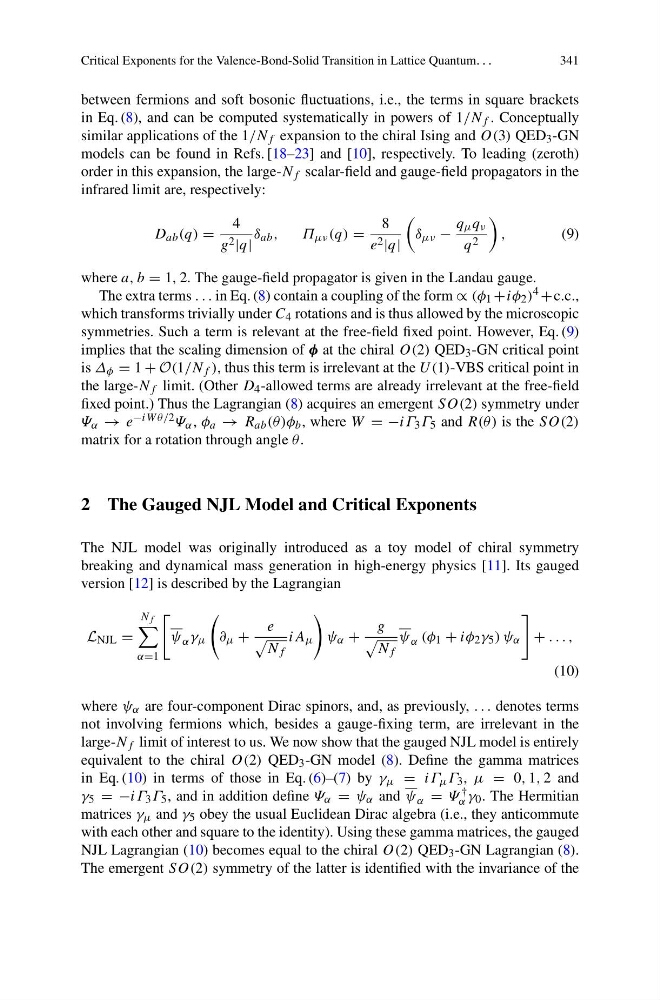
order in this expansion, the large-N f scalar-field and gauge-field propagators in the
infrared limit are, respectively:
D ab (q) =
4
g 2 |q|
δ ab ,
Π μν (q) =
8
e 2 |q|
δ μν −
q μ q ν
q 2
,
(9)
where a, b = 1, 2. The gauge-field propagator is given in the Landau gauge.
The extra terms . . . in Eq. (8) contain a coupling of the form ∝ (φ 1 +iφ 2 ) 4 +c.c.,
which transforms trivially under C 4 rotations and is thus allowed by the microscopic
symmetries. Such a term is relevant at the free-field fixed point. However, Eq. (9)
implies that the scaling dimension of φ at the chiral O(2) QED 3 -GN critical point
is Δ φ = 1 + O(1/N f ), thus this term is irrelevant at the U(1)-VBS critical point in
the large-N f limit. (Other D 4 -allowed terms are already irrelevant at the free-field
fixed point.) Thus the Lagrangian (8) acquires an emergent SO(2) symmetry under
Ψ α → e −iW θ/2 Ψ α , φ a → R ab (θ )φ b , where W = −iΓ 3 Γ 5 and R(θ) is the SO(2)
matrix for a rotation through angle θ .
2 The Gauged NJL Model and Critical Exponents
The NJL model was originally introduced as a toy model of chiral symmetry
breaking and dynamical mass generation in high-energy physics [11]. Its gauged
version [12] is described by the Lagrangian
L NJL =
N f
α=1
ψ α γ μ
∂ μ +
e
N f
iA μ
ψ α +
g
N f
ψ α (φ 1 + iφ 2 γ 5 ) ψ α
+ . . . ,
(10)
where ψ α are four-component Dirac spinors, and, as previously, . . . denotes terms
not involving fermions which, besides a gauge-fixing term, are irrelevant in the
large-N f limit of interest to us. We now show that the gauged NJL model is entirely
equivalent to the chiral O(2) QED 3 -GN model (8). Define the gamma matrices
in Eq. (10) in terms of those in Eq. (6)–(7) by γ μ = iΓ μ Γ 3 , μ = 0, 1, 2 and
γ 5 = −iΓ 3 Γ 5 , and in addition define Ψ α = ψ α and ψ α = Ψ †
α γ 0 . The Hermitian
matrices γ μ and γ 5 obey the usual Euclidean Dirac algebra (i.e., they anticommute
with each other and square to the identity). Using these gamma matrices, the gauged
NJL Lagrangian (10) becomes equal to the chiral O(2) QED 3 -GN Lagrangian (8).
The emergent SO(2) symmetry of the latter is identified with the invariance of the
341
between fermions and soft bosonic fluctuations, i.e., the terms in square brackets
in Eq. (8), and can be computed systematically in powers of 1/N f . Conceptually
similar applications of the 1/N f expansion to the chiral Ising and O(3) QED 3 -GN
models can be found in Refs. [18–23] and [10], respectively. To leading (zeroth)
order in this expansion, the large-N f scalar-field and gauge-field propagators in the
infrared limit are, respectively:
D ab (q) =
4
g 2 |q|
δ ab ,
Π μν (q) =
8
e 2 |q|
δ μν −
q μ q ν
q 2
,
(9)
where a, b = 1, 2. The gauge-field propagator is given in the Landau gauge.
The extra terms . . . in Eq. (8) contain a coupling of the form ∝ (φ 1 +iφ 2 ) 4 +c.c.,
which transforms trivially under C 4 rotations and is thus allowed by the microscopic
symmetries. Such a term is relevant at the free-field fixed point. However, Eq. (9)
implies that the scaling dimension of φ at the chiral O(2) QED 3 -GN critical point
is Δ φ = 1 + O(1/N f ), thus this term is irrelevant at the U(1)-VBS critical point in
the large-N f limit. (Other D 4 -allowed terms are already irrelevant at the free-field
fixed point.) Thus the Lagrangian (8) acquires an emergent SO(2) symmetry under
Ψ α → e −iW θ/2 Ψ α , φ a → R ab (θ )φ b , where W = −iΓ 3 Γ 5 and R(θ) is the SO(2)
matrix for a rotation through angle θ .
2 The Gauged NJL Model and Critical Exponents
The NJL model was originally introduced as a toy model of chiral symmetry
breaking and dynamical mass generation in high-energy physics [11]. Its gauged
version [12] is described by the Lagrangian
L NJL =
N f
α=1
ψ α γ μ
∂ μ +
e
N f
iA μ
ψ α +
g
N f
ψ α (φ 1 + iφ 2 γ 5 ) ψ α
+ . . . ,
(10)
where ψ α are four-component Dirac spinors, and, as previously, . . . denotes terms
not involving fermions which, besides a gauge-fixing term, are irrelevant in the
large-N f limit of interest to us. We now show that the gauged NJL model is entirely
equivalent to the chiral O(2) QED 3 -GN model (8). Define the gamma matrices
in Eq. (10) in terms of those in Eq. (6)–(7) by γ μ = iΓ μ Γ 3 , μ = 0, 1, 2 and
γ 5 = −iΓ 3 Γ 5 , and in addition define Ψ α = ψ α and ψ α = Ψ †
α γ 0 . The Hermitian
matrices γ μ and γ 5 obey the usual Euclidean Dirac algebra (i.e., they anticommute
with each other and square to the identity). Using these gamma matrices, the gauged
NJL Lagrangian (10) becomes equal to the chiral O(2) QED 3 -GN Lagrangian (8).
The emergent SO(2) symmetry of the latter is identified with the invariance of the