

320
E. Díaz-Bautista et al.
3 Annhilation Operator
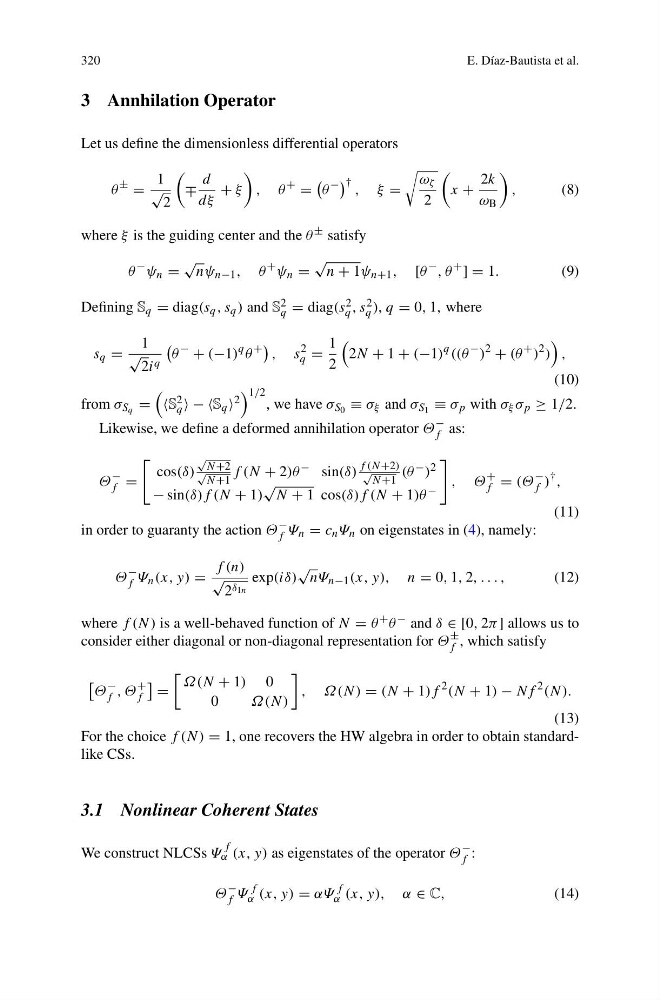
Let us define the dimensionless differential operators
θ
±
=
1
√
2
∓
d
dξ
+ ξ
, θ
+
=
θ
−
† , ξ =
ω ζ
2
x +
2k
ω B
,
(8)
where ξ is the guiding center and the θ ± satisfy
θ
− ψ n =
√
nψ n−1 , θ
+ ψ n =
√
n + 1ψ n+1 , [θ
− , θ
+
] = 1.
(9)
Defining S q = diag(s q , s q ) and S 2
q = diag(s 2
q , s 2
q ), q = 0, 1, where
s q =
1
√
2i q
θ
−
+ (−1)
q θ
+
, s
2
q =
1
2
2N + 1 + (−1)
q ((θ
− )
2
+ (θ
+ )
2 )
,
(10)
from σ S q =
2
q − −S q 2
1/2
, we have σ S 0 ≡ σ ξ and σ S 1 ≡ σ p with σ ξ σ p ≥ 1/2.
Likewise, we define a deformed annihilation operator Θ
−
f as:
Θ
−
f =
cos(δ)
√
N +2
√
N +1
f (N + 2)θ − sin(δ)
f (N+2)
√
N +1
(θ − ) 2
− sin(δ)f (N + 1)
√
N + 1 cos(δ)f (N + 1)θ −
, Θ
+
f = (Θ
−
f )
† ,
(11)
in order to guaranty the action Θ
−
f Ψ n = c n Ψ n on eigenstates in (4), namely:
Θ
−
f Ψ n (x, y) =
f (n)
√
2 δ 1n
exp(iδ)
√
nΨ n−1 (x, y), n = 0, 1, 2, . . . ,
(12)
where f (N) is a well-behaved function of N = θ + θ − and δ ∈ [0, 2π ] allows us to
consider either diagonal or non-diagonal representation for Θ
±
f , which satisfy
Θ
−
f , Θ
+
f
=
Ω(N + 1) 0
0
Ω(N)
, Ω(N) = (N + 1)f
2 (N + 1) − Nf
2 (N).
(13)
For the choice f (N) = 1, one recovers the HW algebra in order to obtain standardlike CSs.
3.1 Nonlinear Coherent States
We construct NLCSs Ψ
f
α (x, y) as eigenstates of the operator Θ
−
f :
Θ
−
f Ψ
f
α (x, y) = αΨ
f
α (x, y), α ∈ C,
(14)
E. Díaz-Bautista et al.
3 Annhilation Operator
Let us define the dimensionless differential operators
θ
±
=
1
√
2
∓
d
dξ
+ ξ
, θ
+
=
θ
−
† , ξ =
ω ζ
2
x +
2k
ω B
,
(8)
where ξ is the guiding center and the θ ± satisfy
θ
− ψ n =
√
nψ n−1 , θ
+ ψ n =
√
n + 1ψ n+1 , [θ
− , θ
+
] = 1.
(9)
Defining S q = diag(s q , s q ) and S 2
q = diag(s 2
q , s 2
q ), q = 0, 1, where
s q =
1
√
2i q
θ
−
+ (−1)
q θ
+
, s
2
q =
1
2
2N + 1 + (−1)
q ((θ
− )
2
+ (θ
+ )
2 )
,
(10)
from σ S q =
2
q − −S q 2
1/2
, we have σ S 0 ≡ σ ξ and σ S 1 ≡ σ p with σ ξ σ p ≥ 1/2.
Likewise, we define a deformed annihilation operator Θ
−
f as:
Θ
−
f =
cos(δ)
√
N +2
√
N +1
f (N + 2)θ − sin(δ)
f (N+2)
√
N +1
(θ − ) 2
− sin(δ)f (N + 1)
√
N + 1 cos(δ)f (N + 1)θ −
, Θ
+
f = (Θ
−
f )
† ,
(11)
in order to guaranty the action Θ
−
f Ψ n = c n Ψ n on eigenstates in (4), namely:
Θ
−
f Ψ n (x, y) =
f (n)
√
2 δ 1n
exp(iδ)
√
nΨ n−1 (x, y), n = 0, 1, 2, . . . ,
(12)
where f (N) is a well-behaved function of N = θ + θ − and δ ∈ [0, 2π ] allows us to
consider either diagonal or non-diagonal representation for Θ
±
f , which satisfy
Θ
−
f , Θ
+
f
=
Ω(N + 1) 0
0
Ω(N)
, Ω(N) = (N + 1)f
2 (N + 1) − Nf
2 (N).
(13)
For the choice f (N) = 1, one recovers the HW algebra in order to obtain standardlike CSs.
3.1 Nonlinear Coherent States
We construct NLCSs Ψ
f
α (x, y) as eigenstates of the operator Θ
−
f :
Θ
−
f Ψ
f
α (x, y) = αΨ
f
α (x, y), α ∈ C,
(14)