

Demazure Formulas for Weight Polytopes
293
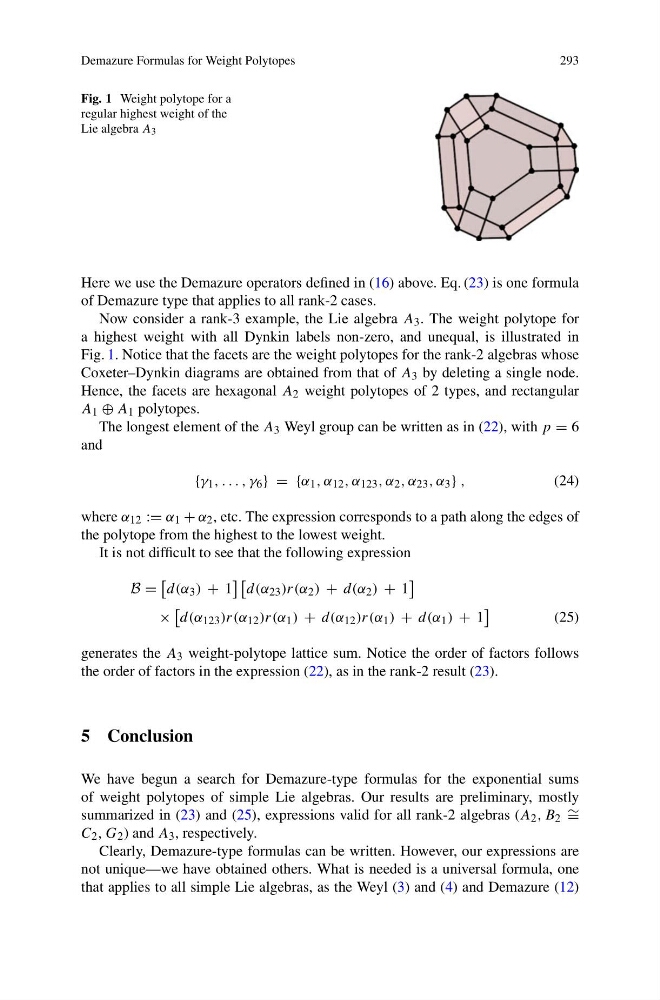
Fig. 1 Weight polytope for a
regular highest weight of the
Lie algebra A 3
Here we use the Demazure operators defined in (16) above. Eq. (23) is one formula
of Demazure type that applies to all rank-2 cases.
Now consider a rank-3 example, the Lie algebra A 3 . The weight polytope for
a highest weight with all Dynkin labels non-zero, and unequal, is illustrated in
Fig. 1. Notice that the facets are the weight polytopes for the rank-2 algebras whose
Coxeter–Dynkin diagrams are obtained from that of A 3 by deleting a single node.
Hence, the facets are hexagonal A 2 weight polytopes of 2 types, and rectangular
A 1 ⊕ A 1 polytopes.
The longest element of the A 3 Weyl group can be written as in (22), with p = 6
and
{γ 1 , . . . , γ 6 } = {α 1 , α 12 , α 123 , α 2 , α 23 , α 3 } ,
(24)
where α 12 := α 1 + α 2 , etc. The expression corresponds to a path along the edges of
the polytope from the highest to the lowest weight.
It is not difficult to see that the following expression
B =
d(α 3 ) + 1
d(α 23 )r(α 2 ) + d(α 2 ) + 1
×
d(α 123 )r(α 12 )r(α 1 ) + d(α 12 )r(α 1 ) + d(α 1 ) + 1
(25)
generates the A 3 weight-polytope lattice sum. Notice the order of factors follows
the order of factors in the expression (22), as in the rank-2 result (23).
5 Conclusion
We have begun a search for Demazure-type formulas for the exponential sums
of weight polytopes of simple Lie algebras. Our results are preliminary, mostly
summarized in (23) and (25), expressions valid for all rank-2 algebras (A 2 , B 2 ∼ =
C 2 , G 2 ) and A 3 , respectively.
Clearly, Demazure-type formulas can be written. However, our expressions are
not unique—we have obtained others. What is needed is a universal formula, one
that applies to all simple Lie algebras, as the Weyl (3) and (4) and Demazure (12)
293
Fig. 1 Weight polytope for a
regular highest weight of the
Lie algebra A 3
Here we use the Demazure operators defined in (16) above. Eq. (23) is one formula
of Demazure type that applies to all rank-2 cases.
Now consider a rank-3 example, the Lie algebra A 3 . The weight polytope for
a highest weight with all Dynkin labels non-zero, and unequal, is illustrated in
Fig. 1. Notice that the facets are the weight polytopes for the rank-2 algebras whose
Coxeter–Dynkin diagrams are obtained from that of A 3 by deleting a single node.
Hence, the facets are hexagonal A 2 weight polytopes of 2 types, and rectangular
A 1 ⊕ A 1 polytopes.
The longest element of the A 3 Weyl group can be written as in (22), with p = 6
and
{γ 1 , . . . , γ 6 } = {α 1 , α 12 , α 123 , α 2 , α 23 , α 3 } ,
(24)
where α 12 := α 1 + α 2 , etc. The expression corresponds to a path along the edges of
the polytope from the highest to the lowest weight.
It is not difficult to see that the following expression
B =
d(α 3 ) + 1
d(α 23 )r(α 2 ) + d(α 2 ) + 1
×
d(α 123 )r(α 12 )r(α 1 ) + d(α 12 )r(α 1 ) + d(α 1 ) + 1
(25)
generates the A 3 weight-polytope lattice sum. Notice the order of factors follows
the order of factors in the expression (22), as in the rank-2 result (23).
5 Conclusion
We have begun a search for Demazure-type formulas for the exponential sums
of weight polytopes of simple Lie algebras. Our results are preliminary, mostly
summarized in (23) and (25), expressions valid for all rank-2 algebras (A 2 , B 2 ∼ =
C 2 , G 2 ) and A 3 , respectively.
Clearly, Demazure-type formulas can be written. However, our expressions are
not unique—we have obtained others. What is needed is a universal formula, one
that applies to all simple Lie algebras, as the Weyl (3) and (4) and Demazure (12)