

288
M. A. Walton
have obtained results for all rank-2 simple Lie algebras and for the rank-3 algebra
A 3 . We hope these first formulas will help lead to general Demazure formulas for
the lattice-polytope sums relevant to Lie characters, and perhaps others.
How might such a formula be useful? Starting with the Demazure character
formulas, Littelmann was able to derive a generalization for all simple Lie algebras
of the famous Littlewood–Richardson rule for A r tensor-product decompositions
[10]. In a similar way, formulas of the Demazure type might lead to efficient, general
computational methods for lattice polytopes.
Physical applications should also be possible. An attempt to apply the Demazure
character formula to Wess–Zumino–Witten conformal field theories was made in
[14], and it has already been used in the study of solvable lattice models [9].
In the following section, we review the initial motivation for the present work,
the similarity between the Weyl character formula and the Brion lattice-polytope
sum formula, and the polytope expansion that exploits it. Section 3 is a quick
review of the Demazure character formulas. Our new results are presented in Sect. 4:
expressions involving Demazure operators for lattice-polytope sums for rank-2
simple Lie algebras, and A 3 . The final section is a short conclusion.
2 Polytope Expansion of Lie Characters
Let X r denote a simple Lie algebra of rank r, so that X = A, B, C, D, E, F, or G.
The sets of fundamental weights and simple roots will be written as F := { Λ i | i ∈
{1, 2, . . . , r} } and S := { α i | i ∈ {1, 2, . . . , r} }, respectively. The weight and root
lattices are P := Z F and Q := Z S, respectively. The set of integrable weights is
P + := N 0 F , and we write R (R + ) for the set of (positive) roots of X r .
2.1 Weyl Character Formula
Consider an irreducible representation L(λ) of X r of highest weight λ ∈ P + . The
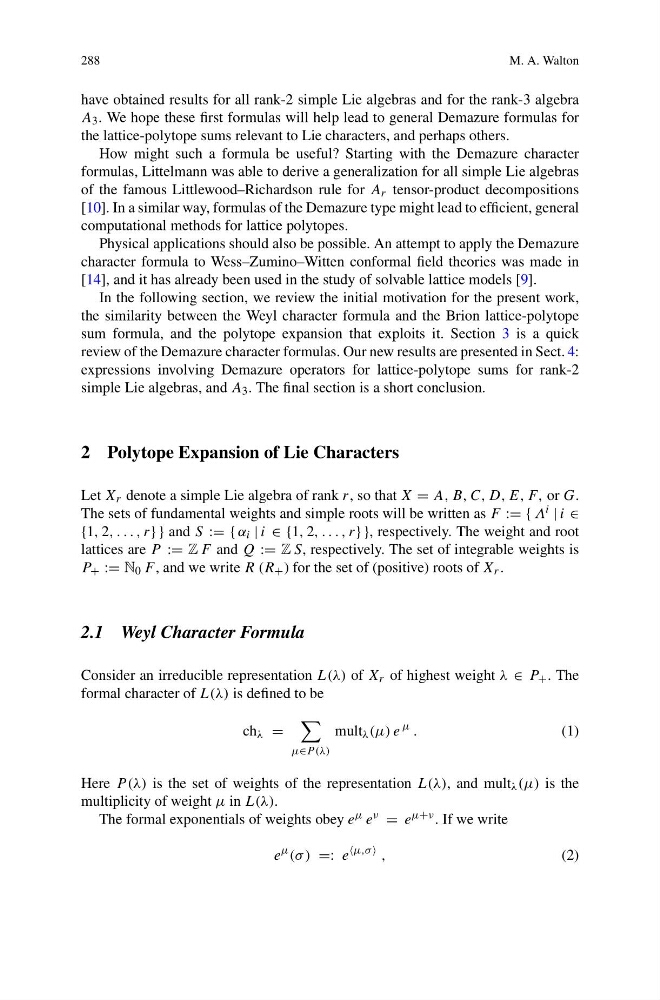
formal character of L(λ) is defined to be
ch λ =
μ∈P (λ)
mult λ (μ) e
μ .
(1)
Here P (λ) is the set of weights of the representation L(λ), and mult λ (μ) is the
multiplicity of weight μ in L(λ).
The formal exponentials of weights obey e μ e ν = e μ+ν . If we write
e
μ (σ ) =: e
μ,σ ,
(2)
M. A. Walton
have obtained results for all rank-2 simple Lie algebras and for the rank-3 algebra
A 3 . We hope these first formulas will help lead to general Demazure formulas for
the lattice-polytope sums relevant to Lie characters, and perhaps others.
How might such a formula be useful? Starting with the Demazure character
formulas, Littelmann was able to derive a generalization for all simple Lie algebras
of the famous Littlewood–Richardson rule for A r tensor-product decompositions
[10]. In a similar way, formulas of the Demazure type might lead to efficient, general
computational methods for lattice polytopes.
Physical applications should also be possible. An attempt to apply the Demazure
character formula to Wess–Zumino–Witten conformal field theories was made in
[14], and it has already been used in the study of solvable lattice models [9].
In the following section, we review the initial motivation for the present work,
the similarity between the Weyl character formula and the Brion lattice-polytope
sum formula, and the polytope expansion that exploits it. Section 3 is a quick
review of the Demazure character formulas. Our new results are presented in Sect. 4:
expressions involving Demazure operators for lattice-polytope sums for rank-2
simple Lie algebras, and A 3 . The final section is a short conclusion.
2 Polytope Expansion of Lie Characters
Let X r denote a simple Lie algebra of rank r, so that X = A, B, C, D, E, F, or G.
The sets of fundamental weights and simple roots will be written as F := { Λ i | i ∈
{1, 2, . . . , r} } and S := { α i | i ∈ {1, 2, . . . , r} }, respectively. The weight and root
lattices are P := Z F and Q := Z S, respectively. The set of integrable weights is
P + := N 0 F , and we write R (R + ) for the set of (positive) roots of X r .
2.1 Weyl Character Formula
Consider an irreducible representation L(λ) of X r of highest weight λ ∈ P + . The
formal character of L(λ) is defined to be
ch λ =
μ∈P (λ)
mult λ (μ) e
μ .
(1)
Here P (λ) is the set of weights of the representation L(λ), and mult λ (μ) is the
multiplicity of weight μ in L(λ).
The formal exponentials of weights obey e μ e ν = e μ+ν . If we write
e
μ (σ ) =: e
μ,σ ,
(2)