

Twist Knot Invariants and Volume Conjecture
277
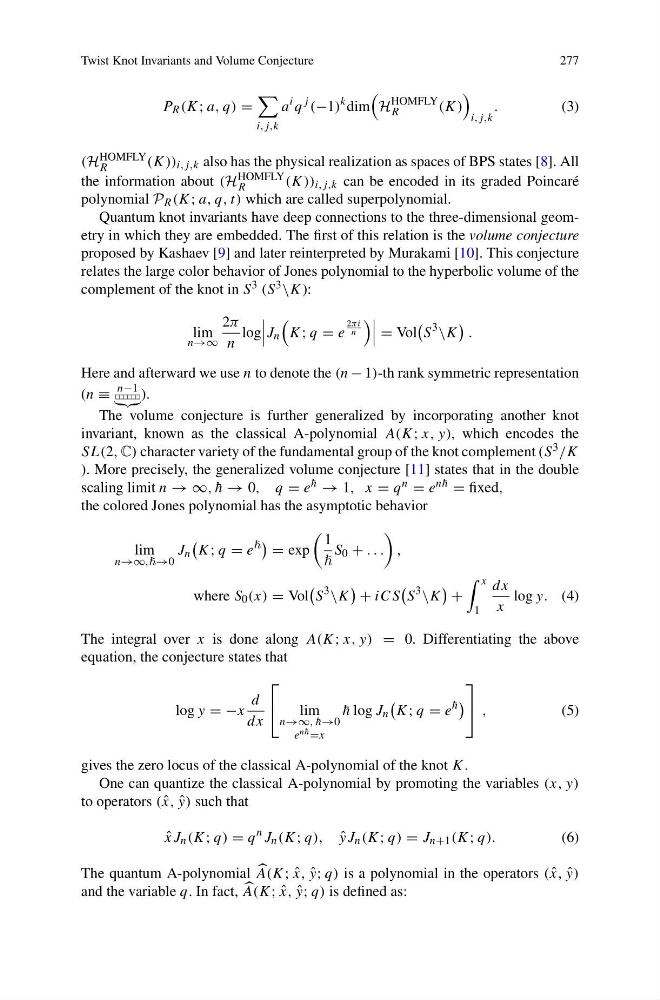
P R (K; a, q) =
i,j,k
a
i q
j (−1)
k dim
H
HOMFLY
R
(K)
i,j,k
.
(3)
(H HOMFLY
R
(K)) i,j,k also has the physical realization as spaces of BPS states [8]. All
the information about (H HOMFLY
R
(K)) i,j,k can be encoded in its graded Poincaré
polynomial P R (K; a, q, t) which are called superpolynomial.
Quantum knot invariants have deep connections to the three-dimensional geometry in which they are embedded. The first of this relation is the volume conjecture
proposed by Kashaev [9] and later reinterpreted by Murakami [10]. This conjecture
relates the large color behavior of Jones polynomial to the hyperbolic volume of the
complement of the knot in S 3 (S 3 \K):
lim
n→∞
2π
n
log
J n
K; q = e
2πi
n
= Vol
S
3
\K
.
Here and afterward we use n to denote the (n − 1)-th rank symmetric representation
(n ≡
n−1
).
The volume conjecture is further generalized by incorporating another knot
invariant, known as the classical A-polynomial A(K; x, y), which encodes the
SL(2, C) character variety of the fundamental group of the knot complement (S 3 /K
). More precisely, the generalized volume conjecture [11] states that in the double
scaling limit n → ∞, ¯
h → 0, q = e ¯
h → 1, x = q n = e n ¯
h = fixed,
the colored Jones polynomial has the asymptotic behavior
lim
n→∞,
J n
K; q = e
= exp
1
S 0 + . . .
,
where S 0 (x) = Vol
S
3
\K
+ iCS
S
3
\K
+
x
1
dx
x
log y. (4)
The integral over x is done along A(K; x, y) = 0. Differentiating the above
equation, the conjecture states that
log y = −x
d
dx
⎡
⎣ lim
n→∞, ¯
h→0
e n¯ h =x
¯
h log J n
K; q = e ¯
h
⎤
⎦ ,
(5)
gives the zero locus of the classical A-polynomial of the knot K.
One can quantize the classical A-polynomial by promoting the variables (x, y)
to operators ( ˆ
x, ˆ
y) such that
ˆ
xJ n (K; q) = q
n J n (K; q), ˆ
yJ n (K; q) = J n+1 (K; q).
(6)
The quantum A-polynomial
A(K; ˆ
x, ˆ
y; q) is a polynomial in the operators ( ˆ
x, ˆ
y)
and the variable q. In fact,
A(K; ˆ
x, ˆ
y; q) is defined as:
277
P R (K; a, q) =
i,j,k
a
i q
j (−1)
k dim
H
HOMFLY
R
(K)
i,j,k
.
(3)
(H HOMFLY
R
(K)) i,j,k also has the physical realization as spaces of BPS states [8]. All
the information about (H HOMFLY
R
(K)) i,j,k can be encoded in its graded Poincaré
polynomial P R (K; a, q, t) which are called superpolynomial.
Quantum knot invariants have deep connections to the three-dimensional geometry in which they are embedded. The first of this relation is the volume conjecture
proposed by Kashaev [9] and later reinterpreted by Murakami [10]. This conjecture
relates the large color behavior of Jones polynomial to the hyperbolic volume of the
complement of the knot in S 3 (S 3 \K):
lim
n→∞
2π
n
log
J n
K; q = e
2πi
n
= Vol
S
3
\K
.
Here and afterward we use n to denote the (n − 1)-th rank symmetric representation
(n ≡
n−1
).
The volume conjecture is further generalized by incorporating another knot
invariant, known as the classical A-polynomial A(K; x, y), which encodes the
SL(2, C) character variety of the fundamental group of the knot complement (S 3 /K
). More precisely, the generalized volume conjecture [11] states that in the double
scaling limit n → ∞, ¯
h → 0, q = e ¯
h → 1, x = q n = e n ¯
h = fixed,
the colored Jones polynomial has the asymptotic behavior
lim
n→∞,
J n
K; q = e
= exp
1
S 0 + . . .
,
where S 0 (x) = Vol
S
3
\K
+ iCS
S
3
\K
+
x
1
dx
x
log y. (4)
The integral over x is done along A(K; x, y) = 0. Differentiating the above
equation, the conjecture states that
log y = −x
d
dx
⎡
⎣ lim
n→∞, ¯
h→0
e n¯ h =x
¯
h log J n
K; q = e ¯
h
⎤
⎦ ,
(5)
gives the zero locus of the classical A-polynomial of the knot K.
One can quantize the classical A-polynomial by promoting the variables (x, y)
to operators ( ˆ
x, ˆ
y) such that
ˆ
xJ n (K; q) = q
n J n (K; q), ˆ
yJ n (K; q) = J n+1 (K; q).
(6)
The quantum A-polynomial
A(K; ˆ
x, ˆ
y; q) is a polynomial in the operators ( ˆ
x, ˆ
y)
and the variable q. In fact,
A(K; ˆ
x, ˆ
y; q) is defined as: