

Electron in Bilayer Graphene with Magnetic Fields Associated with Solvable Potentials
269
where η (x) ≡ dη(x)/dx and so on. The factorization energies 1 and 2 are in
general complex [7]. However, in this paper we will work just with real values,
specifically with two consecutive eigenvalues of H 0 , i.e., 2 = E
(0)
j , , 1 = E
(0)
j +1 .
Although the spectra of H 2 and H 0 are almost the same, H 0 has two extra energy
levels at 1 and 2 . Moreover, there are some relations between the eigenfunctions
of H 0 and H 2 , which can be derived from the next equations
L 2 L
†
2 ψ
(2)
n =
E
(2)
n − E
(0)
j
E
(2)
n − E
(0)
j +1
ψ
(2)
n ,
(14)
L
†
2 L 2 ψ
(0)
n =
E
(0)
n − E
(0)
j
E
(0)
n − E
(0)
j +1
ψ
(0)
n ,
(15)
where ψ
(l)
n and E
(l)
n are the corresponding eigenfunctions and eigenvalues of H l ,
l = 0, 2, respectively. Another important fact is that the two eigenfunctions ψ
(0)
j ,
ψ
(0)
j +1 of H 0 , which are also in the kernel of L 2 , L 2 ψ
(0)
j (x) = L 2 ψ
(0)
j +1 = 0, are
required to determine the intertwining transformation of Eq. (10). In particular, the
function η(x) can be determined from ψ
(0)
j , ψ
(0)
j +1 through the relation
η(x) = −
W
ψ
(0)
j , ψ
(0)
j +1
W
ψ
(0)
j , ψ
(0)
j +1
,
(16)
with W (f, g) = fg − f g being the Wronskian of f and g.
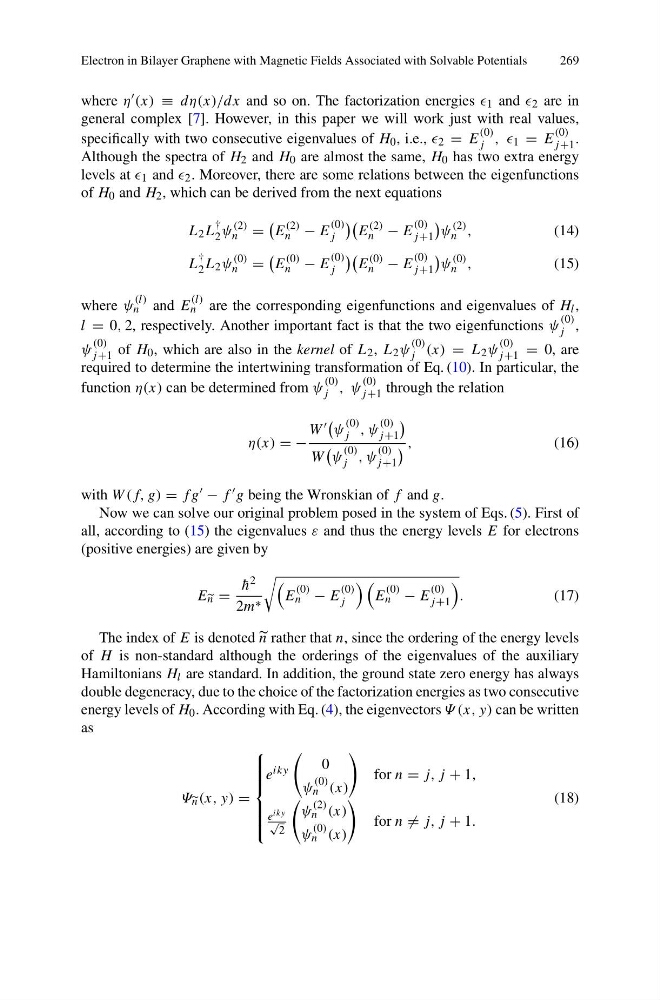
Now we can solve our original problem posed in the system of Eqs. (5). First of
all, according to (15) the eigenvalues ε and thus the energy levels E for electrons
(positive energies) are given by
E n =
¯
h 2
2m ∗
E
(0)
n − E
(0)
j
E
(0)
n − E
(0)
j +1
.
(17)
The index of E is denoted n rather that n, since the ordering of the energy levels
of H is non-standard although the orderings of the eigenvalues of the auxiliary
Hamiltonians H l are standard. In addition, the ground state zero energy has always
double degeneracy, due to the choice of the factorization energies as two consecutive
energy levels of H 0 . According with Eq. (4), the eigenvectors Ψ (x, y) can be written
as
Ψ n (x, y) =
⎧
⎪ ⎪ ⎪ ⎪ ⎨
⎪ ⎪ ⎪ ⎪ ⎩
e iky
0
ψ
(0)
n (x)
for n = j, j + 1,
e iky
√
2
ψ
(2)
n (x)
ψ
(0)
n (x)
for n = j, j + 1.
(18)
269
where η (x) ≡ dη(x)/dx and so on. The factorization energies 1 and 2 are in
general complex [7]. However, in this paper we will work just with real values,
specifically with two consecutive eigenvalues of H 0 , i.e., 2 = E
(0)
j , , 1 = E
(0)
j +1 .
Although the spectra of H 2 and H 0 are almost the same, H 0 has two extra energy
levels at 1 and 2 . Moreover, there are some relations between the eigenfunctions
of H 0 and H 2 , which can be derived from the next equations
L 2 L
†
2 ψ
(2)
n =
E
(2)
n − E
(0)
j
E
(2)
n − E
(0)
j +1
ψ
(2)
n ,
(14)
L
†
2 L 2 ψ
(0)
n =
E
(0)
n − E
(0)
j
E
(0)
n − E
(0)
j +1
ψ
(0)
n ,
(15)
where ψ
(l)
n and E
(l)
n are the corresponding eigenfunctions and eigenvalues of H l ,
l = 0, 2, respectively. Another important fact is that the two eigenfunctions ψ
(0)
j ,
ψ
(0)
j +1 of H 0 , which are also in the kernel of L 2 , L 2 ψ
(0)
j (x) = L 2 ψ
(0)
j +1 = 0, are
required to determine the intertwining transformation of Eq. (10). In particular, the
function η(x) can be determined from ψ
(0)
j , ψ
(0)
j +1 through the relation
η(x) = −
W
ψ
(0)
j , ψ
(0)
j +1
W
ψ
(0)
j , ψ
(0)
j +1
,
(16)
with W (f, g) = fg − f g being the Wronskian of f and g.
Now we can solve our original problem posed in the system of Eqs. (5). First of
all, according to (15) the eigenvalues ε and thus the energy levels E for electrons
(positive energies) are given by
E n =
¯
h 2
2m ∗
E
(0)
n − E
(0)
j
E
(0)
n − E
(0)
j +1
.
(17)
The index of E is denoted n rather that n, since the ordering of the energy levels
of H is non-standard although the orderings of the eigenvalues of the auxiliary
Hamiltonians H l are standard. In addition, the ground state zero energy has always
double degeneracy, due to the choice of the factorization energies as two consecutive
energy levels of H 0 . According with Eq. (4), the eigenvectors Ψ (x, y) can be written
as
Ψ n (x, y) =
⎧
⎪ ⎪ ⎪ ⎪ ⎨
⎪ ⎪ ⎪ ⎪ ⎩
e iky
0
ψ
(0)
n (x)
for n = j, j + 1,
e iky
√
2
ψ
(2)
n (x)
ψ
(0)
n (x)
for n = j, j + 1.
(18)