

2D Coherent and Squeezed States
257
z = ψ − ¯
ψe
iθ tanh r,
γ = −e
iθ tanh r.
(4)
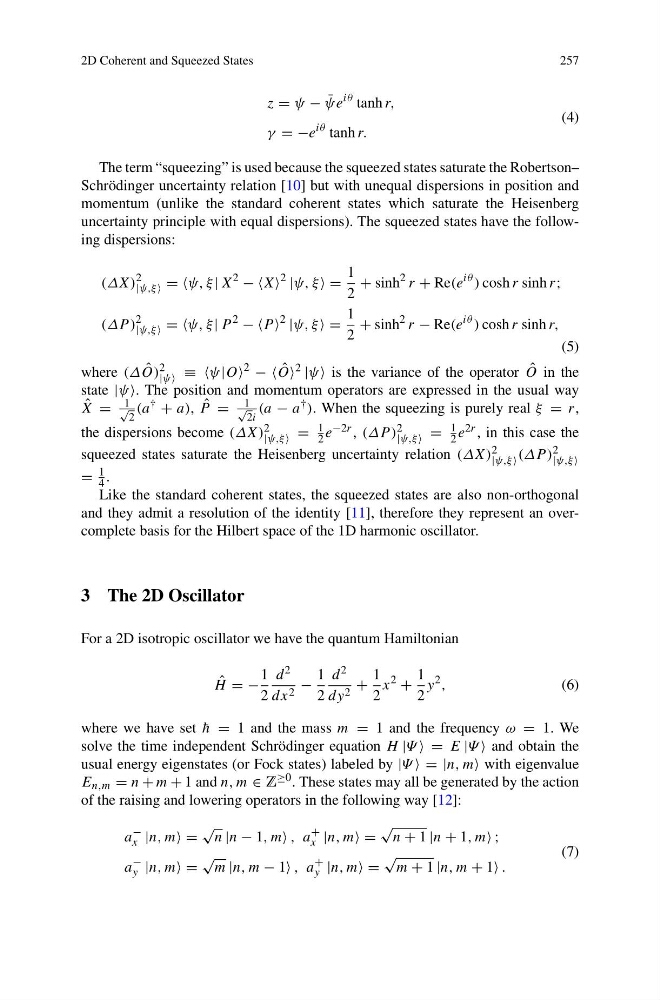
The term “squeezing” is used because the squeezed states saturate the Robertson–
Schrödinger uncertainty relation [10] but with unequal dispersions in position and
momentum (unlike the standard coherent states which saturate the Heisenberg
uncertainty principle with equal dispersions). The squeezed states have the following dispersions:
(ΔX)
2
|ψ,ξ = ψ, ξ | X
2
− X
2
|ψ, ξ =
1
2
+ sinh
2 r + Re(e
iθ ) cosh r sinh r;
(ΔP )
2
|ψ,ξ = ψ, ξ | P
2
− P
2
|ψ, ξ =
1
2
+ sinh
2 r − Re(e
iθ ) cosh r sinh r,
(5)
where (Δ ˆ
O) 2
|ψ ≡ ψ|O 2 − − ˆ
O 2 |ψ is the variance of the operator ˆ
O in the
state |ψ. The position and momentum operators are expressed in the usual way
ˆ
X =
1
√
2
(a † + a), ˆ
P =
1
√
2i
(a − a † ). When the squeezing is purely real ξ = r,
the dispersions become (ΔX) 2
|ψ,ξ =
1
2 e −2r , (ΔP ) 2
|ψ,ξ =
1
2 e 2r , in this case the
squeezed states saturate the Heisenberg uncertainty relation (ΔX) 2
|ψ,ξ (ΔP ) 2
|ψ,ξ
=
1
4 .
Like the standard coherent states, the squeezed states are also non-orthogonal
and they admit a resolution of the identity [11], therefore they represent an overcomplete basis for the Hilbert space of the 1D harmonic oscillator.
3 The 2D Oscillator
For a 2D isotropic oscillator we have the quantum Hamiltonian
ˆ
H = −
1
2
d 2
dx 2 −
1
2
d 2
dy 2 +
1
2
x
2
+
1
2
y
2 ,
(6)
where we have set ¯
h = 1 and the mass m = 1 and the frequency ω = 1. We
solve the time independent Schrödinger equation H |Ψ = E |Ψ and obtain the
usual energy eigenstates (or Fock states) labeled by |Ψ = |n, m with eigenvalue
E n,m = n + m + 1 and n, m ∈ Z
≥0 . These states may all be generated by the action
of the raising and lowering operators in the following way [12]:
a
−
x |n, m =
√
n |n − 1, m , a
+
x |n, m =
√
n + 1 |n + 1, m ;
a
−
y |n, m =
√
m |n, m − 1 , a
+
y |n, m =
√
m + 1 |n, m + 1 .
(7)
257
z = ψ − ¯
ψe
iθ tanh r,
γ = −e
iθ tanh r.
(4)
The term “squeezing” is used because the squeezed states saturate the Robertson–
Schrödinger uncertainty relation [10] but with unequal dispersions in position and
momentum (unlike the standard coherent states which saturate the Heisenberg
uncertainty principle with equal dispersions). The squeezed states have the following dispersions:
(ΔX)
2
|ψ,ξ = ψ, ξ | X
2
− X
2
|ψ, ξ =
1
2
+ sinh
2 r + Re(e
iθ ) cosh r sinh r;
(ΔP )
2
|ψ,ξ = ψ, ξ | P
2
− P
2
|ψ, ξ =
1
2
+ sinh
2 r − Re(e
iθ ) cosh r sinh r,
(5)
where (Δ ˆ
O) 2
|ψ ≡ ψ|O 2 − − ˆ
O 2 |ψ is the variance of the operator ˆ
O in the
state |ψ. The position and momentum operators are expressed in the usual way
ˆ
X =
1
√
2
(a † + a), ˆ
P =
1
√
2i
(a − a † ). When the squeezing is purely real ξ = r,
the dispersions become (ΔX) 2
|ψ,ξ =
1
2 e −2r , (ΔP ) 2
|ψ,ξ =
1
2 e 2r , in this case the
squeezed states saturate the Heisenberg uncertainty relation (ΔX) 2
|ψ,ξ (ΔP ) 2
|ψ,ξ
=
1
4 .
Like the standard coherent states, the squeezed states are also non-orthogonal
and they admit a resolution of the identity [11], therefore they represent an overcomplete basis for the Hilbert space of the 1D harmonic oscillator.
3 The 2D Oscillator
For a 2D isotropic oscillator we have the quantum Hamiltonian
ˆ
H = −
1
2
d 2
dx 2 −
1
2
d 2
dy 2 +
1
2
x
2
+
1
2
y
2 ,
(6)
where we have set ¯
h = 1 and the mass m = 1 and the frequency ω = 1. We
solve the time independent Schrödinger equation H |Ψ = E |Ψ and obtain the
usual energy eigenstates (or Fock states) labeled by |Ψ = |n, m with eigenvalue
E n,m = n + m + 1 and n, m ∈ Z
≥0 . These states may all be generated by the action
of the raising and lowering operators in the following way [12]:
a
−
x |n, m =
√
n |n − 1, m , a
+
x |n, m =
√
n + 1 |n + 1, m ;
a
−
y |n, m =
√
m |n, m − 1 , a
+
y |n, m =
√
m + 1 |n, m + 1 .
(7)