

NCG and the Batalin–Vilkovisky Construction
247
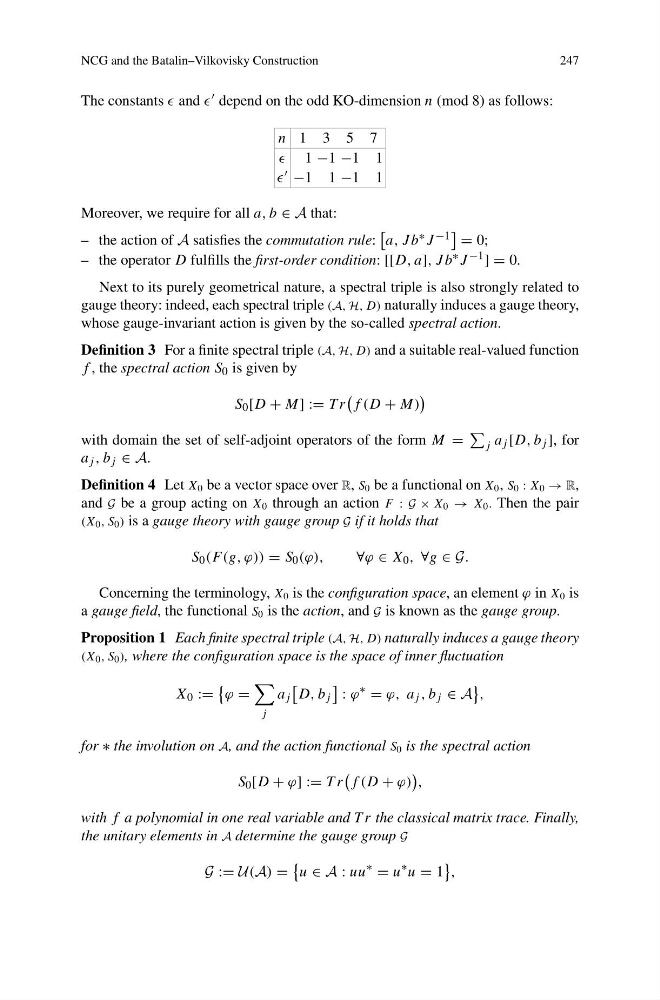
The constants and depend on the odd KO-dimension n (mod 8) as follows:
n 1 3 5 7
1 −1 −1 1
−1 1 −1 1
Moreover, we require for all a, b ∈ A that:
– the action of A satisfies the commutation rule:
a, J b ∗ J −1 = 0;
– the operator D fulfills the first-order condition: [[D, a], J b ∗ J −1 ] = 0.
Next to its purely geometrical nature, a spectral triple is also strongly related to
gauge theory: indeed, each spectral triple (A, H, D) naturally induces a gauge theory,
whose gauge-invariant action is given by the so-called spectral action.
Definition 3 For a finite spectral triple (A, H, D) and a suitable real-valued function
f , the spectral action S 0 is given by
S 0 [D + M] := T r
f (D + M)
with domain the set of self-adjoint operators of the form M =
j a j [D, b j ], for
a j , b j ∈ A.
Definition 4 Let X 0 be a vector space over R, S 0 be a functional on X 0 , S 0 : X 0 → R,
and G be a group acting on X 0 through an action F : G × X 0 → X 0 . Then the pair
(X 0 , S 0 ) is a gauge theory with gauge group G if it holds that
S 0 (F (g, ϕ)) = S 0 (ϕ),
∀ϕ ∈ X 0 , ∀g ∈ G.
Concerning the terminology, X 0 is the configuration space, an element ϕ in X 0 is
a gauge field, the functional S 0 is the action, and G is known as the gauge group.
Proposition 1 Each finite spectral triple (A, H, D) naturally induces a gauge theory
(X 0 , S 0 ), where the configuration space is the space of inner fluctuation
X 0 :=
ϕ =
j
a j
D, b j
: ϕ
∗
= ϕ, a j , b j ∈ A
,
for ∗ the involution on A, and the action functional S 0 is the spectral action
S 0 [D + ϕ] := T r
f (D + ϕ)
,
with f a polynomial in one real variable and T r the classical matrix trace. Finally,
the unitary elements in A determine the gauge group G
G := U (A) =
u ∈ A : uu
∗
= u
∗ u = 1
,
247
The constants and depend on the odd KO-dimension n (mod 8) as follows:
n 1 3 5 7
1 −1 −1 1
−1 1 −1 1
Moreover, we require for all a, b ∈ A that:
– the action of A satisfies the commutation rule:
a, J b ∗ J −1 = 0;
– the operator D fulfills the first-order condition: [[D, a], J b ∗ J −1 ] = 0.
Next to its purely geometrical nature, a spectral triple is also strongly related to
gauge theory: indeed, each spectral triple (A, H, D) naturally induces a gauge theory,
whose gauge-invariant action is given by the so-called spectral action.
Definition 3 For a finite spectral triple (A, H, D) and a suitable real-valued function
f , the spectral action S 0 is given by
S 0 [D + M] := T r
f (D + M)
with domain the set of self-adjoint operators of the form M =
j a j [D, b j ], for
a j , b j ∈ A.
Definition 4 Let X 0 be a vector space over R, S 0 be a functional on X 0 , S 0 : X 0 → R,
and G be a group acting on X 0 through an action F : G × X 0 → X 0 . Then the pair
(X 0 , S 0 ) is a gauge theory with gauge group G if it holds that
S 0 (F (g, ϕ)) = S 0 (ϕ),
∀ϕ ∈ X 0 , ∀g ∈ G.
Concerning the terminology, X 0 is the configuration space, an element ϕ in X 0 is
a gauge field, the functional S 0 is the action, and G is known as the gauge group.
Proposition 1 Each finite spectral triple (A, H, D) naturally induces a gauge theory
(X 0 , S 0 ), where the configuration space is the space of inner fluctuation
X 0 :=
ϕ =
j
a j
D, b j
: ϕ
∗
= ϕ, a j , b j ∈ A
,
for ∗ the involution on A, and the action functional S 0 is the spectral action
S 0 [D + ϕ] := T r
f (D + ϕ)
,
with f a polynomial in one real variable and T r the classical matrix trace. Finally,
the unitary elements in A determine the gauge group G
G := U (A) =
u ∈ A : uu
∗
= u
∗ u = 1
,