

236
R. Reyes et al.
second-order SUSY QM to the TRM potential for generating new families of exactly
solvable potentials. Through these transformations we can design the spectra for the
new potentials in several different ways, as we will exhibit in this article.
This work consists of three parts, the first one contains a brief review of the
second-order SUSY QM, while the second will address the TRM potential and
the solution to the corresponding Schrödinger equation. In the third part we will
show results of the second-order SUSY transformation when applied to the TRM
potential. At the end we will highlight the main results of this paper.
2 Supersymmetric Quantum Mechanics
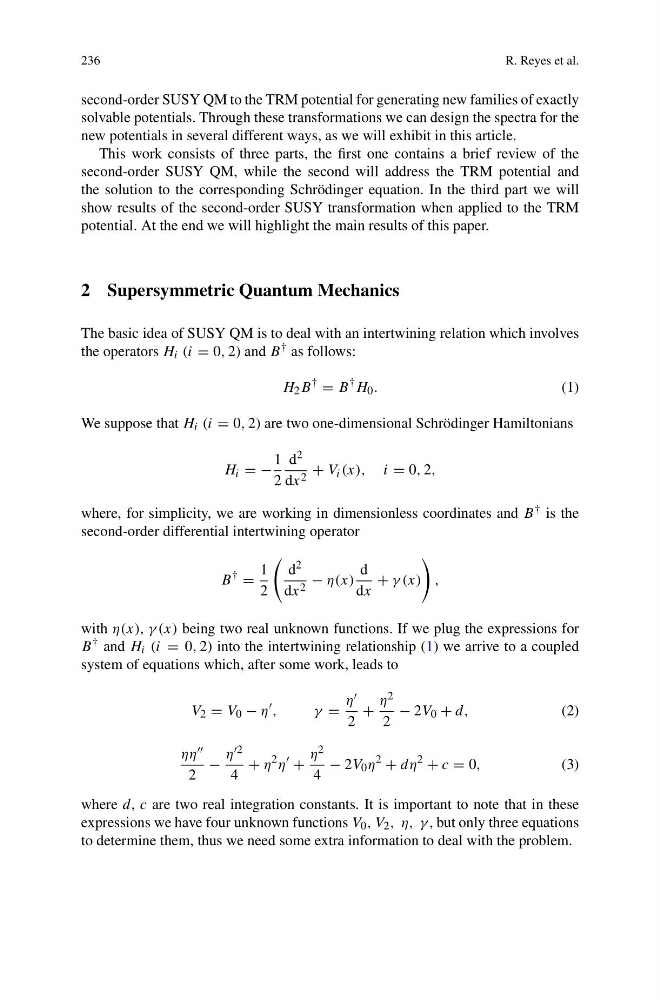
The basic idea of SUSY QM is to deal with an intertwining relation which involves
the operators H i (i = 0, 2) and B † as follows:
H 2 B
†
= B
† H 0 .
(1)
We suppose that H i (i = 0, 2) are two one-dimensional Schrödinger Hamiltonians
H i = −
1
2
d
2
dx 2 + V i (x), i = 0, 2,
where, for simplicity, we are working in dimensionless coordinates and B † is the
second-order differential intertwining operator
B
†
=
1
2
d
2
dx 2 − η(x)
d
dx
+ γ (x)
,
with η(x), γ (x) being two real unknown functions. If we plug the expressions for
B † and H i (i = 0, 2) into the intertwining relationship (1) we arrive to a coupled
system of equations which, after some work, leads to
V 2 = V 0 − η
,
γ =
η
2
+
η 2
2
− 2V 0 + d,
(2)
ηη
2
−
η
4
+ η
2 η
+
η 2
4
− 2V 0 η
2
+ dη
2
+ c = 0,
(3)
where d, c are two real integration constants. It is important to note that in these
expressions we have four unknown functions V 0 , V 2 , η, γ , but only three equations
to determine them, thus we need some extra information to deal with the problem.
R. Reyes et al.
second-order SUSY QM to the TRM potential for generating new families of exactly
solvable potentials. Through these transformations we can design the spectra for the
new potentials in several different ways, as we will exhibit in this article.
This work consists of three parts, the first one contains a brief review of the
second-order SUSY QM, while the second will address the TRM potential and
the solution to the corresponding Schrödinger equation. In the third part we will
show results of the second-order SUSY transformation when applied to the TRM
potential. At the end we will highlight the main results of this paper.
2 Supersymmetric Quantum Mechanics
The basic idea of SUSY QM is to deal with an intertwining relation which involves
the operators H i (i = 0, 2) and B † as follows:
H 2 B
†
= B
† H 0 .
(1)
We suppose that H i (i = 0, 2) are two one-dimensional Schrödinger Hamiltonians
H i = −
1
2
d
2
dx 2 + V i (x), i = 0, 2,
where, for simplicity, we are working in dimensionless coordinates and B † is the
second-order differential intertwining operator
B
†
=
1
2
d
2
dx 2 − η(x)
d
dx
+ γ (x)
,
with η(x), γ (x) being two real unknown functions. If we plug the expressions for
B † and H i (i = 0, 2) into the intertwining relationship (1) we arrive to a coupled
system of equations which, after some work, leads to
V 2 = V 0 − η
,
γ =
η
2
+
η 2
2
− 2V 0 + d,
(2)
ηη
2
−
η
4
+ η
2 η
+
η 2
4
− 2V 0 η
2
+ dη
2
+ c = 0,
(3)
where d, c are two real integration constants. It is important to note that in these
expressions we have four unknown functions V 0 , V 2 , η, γ , but only three equations
to determine them, thus we need some extra information to deal with the problem.