

Howe Duality and AW Algebras
231
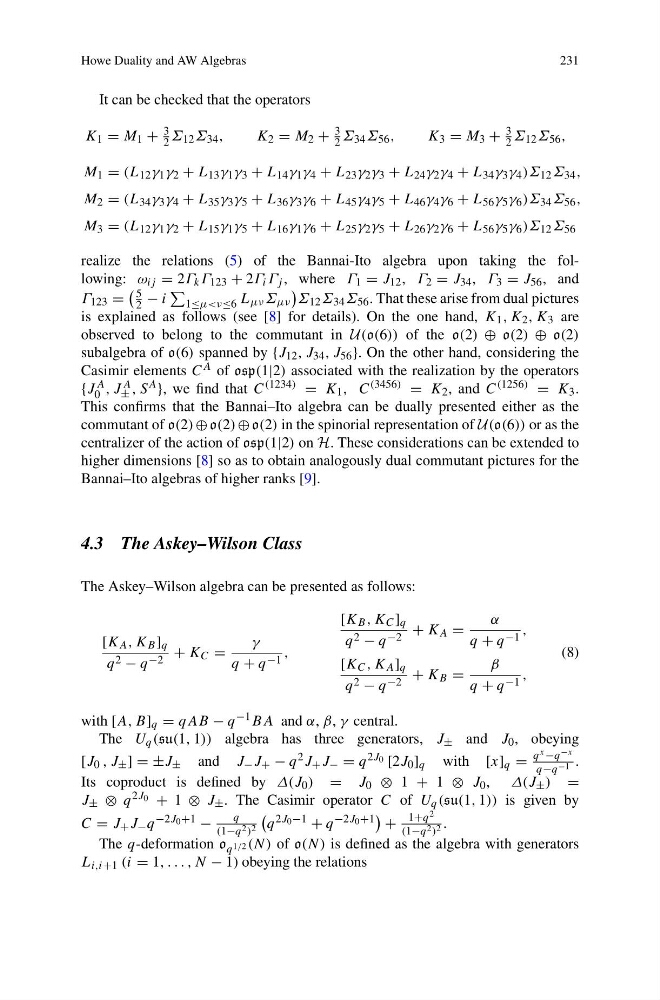
It can be checked that the operators
K 1 = M 1 +
3
2 Σ 12 Σ 34 ,
K 2 = M 2 +
3
2 Σ 34 Σ 56 ,
K 3 = M 3 +
3
2 Σ 12 Σ 56 ,
M 1 = (L 12 γ 1 γ 2 + L 13 γ 1 γ 3 + L 14 γ 1 γ 4 + L 23 γ 2 γ 3 + L 24 γ 2 γ 4 + L 34 γ 3 γ 4 )Σ 12 Σ 34 ,
M 2 = (L 34 γ 3 γ 4 + L 35 γ 3 γ 5 + L 36 γ 3 γ 6 + L 45 γ 4 γ 5 + L 46 γ 4 γ 6 + L 56 γ 5 γ 6 )Σ 34 Σ 56 ,
M 3 = (L 12 γ 1 γ 2 + L 15 γ 1 γ 5 + L 16 γ 1 γ 6 + L 25 γ 2 γ 5 + L 26 γ 2 γ 6 + L 56 γ 5 γ 6 )Σ 12 Σ 56
realize the relations (5) of the Bannai-Ito algebra upon taking the following: ω ij = 2Γ k Γ 123 + 2Γ i Γ j , where Γ 1 = J 12 , Γ 2 = J 34 , Γ 3 = J 56 , and
Γ 123 =
5
2 − i
1≤μ<ν≤6 L μν Σ μν
Σ 12 Σ 34 Σ 56 . That these arise from dual pictures
is explained as follows (see [8] for details). On the one hand, K 1 , K 2 , K 3 are
observed to belong to the commutant in U (o(6)) of the o(2) ⊕ o(2) ⊕ o(2)
subalgebra of o(6) spanned by {J 12 , J 34 , J 56 }. On the other hand, considering the
Casimir elements C A of osp(1|2) associated with the realization by the operators
{J A
0 , J A
± , S A }, we find that C (1234) = K 1 , C (3456) = K 2 , and C (1256) = K 3 .
This confirms that the Bannai–Ito algebra can be dually presented either as the
commutant of o(2) ⊕ o(2) ⊕ o(2) in the spinorial representation of U (o(6)) or as the
centralizer of the action of osp(1|2) on H. These considerations can be extended to
higher dimensions [8] so as to obtain analogously dual commutant pictures for the
Bannai–Ito algebras of higher ranks [9].
4.3 The Askey–Wilson Class
The Askey–Wilson algebra can be presented as follows:
[K A , K B ] q
q 2 − q −2 + K C =
γ
q + q −1 ,
[K B , K C ] q
q 2 − q −2 + K A =
α
q + q −1 ,
[K C , K A ] q
q 2 − q −2 + K B =
β
q + q −1 ,
(8)
with [A, B] q = qAB − q −1 BA and α, β, γ central.
The U q (su(1, 1)) algebra has three generators, J ± and J 0 , obeying
[J 0 , J ± ] = ±J ± and J − J + − q 2 J + J − = q 2J 0 [2J 0 ] q with [x] q =
q x −q −x
q−q −1 .
Its coproduct is defined by Δ(J 0 ) = J 0 ⊗ 1 + 1 ⊗ J 0 , Δ(J ± ) =
J ± ⊗ q 2J 0 + 1 ⊗ J ± . The Casimir operator C of U q (su(1, 1)) is given by
C = J + J − q −2J 0 +1 −
q
(1−q 2 ) 2
q 2J 0 −1 + q −2J 0 +1 +
1+q 2
(1−q 2 ) 2 .
The q-deformation o q 1/2 (N) of o(N) is defined as the algebra with generators
L i,i+1 (i = 1, . . . , N − 1) obeying the relations
231
It can be checked that the operators
K 1 = M 1 +
3
2 Σ 12 Σ 34 ,
K 2 = M 2 +
3
2 Σ 34 Σ 56 ,
K 3 = M 3 +
3
2 Σ 12 Σ 56 ,
M 1 = (L 12 γ 1 γ 2 + L 13 γ 1 γ 3 + L 14 γ 1 γ 4 + L 23 γ 2 γ 3 + L 24 γ 2 γ 4 + L 34 γ 3 γ 4 )Σ 12 Σ 34 ,
M 2 = (L 34 γ 3 γ 4 + L 35 γ 3 γ 5 + L 36 γ 3 γ 6 + L 45 γ 4 γ 5 + L 46 γ 4 γ 6 + L 56 γ 5 γ 6 )Σ 34 Σ 56 ,
M 3 = (L 12 γ 1 γ 2 + L 15 γ 1 γ 5 + L 16 γ 1 γ 6 + L 25 γ 2 γ 5 + L 26 γ 2 γ 6 + L 56 γ 5 γ 6 )Σ 12 Σ 56
realize the relations (5) of the Bannai-Ito algebra upon taking the following: ω ij = 2Γ k Γ 123 + 2Γ i Γ j , where Γ 1 = J 12 , Γ 2 = J 34 , Γ 3 = J 56 , and
Γ 123 =
5
2 − i
1≤μ<ν≤6 L μν Σ μν
Σ 12 Σ 34 Σ 56 . That these arise from dual pictures
is explained as follows (see [8] for details). On the one hand, K 1 , K 2 , K 3 are
observed to belong to the commutant in U (o(6)) of the o(2) ⊕ o(2) ⊕ o(2)
subalgebra of o(6) spanned by {J 12 , J 34 , J 56 }. On the other hand, considering the
Casimir elements C A of osp(1|2) associated with the realization by the operators
{J A
0 , J A
± , S A }, we find that C (1234) = K 1 , C (3456) = K 2 , and C (1256) = K 3 .
This confirms that the Bannai–Ito algebra can be dually presented either as the
commutant of o(2) ⊕ o(2) ⊕ o(2) in the spinorial representation of U (o(6)) or as the
centralizer of the action of osp(1|2) on H. These considerations can be extended to
higher dimensions [8] so as to obtain analogously dual commutant pictures for the
Bannai–Ito algebras of higher ranks [9].
4.3 The Askey–Wilson Class
The Askey–Wilson algebra can be presented as follows:
[K A , K B ] q
q 2 − q −2 + K C =
γ
q + q −1 ,
[K B , K C ] q
q 2 − q −2 + K A =
α
q + q −1 ,
[K C , K A ] q
q 2 − q −2 + K B =
β
q + q −1 ,
(8)
with [A, B] q = qAB − q −1 BA and α, β, γ central.
The U q (su(1, 1)) algebra has three generators, J ± and J 0 , obeying
[J 0 , J ± ] = ±J ± and J − J + − q 2 J + J − = q 2J 0 [2J 0 ] q with [x] q =
q x −q −x
q−q −1 .
Its coproduct is defined by Δ(J 0 ) = J 0 ⊗ 1 + 1 ⊗ J 0 , Δ(J ± ) =
J ± ⊗ q 2J 0 + 1 ⊗ J ± . The Casimir operator C of U q (su(1, 1)) is given by
C = J + J − q −2J 0 +1 −
q
(1−q 2 ) 2
q 2J 0 −1 + q −2J 0 +1 +
1+q 2
(1−q 2 ) 2 .
The q-deformation o q 1/2 (N) of o(N) is defined as the algebra with generators
L i,i+1 (i = 1, . . . , N − 1) obeying the relations