

220
V. K. Dobrev
4 Verma Modules and Singular Vectors
4.1 Definitions
We shall introduce Verma modules over the Jacobi algebra analogously to the case
of semi-simple algebras. Thus, we define a lowest weight Verma module V Λ over
G n as the lowest weight module over G n with lowest weight Λ ∈ K ∗
n and lowest
weight vector v 0 ∈ V Λ , induced from the one-dimensional representation V 0 ∼ =
Cv 0 of U(B n ) , (where B n = K n ⊕ G −
n is a Borel subalgebra of G n ), such that:
X v 0 = 0, ∀ X ∈ G
−
n
(10)
H v 0 = Λ(H ) v 0 , ∀ H ∈ K n .
Pursuing the analogy with the semi-simple case and following our approach
we are interested in the cases when the Verma modules are reducible. Namely,
we are interested in the cases when a Verma module V Λ contains an invariant
submodule which is also a Verma module V Λ , where Λ = Λ, and holds the
analog of
X v
0 = 0, ∀ X ∈ G
−
n
(11a)
H v
0 = Λ
(H ) v
0 , ∀ H ∈ K n .
(11b)
Since V Λ is an invariant submodule then there should be a mapping such that
v
0 is mapped to a singular vector v s ∈ V Λ fulfilling exactly (11). Thus, as in
the semi-simple case there should be a polynomial P of G +
n elements which
is eigenvector of K n : [H, P] = Λ (H )P, (∀H ∈ K n ), and then we would have:
v s = Pv 0 .
4.2 Case G 2
We shall consider several examples of reducible Verma modules with different
weights.
Weight 2δ 1
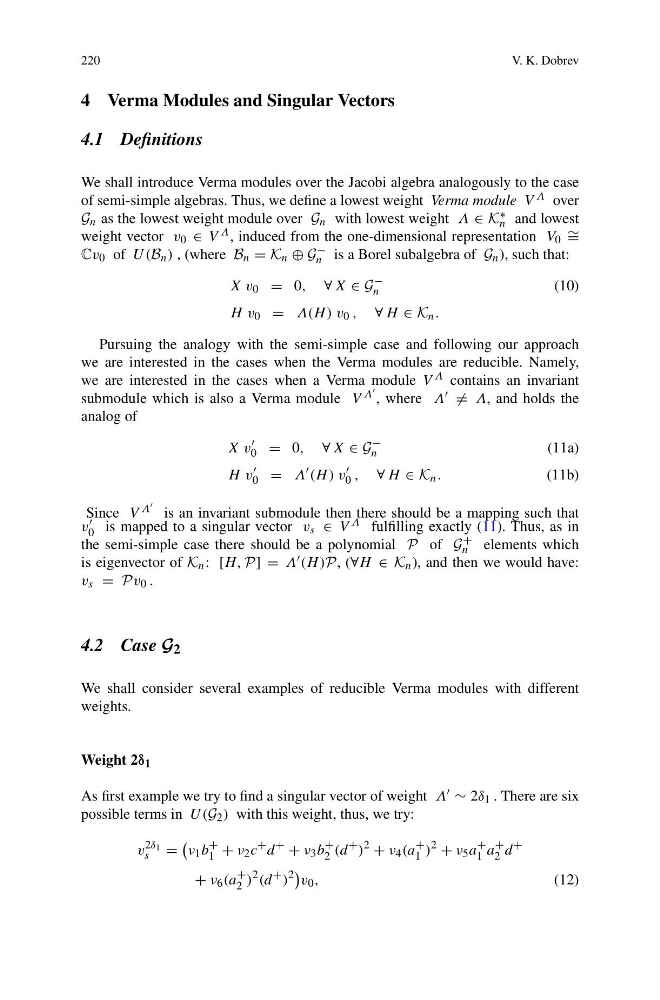
As first example we try to find a singular vector of weight Λ ∼ 2δ 1 . There are six
possible terms in U(G 2 ) with this weight, thus, we try:
v
2δ 1
s =
ν 1 b
+
1 + ν 2 c
+ d
+
+ ν 3 b
+
2 (d
+ )
2
+ ν 4 (a
+
1 )
2
+ ν 5 a
+
1 a
+
2 d
+
+ ν 6 (a
+
2 )
2 (d
+ )
2
v 0 ,
(12)
V. K. Dobrev
4 Verma Modules and Singular Vectors
4.1 Definitions
We shall introduce Verma modules over the Jacobi algebra analogously to the case
of semi-simple algebras. Thus, we define a lowest weight Verma module V Λ over
G n as the lowest weight module over G n with lowest weight Λ ∈ K ∗
n and lowest
weight vector v 0 ∈ V Λ , induced from the one-dimensional representation V 0 ∼ =
Cv 0 of U(B n ) , (where B n = K n ⊕ G −
n is a Borel subalgebra of G n ), such that:
X v 0 = 0, ∀ X ∈ G
−
n
(10)
H v 0 = Λ(H ) v 0 , ∀ H ∈ K n .
Pursuing the analogy with the semi-simple case and following our approach
we are interested in the cases when the Verma modules are reducible. Namely,
we are interested in the cases when a Verma module V Λ contains an invariant
submodule which is also a Verma module V Λ , where Λ = Λ, and holds the
analog of
X v
0 = 0, ∀ X ∈ G
−
n
(11a)
H v
0 = Λ
(H ) v
0 , ∀ H ∈ K n .
(11b)
Since V Λ is an invariant submodule then there should be a mapping such that
v
0 is mapped to a singular vector v s ∈ V Λ fulfilling exactly (11). Thus, as in
the semi-simple case there should be a polynomial P of G +
n elements which
is eigenvector of K n : [H, P] = Λ (H )P, (∀H ∈ K n ), and then we would have:
v s = Pv 0 .
4.2 Case G 2
We shall consider several examples of reducible Verma modules with different
weights.
Weight 2δ 1
As first example we try to find a singular vector of weight Λ ∼ 2δ 1 . There are six
possible terms in U(G 2 ) with this weight, thus, we try:
v
2δ 1
s =
ν 1 b
+
1 + ν 2 c
+ d
+
+ ν 3 b
+
2 (d
+ )
2
+ ν 4 (a
+
1 )
2
+ ν 5 a
+
1 a
+
2 d
+
+ ν 6 (a
+
2 )
2 (d
+ )
2
v 0 ,
(12)