

214
H. De Bie et al.
4.1 The Differential Embedding
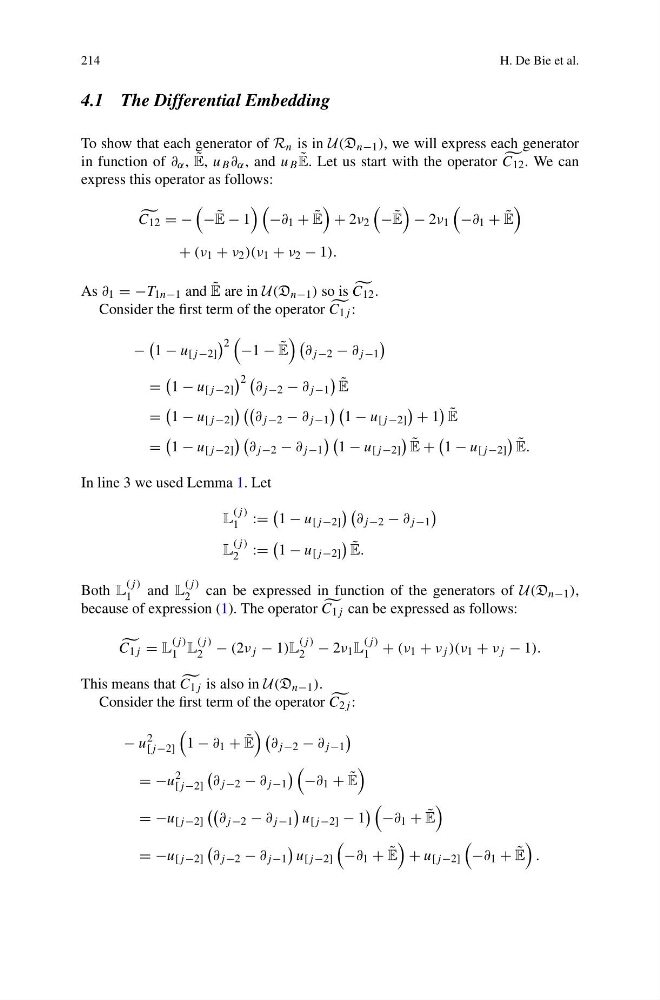
To show that each generator of R n is in U (D n−1 ), we will express each generator
in function of ∂ α , ˜
E, u B ∂ α , and u B ˜
E. Let us start with the operator
C 12 . We can
express this operator as follows:
C 12 = −
− ˜
E − 1
−∂ 1 + ˜
E
+ 2ν 2
− ˜
E
− 2ν 1
−∂ 1 + ˜
E
+ (ν 1 + ν 2 )(ν 1 + ν 2 − 1).
As ∂ 1 = −T 1n−1 and ˜
E are in U (D n−1 ) so is
C 12 .
Consider the first term of the operator
C 1j :
−
1 − u [j −2]
2
−1 − ˜
E
∂ j −2 − ∂ j −1
=
1 − u [j −2]
2
∂ j −2 − ∂ j −1
˜
E
=
1 − u [j −2]
∂ j −2 − ∂ j −1
1 − u [j −2]
+ 1
˜
E
=
1 − u [j −2]
∂ j −2 − ∂ j −1
1 − u [j −2]
˜
E +
1 − u [j −2]
˜
E.
In line 3 we used Lemma 1. Let
L
(j )
1 :=
1 − u [j −2]
∂ j −2 − ∂ j −1
L
(j )
2 :=
1 − u [j −2]
˜
E.
Both L
(j )
1 and L
(j )
2 can be expressed in function of the generators of U (D n−1 ),
because of expression (1). The operator
C 1j can be expressed as follows:
C 1j = L
(j )
1 L
(j )
2 − (2ν j − 1)L
(j )
2 − 2ν 1 L
(j )
1 + (ν 1 + ν j )(ν 1 + ν j − 1).
This means that
C 1j is also in U (D n−1 ).
Consider the first term of the operator
C 2j :
− u
2
[j −2]
1 − ∂ 1 + ˜
E
∂ j −2 − ∂ j −1
= −u
2
[j −2]
∂ j −2 − ∂ j −1
−∂ 1 + ˜
E
= −u [j −2]
∂ j −2 − ∂ j −1
u [j −2] − 1
−∂ 1 + ˜
E
= −u [j −2]
∂ j −2 − ∂ j −1
u [j −2]
−∂ 1 + ˜
E
+ u [j −2]
−∂ 1 + ˜
E
.
H. De Bie et al.
4.1 The Differential Embedding
To show that each generator of R n is in U (D n−1 ), we will express each generator
in function of ∂ α , ˜
E, u B ∂ α , and u B ˜
E. Let us start with the operator
C 12 . We can
express this operator as follows:
C 12 = −
− ˜
E − 1
−∂ 1 + ˜
E
+ 2ν 2
− ˜
E
− 2ν 1
−∂ 1 + ˜
E
+ (ν 1 + ν 2 )(ν 1 + ν 2 − 1).
As ∂ 1 = −T 1n−1 and ˜
E are in U (D n−1 ) so is
C 12 .
Consider the first term of the operator
C 1j :
−
1 − u [j −2]
2
−1 − ˜
E
∂ j −2 − ∂ j −1
=
1 − u [j −2]
2
∂ j −2 − ∂ j −1
˜
E
=
1 − u [j −2]
∂ j −2 − ∂ j −1
1 − u [j −2]
+ 1
˜
E
=
1 − u [j −2]
∂ j −2 − ∂ j −1
1 − u [j −2]
˜
E +
1 − u [j −2]
˜
E.
In line 3 we used Lemma 1. Let
L
(j )
1 :=
1 − u [j −2]
∂ j −2 − ∂ j −1
L
(j )
2 :=
1 − u [j −2]
˜
E.
Both L
(j )
1 and L
(j )
2 can be expressed in function of the generators of U (D n−1 ),
because of expression (1). The operator
C 1j can be expressed as follows:
C 1j = L
(j )
1 L
(j )
2 − (2ν j − 1)L
(j )
2 − 2ν 1 L
(j )
1 + (ν 1 + ν j )(ν 1 + ν j − 1).
This means that
C 1j is also in U (D n−1 ).
Consider the first term of the operator
C 2j :
− u
2
[j −2]
1 − ∂ 1 + ˜
E
∂ j −2 − ∂ j −1
= −u
2
[j −2]
∂ j −2 − ∂ j −1
−∂ 1 + ˜
E
= −u [j −2]
∂ j −2 − ∂ j −1
u [j −2] − 1
−∂ 1 + ˜
E
= −u [j −2]
∂ j −2 − ∂ j −1
u [j −2]
−∂ 1 + ˜
E
+ u [j −2]
−∂ 1 + ˜
E
.