

210
H. De Bie et al.
connections with Brauer and Temperley-Lieb algebras, and to [6] for connections
with Howe duality.
The present paper aims to provide evidence for the following conjecture:
Conjecture 1 There exists an embedding of the higher rank Racah algebra into the
universal enveloping algebra of the Lie algebra sl n .
Indeed, we construct this embedding for a differential operator realization of
R n (recently introduced in [5]) in the enveloping algebra of a differential operator
realization of sl n . Note that the embedding in the rank one case was already
constructed in [7].
2 Definition of the Higher Rank Racah Algebra
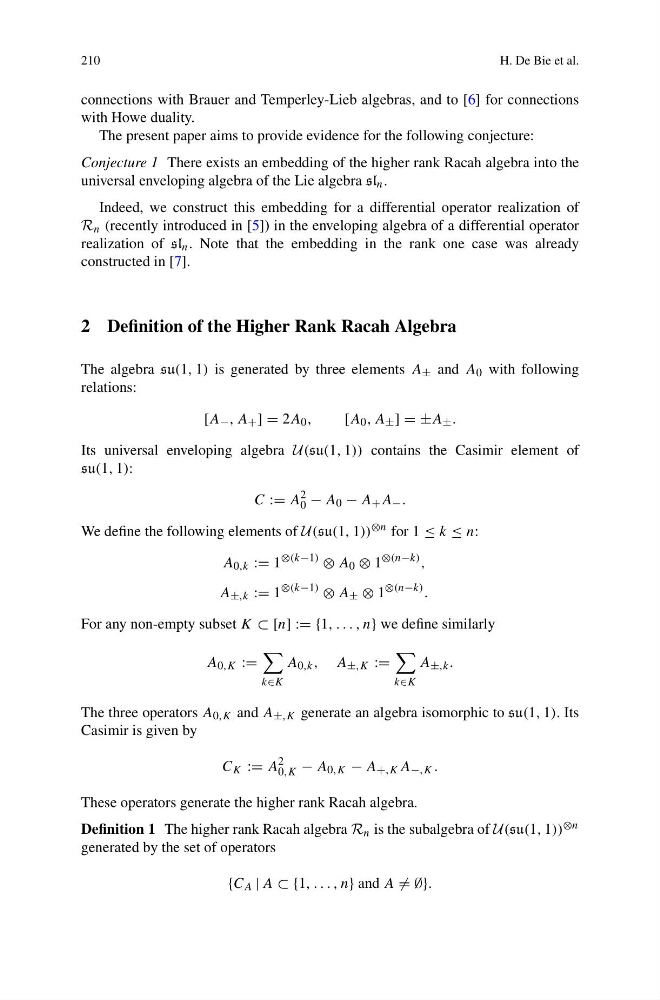
The algebra su(1, 1) is generated by three elements A ± and A 0 with following
relations:
[A − , A + ] = 2A 0 ,
[A 0 , A ± ] = ±A ± .
Its universal enveloping algebra U (su(1, 1)) contains the Casimir element of
su(1, 1):
C := A
2
0 − A 0 − A + A − .
We define the following elements of U (su(1, 1)) ⊗n for 1 ≤ k ≤ n:
A 0,k := 1
⊗(k−1)
⊗ A 0 ⊗ 1
⊗(n−k) ,
A ±,k := 1
⊗(k−1)
⊗ A ± ⊗ 1
⊗(n−k) .
For any non-empty subset K ⊂ [n] := {1, . . . , n} we define similarly
A 0,K :=
k∈K
A 0,k , A ±,K :=
k∈K
A ±,k .
The three operators A 0,K and A ±,K generate an algebra isomorphic to su(1, 1). Its
Casimir is given by
C K := A
2
0,K − A 0,K − A +,K A −,K .
These operators generate the higher rank Racah algebra.
Definition 1 The higher rank Racah algebra R n is the subalgebra of U (su(1, 1)) ⊗n
generated by the set of operators
{C A | A ⊂ {1, . . . , n} and A = ∅}.
H. De Bie et al.
connections with Brauer and Temperley-Lieb algebras, and to [6] for connections
with Howe duality.
The present paper aims to provide evidence for the following conjecture:
Conjecture 1 There exists an embedding of the higher rank Racah algebra into the
universal enveloping algebra of the Lie algebra sl n .
Indeed, we construct this embedding for a differential operator realization of
R n (recently introduced in [5]) in the enveloping algebra of a differential operator
realization of sl n . Note that the embedding in the rank one case was already
constructed in [7].
2 Definition of the Higher Rank Racah Algebra
The algebra su(1, 1) is generated by three elements A ± and A 0 with following
relations:
[A − , A + ] = 2A 0 ,
[A 0 , A ± ] = ±A ± .
Its universal enveloping algebra U (su(1, 1)) contains the Casimir element of
su(1, 1):
C := A
2
0 − A 0 − A + A − .
We define the following elements of U (su(1, 1)) ⊗n for 1 ≤ k ≤ n:
A 0,k := 1
⊗(k−1)
⊗ A 0 ⊗ 1
⊗(n−k) ,
A ±,k := 1
⊗(k−1)
⊗ A ± ⊗ 1
⊗(n−k) .
For any non-empty subset K ⊂ [n] := {1, . . . , n} we define similarly
A 0,K :=
k∈K
A 0,k , A ±,K :=
k∈K
A ±,k .
The three operators A 0,K and A ±,K generate an algebra isomorphic to su(1, 1). Its
Casimir is given by
C K := A
2
0,K − A 0,K − A +,K A −,K .
These operators generate the higher rank Racah algebra.
Definition 1 The higher rank Racah algebra R n is the subalgebra of U (su(1, 1)) ⊗n
generated by the set of operators
{C A | A ⊂ {1, . . . , n} and A = ∅}.