

Color Extension of SUSY QM
205
(0, 0) : H =
H 0
0 H
,
D =
D 0
0 D
,
K =
K 0
0 K
,
(0, 1) : Q =
Q 0
0 Q
,
S =
S 0
0 S
,
(1, 0) : ˜
Q = i
0 Qσ 3
Qσ 3 0
,
˜
S = i
0 Sσ 3
Sσ 3 0
,
(1, 1) : ˜
H =
0 H σ 3
H σ 3 0
,
˜
D =
0 Dσ 3
Dσ 3 0
,
˜
K =
0 Kσ 3
Kσ 3 0
.
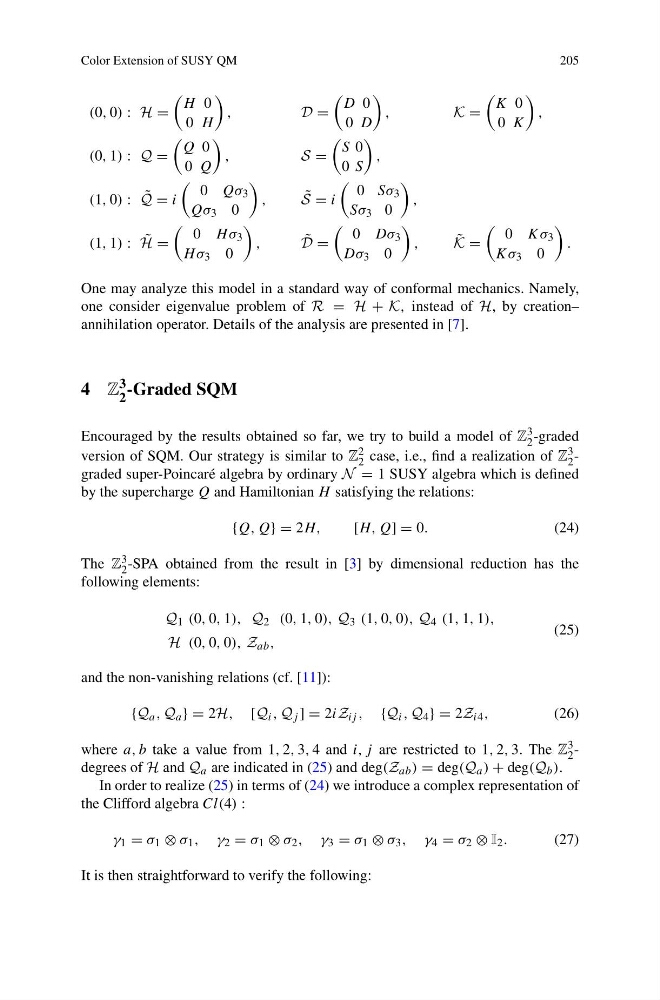
One may analyze this model in a standard way of conformal mechanics. Namely,
one consider eigenvalue problem of R = H + K, instead of H, by creation–
annihilation operator. Details of the analysis are presented in [7].
4 Z 3
2
-Graded SQM
Encouraged by the results obtained so far, we try to build a model of Z 3
2 -graded
version of SQM. Our strategy is similar to Z 2
2 case, i.e., find a realization of Z 3
2 -
graded super-Poincaré algebra by ordinary N = 1 SUSY algebra which is defined
by the supercharge Q and Hamiltonian H satisfying the relations:
{Q, Q} = 2H,
[H, Q] = 0.
(24)
The Z 3
2 -SPA obtained from the result in [3] by dimensional reduction has the
following elements:
Q 1 (0, 0, 1), Q 2 (0, 1, 0), Q 3 (1, 0, 0), Q 4 (1, 1, 1),
H (0, 0, 0), Z ab ,
(25)
and the non-vanishing relations (cf. [11]):
{Q a , Q a } = 2H, [Q i , Q j ] = 2iZ ij , {Q i , Q 4 } = 2Z i4 ,
(26)
where a, b take a value from 1, 2, 3, 4 and i, j are restricted to 1, 2, 3. The Z 3
2 -
degrees of H and Q a are indicated in (25) and deg(Z ab ) = deg(Q a ) + deg(Q b ).
In order to realize (25) in terms of (24) we introduce a complex representation of
the Clifford algebra Cl(4) :
γ 1 = σ 1 ⊗ σ 1 , γ 2 = σ 1 ⊗ σ 2 , γ 3 = σ 1 ⊗ σ 3 , γ 4 = σ 2 ⊗ I 2 .
(27)
It is then straightforward to verify the following:
205
(0, 0) : H =
H 0
0 H
,
D =
D 0
0 D
,
K =
K 0
0 K
,
(0, 1) : Q =
Q 0
0 Q
,
S =
S 0
0 S
,
(1, 0) : ˜
Q = i
0 Qσ 3
Qσ 3 0
,
˜
S = i
0 Sσ 3
Sσ 3 0
,
(1, 1) : ˜
H =
0 H σ 3
H σ 3 0
,
˜
D =
0 Dσ 3
Dσ 3 0
,
˜
K =
0 Kσ 3
Kσ 3 0
.
One may analyze this model in a standard way of conformal mechanics. Namely,
one consider eigenvalue problem of R = H + K, instead of H, by creation–
annihilation operator. Details of the analysis are presented in [7].
4 Z 3
2
-Graded SQM
Encouraged by the results obtained so far, we try to build a model of Z 3
2 -graded
version of SQM. Our strategy is similar to Z 2
2 case, i.e., find a realization of Z 3
2 -
graded super-Poincaré algebra by ordinary N = 1 SUSY algebra which is defined
by the supercharge Q and Hamiltonian H satisfying the relations:
{Q, Q} = 2H,
[H, Q] = 0.
(24)
The Z 3
2 -SPA obtained from the result in [3] by dimensional reduction has the
following elements:
Q 1 (0, 0, 1), Q 2 (0, 1, 0), Q 3 (1, 0, 0), Q 4 (1, 1, 1),
H (0, 0, 0), Z ab ,
(25)
and the non-vanishing relations (cf. [11]):
{Q a , Q a } = 2H, [Q i , Q j ] = 2iZ ij , {Q i , Q 4 } = 2Z i4 ,
(26)
where a, b take a value from 1, 2, 3, 4 and i, j are restricted to 1, 2, 3. The Z 3
2 -
degrees of H and Q a are indicated in (25) and deg(Z ab ) = deg(Q a ) + deg(Q b ).
In order to realize (25) in terms of (24) we introduce a complex representation of
the Clifford algebra Cl(4) :
γ 1 = σ 1 ⊗ σ 1 , γ 2 = σ 1 ⊗ σ 2 , γ 3 = σ 1 ⊗ σ 3 , γ 4 = σ 2 ⊗ I 2 .
(27)
It is then straightforward to verify the following: