

202
N. Aizawa et al.
[T
0
i , T
0
j ] = if
k
ij T
0
k ,
[T
0
i , T
1
j ] = ih
k
ij T
1
k ,
{T
1
i , T
1
j } = g
k
ij T
0
k ,
(5)
where the summation over the repeated indices is understood.
Suppose that we have a representation of s in which odd (degree 1) elements
are represented by block-antidiagonal Hermitian matrix of dimensions 2m × 2m.
Suppose further that there exists a Hermitian block-diagonal matrix Γ of the same
dimension which satisfies the relations
{Γ, T
1
i } = 0,
Γ
2
= I 2m ,
(6)
where T 1
i denotes the matrix representation of s (slight abuse of notation) and I 2m
denotes the 2m × 2m identity matrix. It then follows that [Γ, T 0
i ] = 0.
Now we define a set of Hermitian matrices:
T
a
i = I 2 ⊗ T
a
i ,
˜
T
a
i = σ 1 ⊗ i
a T
a
i Γ.
(7)
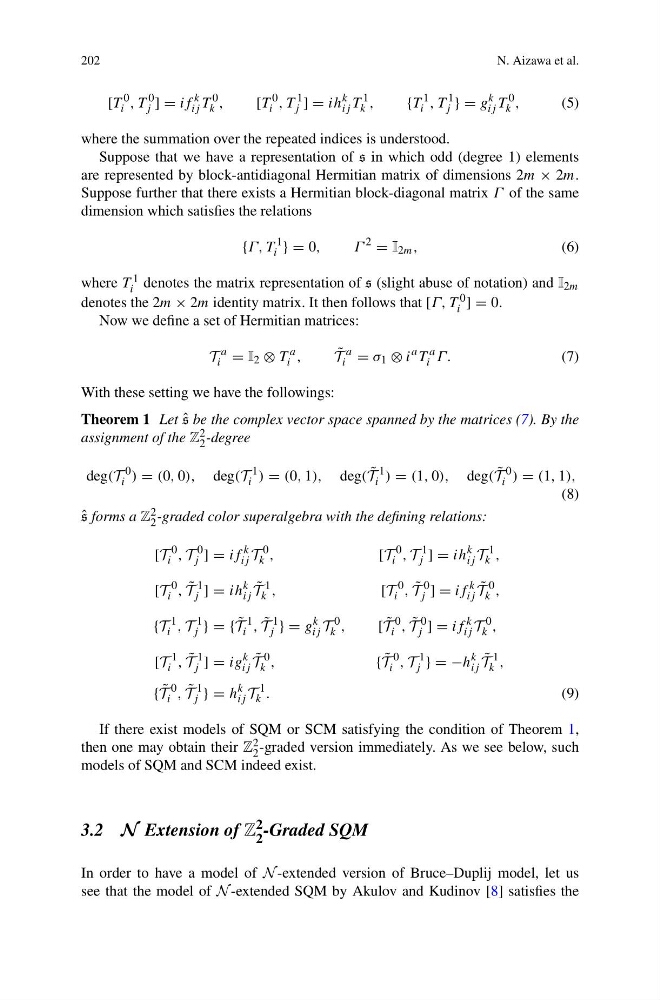
With these setting we have the followings:
Theorem 1 Let ˆ
s be the complex vector space spanned by the matrices (7). By the
assignment of the Z 2
2 -degree
deg(T
0
i ) = (0, 0), deg(T
1
i ) = (0, 1), deg( ˜
T
1
i ) = (1, 0), deg( ˜
T
0
i ) = (1, 1),
(8)
ˆ
s forms a Z 2
2 -graded color superalgebra with the defining relations:
[T
0
i , T
0
j ] = if
k
ij T
0
k ,
[T
0
i , T
1
j ] = ih
k
ij T
1
k ,
[T
0
i , ˜
T
1
j ] = ih
k
ij
˜
T
1
k ,
[T
0
i , ˜
T
0
j ] = if
k
ij
˜
T
0
k ,
{T
1
i , T
1
j } = { ˜
T
1
i , ˜
T
1
j } = g
k
ij T
0
k ,
[ ˜
T
0
i , ˜
T
0
j ] = if
k
ij T
0
k ,
[T
1
i , ˜
T
1
j ] = ig
k
ij
˜
T
0
k ,
{ ˜
T
0
i , T
1
j } = −h
k
ij
˜
T
1
k ,
{ ˜
T
0
i , ˜
T
1
j } = h
k
ij T
1
k .
(9)
If there exist models of SQM or SCM satisfying the condition of Theorem 1,
then one may obtain their Z 2
2 -graded version immediately. As we see below, such
models of SQM and SCM indeed exist.
3.2 N Extension of Z 2
2
-Graded SQM
In order to have a model of N -extended version of Bruce–Duplij model, let us
see that the model of N -extended SQM by Akulov and Kudinov [8] satisfies the
N. Aizawa et al.
[T
0
i , T
0
j ] = if
k
ij T
0
k ,
[T
0
i , T
1
j ] = ih
k
ij T
1
k ,
{T
1
i , T
1
j } = g
k
ij T
0
k ,
(5)
where the summation over the repeated indices is understood.
Suppose that we have a representation of s in which odd (degree 1) elements
are represented by block-antidiagonal Hermitian matrix of dimensions 2m × 2m.
Suppose further that there exists a Hermitian block-diagonal matrix Γ of the same
dimension which satisfies the relations
{Γ, T
1
i } = 0,
Γ
2
= I 2m ,
(6)
where T 1
i denotes the matrix representation of s (slight abuse of notation) and I 2m
denotes the 2m × 2m identity matrix. It then follows that [Γ, T 0
i ] = 0.
Now we define a set of Hermitian matrices:
T
a
i = I 2 ⊗ T
a
i ,
˜
T
a
i = σ 1 ⊗ i
a T
a
i Γ.
(7)
With these setting we have the followings:
Theorem 1 Let ˆ
s be the complex vector space spanned by the matrices (7). By the
assignment of the Z 2
2 -degree
deg(T
0
i ) = (0, 0), deg(T
1
i ) = (0, 1), deg( ˜
T
1
i ) = (1, 0), deg( ˜
T
0
i ) = (1, 1),
(8)
ˆ
s forms a Z 2
2 -graded color superalgebra with the defining relations:
[T
0
i , T
0
j ] = if
k
ij T
0
k ,
[T
0
i , T
1
j ] = ih
k
ij T
1
k ,
[T
0
i , ˜
T
1
j ] = ih
k
ij
˜
T
1
k ,
[T
0
i , ˜
T
0
j ] = if
k
ij
˜
T
0
k ,
{T
1
i , T
1
j } = { ˜
T
1
i , ˜
T
1
j } = g
k
ij T
0
k ,
[ ˜
T
0
i , ˜
T
0
j ] = if
k
ij T
0
k ,
[T
1
i , ˜
T
1
j ] = ig
k
ij
˜
T
0
k ,
{ ˜
T
0
i , T
1
j } = −h
k
ij
˜
T
1
k ,
{ ˜
T
0
i , ˜
T
1
j } = h
k
ij T
1
k .
(9)
If there exist models of SQM or SCM satisfying the condition of Theorem 1,
then one may obtain their Z 2
2 -graded version immediately. As we see below, such
models of SQM and SCM indeed exist.
3.2 N Extension of Z 2
2
-Graded SQM
In order to have a model of N -extended version of Bruce–Duplij model, let us
see that the model of N -extended SQM by Akulov and Kudinov [8] satisfies the