

W -Algebras via Lax Type Operators
195
Theorem 4
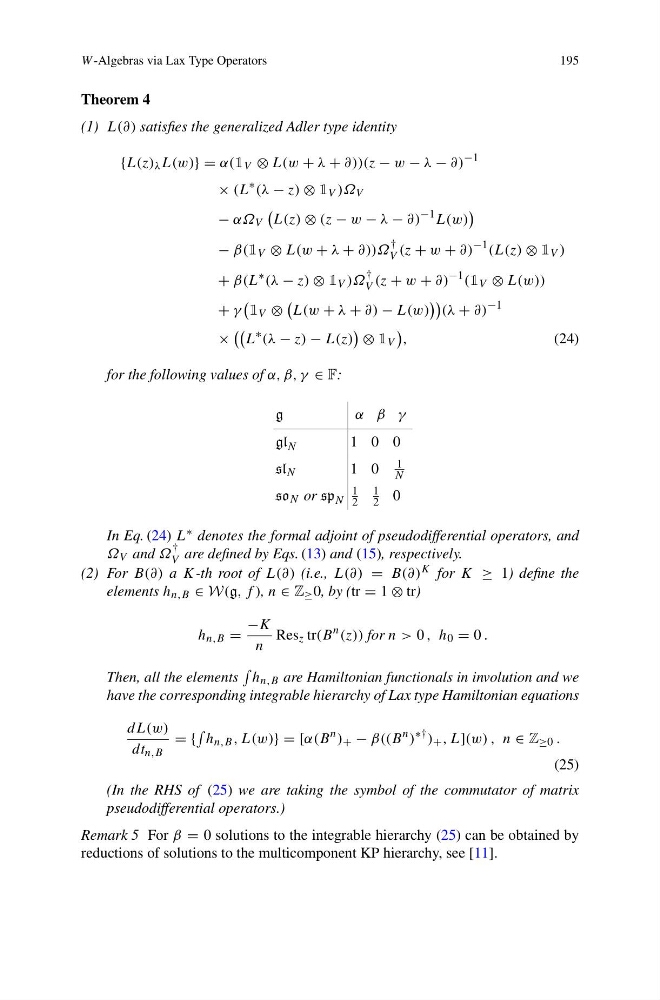
(1) L(∂) satisfies the generalized Adler type identity
{L(z) λ L(w)} = α(1 V ⊗ L(w + λ + ∂))(z − w − λ − ∂)
−1
× (L
∗ (λ − z) ⊗ 1 V )Ω V
− αΩ V
L(z) ⊗ (z − w − λ − ∂)
−1 L(w)
− β(1 V ⊗ L(w + λ + ∂))Ω
†
V (z + w + ∂)
−1 (L(z) ⊗ 1 V )
+ β(L
∗ (λ − z) ⊗ 1 V )Ω
†
V (z + w + ∂)
−1 (1 V ⊗ L(w))
+ γ
1 V ⊗
L(w + λ + ∂) − L(w)
(λ + ∂)
−1
×
L
∗ (λ − z) − L(z)
⊗ 1 V
,
(24)
for the following values of α, β, γ ∈ F:
g
α β γ
gl N
1 0 0
sl N
1 0
1
N
so N or sp N
1
2
1
2 0
In Eq. (24) L ∗ denotes the formal adjoint of pseudodifferential operators, and
Ω V and Ω
†
V are defined by Eqs. (13) and (15), respectively.
(2) For B(∂) a K-th root of L(∂) (i.e., L(∂) = B(∂) K for K ≥ 1) define the
elements h n,B ∈ W(g, f ), n ∈ Z ≥ 0, by (tr = 1 ⊗ tr)
h n,B =
−K
n
Res z tr(B
n (z)) for n > 0 , h 0 = 0 .
Then, all the elements
h n,B are Hamiltonian functionals in involution and we
have the corresponding integrable hierarchy of Lax type Hamiltonian equations
dL(w)
dt n,B
= {
h n,B , L(w)} = [α(B
n ) + − β((B
n )
∗† ) + , L](w) , n ∈ Z ≥0 .
(25)
(In the RHS of (25) we are taking the symbol of the commutator of matrix
pseudodifferential operators.)
Remark 5 For β = 0 solutions to the integrable hierarchy (25) can be obtained by
reductions of solutions to the multicomponent KP hierarchy, see [11].
195
Theorem 4
(1) L(∂) satisfies the generalized Adler type identity
{L(z) λ L(w)} = α(1 V ⊗ L(w + λ + ∂))(z − w − λ − ∂)
−1
× (L
∗ (λ − z) ⊗ 1 V )Ω V
− αΩ V
L(z) ⊗ (z − w − λ − ∂)
−1 L(w)
− β(1 V ⊗ L(w + λ + ∂))Ω
†
V (z + w + ∂)
−1 (L(z) ⊗ 1 V )
+ β(L
∗ (λ − z) ⊗ 1 V )Ω
†
V (z + w + ∂)
−1 (1 V ⊗ L(w))
+ γ
1 V ⊗
L(w + λ + ∂) − L(w)
(λ + ∂)
−1
×
L
∗ (λ − z) − L(z)
⊗ 1 V
,
(24)
for the following values of α, β, γ ∈ F:
g
α β γ
gl N
1 0 0
sl N
1 0
1
N
so N or sp N
1
2
1
2 0
In Eq. (24) L ∗ denotes the formal adjoint of pseudodifferential operators, and
Ω V and Ω
†
V are defined by Eqs. (13) and (15), respectively.
(2) For B(∂) a K-th root of L(∂) (i.e., L(∂) = B(∂) K for K ≥ 1) define the
elements h n,B ∈ W(g, f ), n ∈ Z ≥ 0, by (tr = 1 ⊗ tr)
h n,B =
−K
n
Res z tr(B
n (z)) for n > 0 , h 0 = 0 .
Then, all the elements
h n,B are Hamiltonian functionals in involution and we
have the corresponding integrable hierarchy of Lax type Hamiltonian equations
dL(w)
dt n,B
= {
h n,B , L(w)} = [α(B
n ) + − β((B
n )
∗† ) + , L](w) , n ∈ Z ≥0 .
(25)
(In the RHS of (25) we are taking the symbol of the commutator of matrix
pseudodifferential operators.)
Remark 5 For β = 0 solutions to the integrable hierarchy (25) can be obtained by
reductions of solutions to the multicomponent KP hierarchy, see [11].