

W -Algebras via Lax Type Operators
183
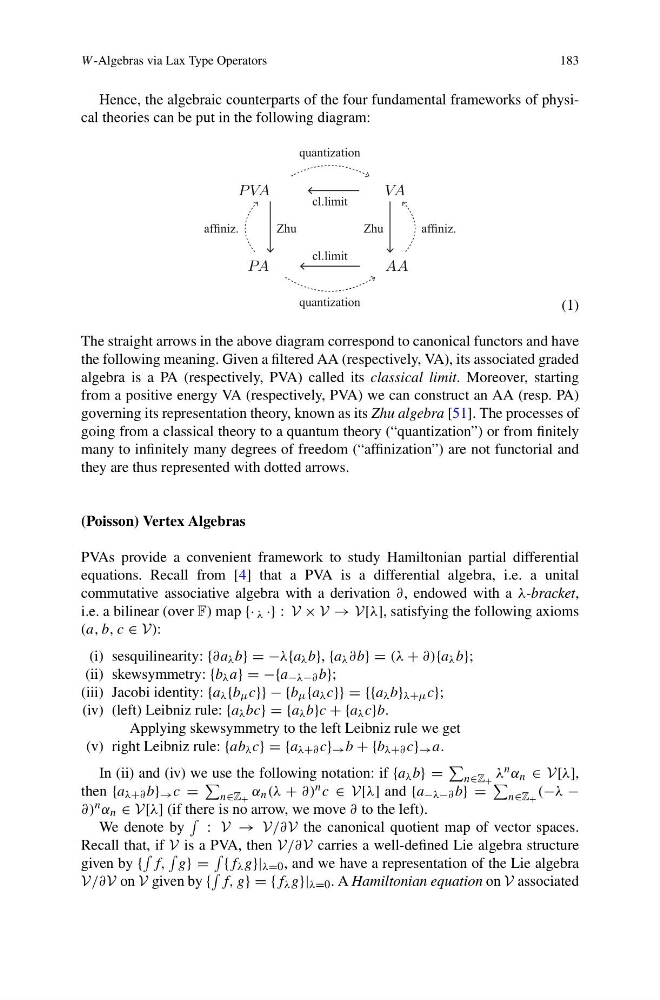
Hence, the algebraic counterparts of the four fundamental frameworks of physical theories can be put in the following diagram:
PVA
Zhu
quantization
VA
cl.limit
Zhu
PA
affiniz.
quantization
AA
cl.limit
affiniz.
(1)
The straight arrows in the above diagram correspond to canonical functors and have
the following meaning. Given a filtered AA (respectively, VA), its associated graded
algebra is a PA (respectively, PVA) called its classical limit. Moreover, starting
from a positive energy VA (respectively, PVA) we can construct an AA (resp. PA)
governing its representation theory, known as its Zhu algebra [51]. The processes of
going from a classical theory to a quantum theory (“quantization”) or from finitely
many to infinitely many degrees of freedom (“affinization”) are not functorial and
they are thus represented with dotted arrows.
(Poisson) Vertex Algebras
PVAs provide a convenient framework to study Hamiltonian partial differential
equations. Recall from [4] that a PVA is a differential algebra, i.e. a unital
commutative associative algebra with a derivation ∂, endowed with a λ-bracket,
i.e. a bilinear (over F) map {· λ ·} : V × V → V[λ], satisfying the following axioms
(a, b, c ∈ V):
(i) sesquilinearity: {∂a λ b} = −λ{a λ b}, {a λ ∂b} = (λ + ∂){a λ b};
(ii) skewsymmetry: {b λ a} = −{a −λ−∂ b};
(iii) Jacobi identity: {a λ {b μ c}} − {b μ {a λ c}} = {{a λ b} λ+μ c};
(iv) (left) Leibniz rule: {a λ bc} = {a λ b}c + {a λ c}b.
Applying skewsymmetry to the left Leibniz rule we get
(v) right Leibniz rule: {ab λ c} = {a λ+∂ c} → b + {b λ+∂ c} → a.
In (ii) and (iv) we use the following notation: if {a λ b} =
n∈Z +
λ n α n ∈ V[λ],
then {a λ+∂ b} → c =
n∈Z +
α n (λ + ∂) n c ∈ V[λ] and {a −λ−∂ b} =
n∈Z +
(−λ −
∂) n α n ∈ V[λ] (if there is no arrow, we move ∂ to the left).
We denote by
: V → V/∂V the canonical quotient map of vector spaces.
Recall that, if V is a PVA, then V/∂V carries a well-defined Lie algebra structure
given by {
f,
g} =
{f λ g}| λ=0 , and we have a representation of the Lie algebra
V/∂V on V given by {
f, g} = {f λ g}| λ=0 . A Hamiltonian equation on V associated
183
Hence, the algebraic counterparts of the four fundamental frameworks of physical theories can be put in the following diagram:
PVA
Zhu
quantization
VA
cl.limit
Zhu
PA
affiniz.
quantization
AA
cl.limit
affiniz.
(1)
The straight arrows in the above diagram correspond to canonical functors and have
the following meaning. Given a filtered AA (respectively, VA), its associated graded
algebra is a PA (respectively, PVA) called its classical limit. Moreover, starting
from a positive energy VA (respectively, PVA) we can construct an AA (resp. PA)
governing its representation theory, known as its Zhu algebra [51]. The processes of
going from a classical theory to a quantum theory (“quantization”) or from finitely
many to infinitely many degrees of freedom (“affinization”) are not functorial and
they are thus represented with dotted arrows.
(Poisson) Vertex Algebras
PVAs provide a convenient framework to study Hamiltonian partial differential
equations. Recall from [4] that a PVA is a differential algebra, i.e. a unital
commutative associative algebra with a derivation ∂, endowed with a λ-bracket,
i.e. a bilinear (over F) map {· λ ·} : V × V → V[λ], satisfying the following axioms
(a, b, c ∈ V):
(i) sesquilinearity: {∂a λ b} = −λ{a λ b}, {a λ ∂b} = (λ + ∂){a λ b};
(ii) skewsymmetry: {b λ a} = −{a −λ−∂ b};
(iii) Jacobi identity: {a λ {b μ c}} − {b μ {a λ c}} = {{a λ b} λ+μ c};
(iv) (left) Leibniz rule: {a λ bc} = {a λ b}c + {a λ c}b.
Applying skewsymmetry to the left Leibniz rule we get
(v) right Leibniz rule: {ab λ c} = {a λ+∂ c} → b + {b λ+∂ c} → a.
In (ii) and (iv) we use the following notation: if {a λ b} =
n∈Z +
λ n α n ∈ V[λ],
then {a λ+∂ b} → c =
n∈Z +
α n (λ + ∂) n c ∈ V[λ] and {a −λ−∂ b} =
n∈Z +
(−λ −
∂) n α n ∈ V[λ] (if there is no arrow, we move ∂ to the left).
We denote by
: V → V/∂V the canonical quotient map of vector spaces.
Recall that, if V is a PVA, then V/∂V carries a well-defined Lie algebra structure
given by {
f,
g} =
{f λ g}| λ=0 , and we have a representation of the Lie algebra
V/∂V on V given by {
f, g} = {f λ g}| λ=0 . A Hamiltonian equation on V associated