

Zernike System from Free Motion on 3-Sphere
175
Δ
(3)
LB Φ J,ν,μ =
Δ
(2)
LB +
1
ξ 3
∂
∂ξ 3
+
1
ξ 2
3
∂ 2
∂ϕ 2
Φ J,ν,μ =
Z(x, y)−
μ 2
ξ 2
3
Φ J,ν,μ , (23)
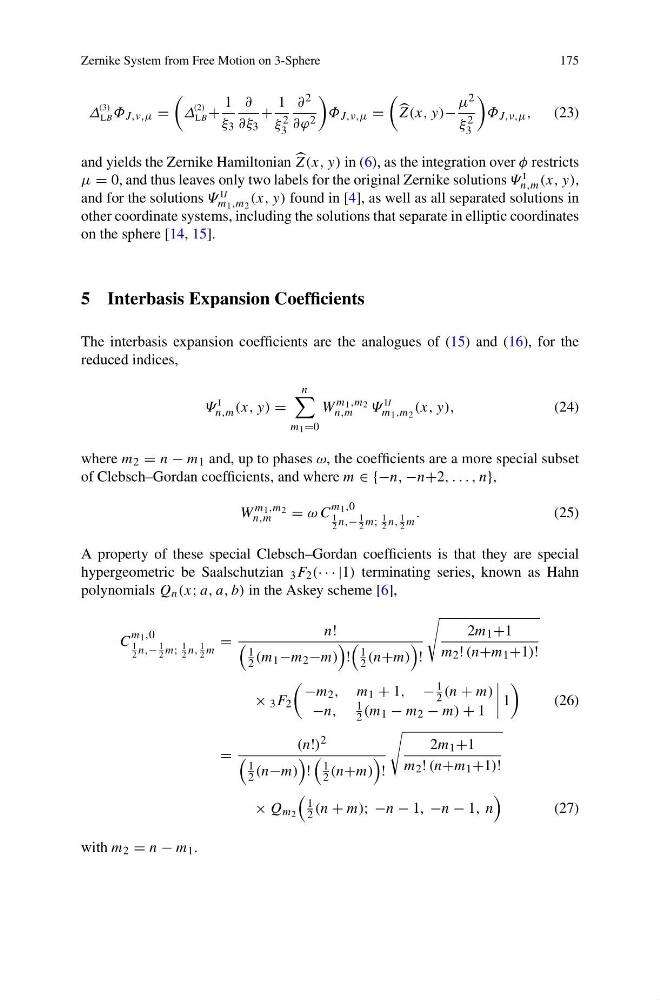
and yields the Zernike Hamiltonian
Z(x, y) in (6), as the integration over φ restricts
μ = 0, and thus leaves only two labels for the original Zernike solutions Ψ
I
n,m (x, y),
and for the solutions Ψ
II
m 1 ,m 2
(x, y) found in [4], as well as all separated solutions in
other coordinate systems, including the solutions that separate in elliptic coordinates
on the sphere [14, 15].
5 Interbasis Expansion Coefficients
The interbasis expansion coefficients are the analogues of (15) and (16), for the
reduced indices,
Ψ
I
n,m (x, y) =
n
m 1 =0
W
m 1 ,m 2
n,m
Ψ
II
m 1 ,m 2
(x, y),
(24)
where m 2 = n − m 1 and, up to phases ω, the coefficients are a more special subset
of Clebsch–Gordan coefficients, and where m ∈ {−n, −n+2, . . . , n},
W
m 1 ,m 2
n,m
= ω C
m 1 ,0
1
2 n,−
1
2 m;
1
2 n,
1
2 m
.
(25)
A property of these special Clebsch–Gordan coefficients is that they are special
hypergeometric be Saalschutzian 3 F 2 (· · · |1) terminating series, known as Hahn
polynomials Q n (x; a, a, b) in the Askey scheme [6],
C
m 1 ,0
1
2 n,−
1
2 m;
1
2 n,
1
2 m
=
n!
1
2 (m 1 −m 2 −m)
!
1
2 (n+m)
!
2m 1 +1
m 2 ! (n+m 1 +1)!
× 3 F 2
−m 2 , m 1 + 1, −
1
2 (n + m)
−n,
1
2 (m 1 − m 2 − m) + 1
1
(26)
=
(n!) 2
1
2 (n−m)
!
1
2 (n+m)
!
2m 1 +1
m 2 ! (n+m 1 +1)!
× Q m 2
1
2 (n + m); −n − 1, −n − 1, n
(27)
with m 2 = n − m 1 .
175
Δ
(3)
LB Φ J,ν,μ =
Δ
(2)
LB +
1
ξ 3
∂
∂ξ 3
+
1
ξ 2
3
∂ 2
∂ϕ 2
Φ J,ν,μ =
Z(x, y)−
μ 2
ξ 2
3
Φ J,ν,μ , (23)
and yields the Zernike Hamiltonian
Z(x, y) in (6), as the integration over φ restricts
μ = 0, and thus leaves only two labels for the original Zernike solutions Ψ
I
n,m (x, y),
and for the solutions Ψ
II
m 1 ,m 2
(x, y) found in [4], as well as all separated solutions in
other coordinate systems, including the solutions that separate in elliptic coordinates
on the sphere [14, 15].
5 Interbasis Expansion Coefficients
The interbasis expansion coefficients are the analogues of (15) and (16), for the
reduced indices,
Ψ
I
n,m (x, y) =
n
m 1 =0
W
m 1 ,m 2
n,m
Ψ
II
m 1 ,m 2
(x, y),
(24)
where m 2 = n − m 1 and, up to phases ω, the coefficients are a more special subset
of Clebsch–Gordan coefficients, and where m ∈ {−n, −n+2, . . . , n},
W
m 1 ,m 2
n,m
= ω C
m 1 ,0
1
2 n,−
1
2 m;
1
2 n,
1
2 m
.
(25)
A property of these special Clebsch–Gordan coefficients is that they are special
hypergeometric be Saalschutzian 3 F 2 (· · · |1) terminating series, known as Hahn
polynomials Q n (x; a, a, b) in the Askey scheme [6],
C
m 1 ,0
1
2 n,−
1
2 m;
1
2 n,
1
2 m
=
n!
1
2 (m 1 −m 2 −m)
!
1
2 (n+m)
!
2m 1 +1
m 2 ! (n+m 1 +1)!
× 3 F 2
−m 2 , m 1 + 1, −
1
2 (n + m)
−n,
1
2 (m 1 − m 2 − m) + 1
1
(26)
=
(n!) 2
1
2 (n−m)
!
1
2 (n+m)
!
2m 1 +1
m 2 ! (n+m 1 +1)!
× Q m 2
1
2 (n + m); −n − 1, −n − 1, n
(27)
with m 2 = n − m 1 .