

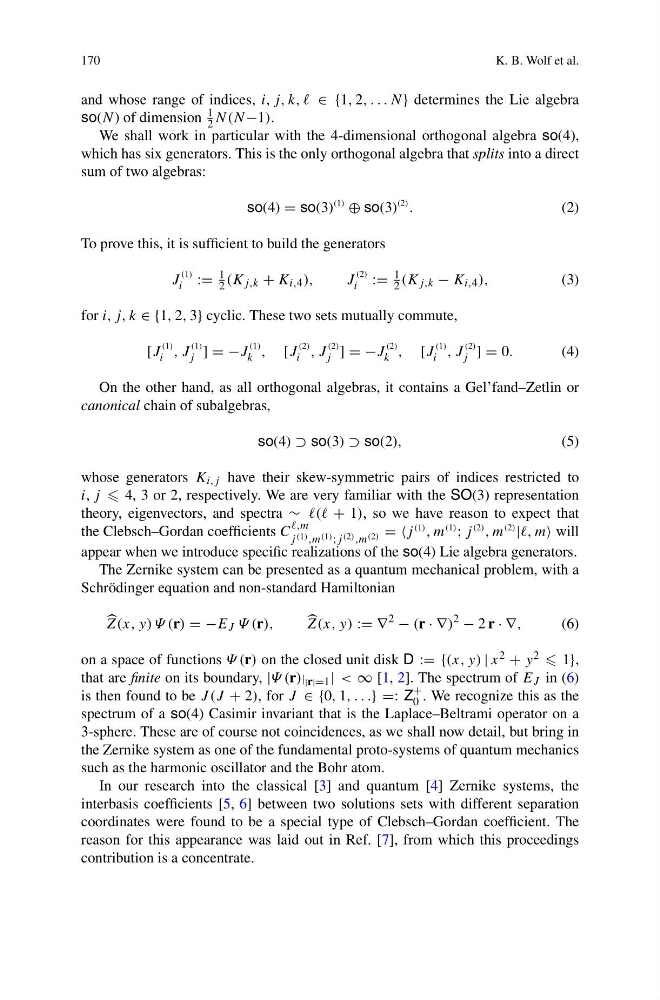
170
K. B. Wolf et al.
and whose range of indices, i, j, k, , ∈ {1, 2, . . . N} determines the Lie algebra
so(N) of dimension
1
2 N(N−1).
We shall work in particular with the 4-dimensional orthogonal algebra so(4),
which has six generators. This is the only orthogonal algebra that splits into a direct
sum of two algebras:
so(4) = so(3)
(1)
⊕ so(3)
(2) .
(2)
To prove this, it is sufficient to build the generators
J
(1)
i :=
1
2 (K j,k + K i,4 ),
J
(2)
i :=
1
2 (K j,k − K i,4 ),
(3)
for i, j, k ∈ {1, 2, 3} cyclic. These two sets mutually commute,
[J
(1)
i , J
(1)
j ] = −J
(1)
k , [J
(2)
i , J
(2)
j ] = −J
(2)
k , [J
(1)
i , J
(2)
j ] = 0.
(4)
On the other hand, as all orthogonal algebras, it contains a Gel’fand–Zetlin or
canonical chain of subalgebras,
so(4) ⊃ so(3) ⊃ so(2),
(5)
whose generators K i,j have their skew-symmetric pairs of indices restricted to
i, j 4, 3 or 2, respectively. We are very familiar with the SO(3) representation
theory, eigenvectors, and spectra ∼ + 1), so we have reason to expect that
the Clebsch–Gordan coefficients C
j (1) ,m (1) ;j (2) ,m (2) = =j
(1) , m
(1)
; j
(2) , m
(2)
|, m will
appear when we introduce specific realizations of the so(4) Lie algebra generators.
The Zernike system can be presented as a quantum mechanical problem, with a
Schrödinger equation and non-standard Hamiltonian
Z(x, y) Ψ (r) = −E J Ψ (r),
Z(x, y) := ∇
2
− (r · ∇)
2
− 2 r · ∇,
(6)
on a space of functions Ψ (r) on the closed unit disk D := {(x, y) | x 2 + y 2 1},
that are finite on its boundary, |Ψ (r)| |r|=1 | < ∞ [1, 2]. The spectrum of E J in (6)
is then found to be J (J + 2), for J ∈ {0, 1, . . .} =: Z
+
0 . We recognize this as the
spectrum of a so(4) Casimir invariant that is the Laplace–Beltrami operator on a
3-sphere. These are of course not coincidences, as we shall now detail, but bring in
the Zernike system as one of the fundamental proto-systems of quantum mechanics
such as the harmonic oscillator and the Bohr atom.
In our research into the classical [3] and quantum [4] Zernike systems, the
interbasis coefficients [5, 6] between two solutions sets with different separation
coordinates were found to be a special type of Clebsch–Gordan coefficient. The
reason for this appearance was laid out in Ref. [7], from which this proceedings
contribution is a concentrate.
K. B. Wolf et al.
and whose range of indices, i, j, k, , ∈ {1, 2, . . . N} determines the Lie algebra
so(N) of dimension
1
2 N(N−1).
We shall work in particular with the 4-dimensional orthogonal algebra so(4),
which has six generators. This is the only orthogonal algebra that splits into a direct
sum of two algebras:
so(4) = so(3)
(1)
⊕ so(3)
(2) .
(2)
To prove this, it is sufficient to build the generators
J
(1)
i :=
1
2 (K j,k + K i,4 ),
J
(2)
i :=
1
2 (K j,k − K i,4 ),
(3)
for i, j, k ∈ {1, 2, 3} cyclic. These two sets mutually commute,
[J
(1)
i , J
(1)
j ] = −J
(1)
k , [J
(2)
i , J
(2)
j ] = −J
(2)
k , [J
(1)
i , J
(2)
j ] = 0.
(4)
On the other hand, as all orthogonal algebras, it contains a Gel’fand–Zetlin or
canonical chain of subalgebras,
so(4) ⊃ so(3) ⊃ so(2),
(5)
whose generators K i,j have their skew-symmetric pairs of indices restricted to
i, j 4, 3 or 2, respectively. We are very familiar with the SO(3) representation
theory, eigenvectors, and spectra ∼ + 1), so we have reason to expect that
the Clebsch–Gordan coefficients C
j (1) ,m (1) ;j (2) ,m (2) = =j
(1) , m
(1)
; j
(2) , m
(2)
|, m will
appear when we introduce specific realizations of the so(4) Lie algebra generators.
The Zernike system can be presented as a quantum mechanical problem, with a
Schrödinger equation and non-standard Hamiltonian
Z(x, y) Ψ (r) = −E J Ψ (r),
Z(x, y) := ∇
2
− (r · ∇)
2
− 2 r · ∇,
(6)
on a space of functions Ψ (r) on the closed unit disk D := {(x, y) | x 2 + y 2 1},
that are finite on its boundary, |Ψ (r)| |r|=1 | < ∞ [1, 2]. The spectrum of E J in (6)
is then found to be J (J + 2), for J ∈ {0, 1, . . .} =: Z
+
0 . We recognize this as the
spectrum of a so(4) Casimir invariant that is the Laplace–Beltrami operator on a
3-sphere. These are of course not coincidences, as we shall now detail, but bring in
the Zernike system as one of the fundamental proto-systems of quantum mechanics
such as the harmonic oscillator and the Bohr atom.
In our research into the classical [3] and quantum [4] Zernike systems, the
interbasis coefficients [5, 6] between two solutions sets with different separation
coordinates were found to be a special type of Clebsch–Gordan coefficient. The
reason for this appearance was laid out in Ref. [7], from which this proceedings
contribution is a concentrate.