

Discrete Curve Flows in Two-Dimensional Cayley–Klein Geometries
165
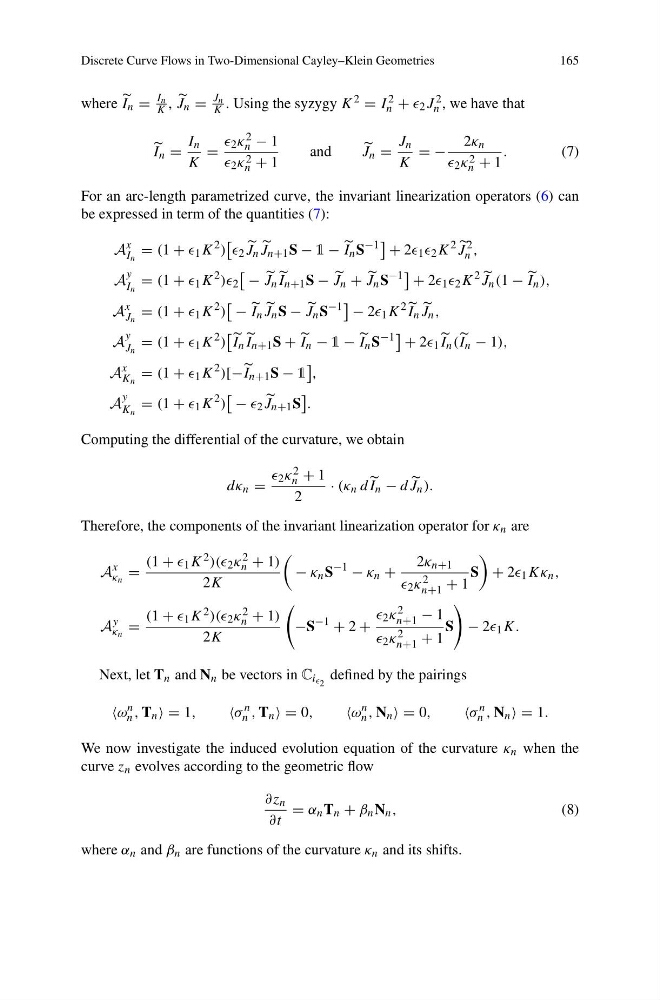
where
I n =
I n
K ,
J n =
J n
K . Using the syzygy K 2 = I 2
n + 2 J 2
n , we have that
I n =
I n
K
=
2 κ 2
n − 1
2 κ 2
n + 1
and
J n =
J n
K
= −
2κ n
2 κ 2
n + 1
.
(7)
For an arc-length parametrized curve, the invariant linearization operators (6) can
be expressed in term of the quantities (7):
A
x
I n
= (1 + 1 K
2 )
2
J n
J n+1 S − 1 −
I n S
−1
+ 2 1 2 K
2
J
2
n ,
A
y
I n
= (1 + 1 K
2 )) 2
−
J n
I n+1 S −
J n +
J n S
−1
+ 2 1 2 K
2
J n (1 −
I n ),
A
x
J n
= (1 + 1 K
2 )
−
I n
J n S −
J n S
−1
− 2 1 K
2
I n
J n ,
A
y
J n
= (1 + 1 K
2 )
I n
I n+1 S +
I n − 1 −
I n S
−1
+ 2 1
I n (
I n − 1),
A
x
K n
= (1 + 1 K
2 )[−
I n+1 S − 1
,
A
y
K n
= (1 + 1 K
2 )
− 2
J n+1 S
.
Computing the differential of the curvature, we obtain
dκ n =
2 κ 2
n + 1
2
· (κ n d
I n − d
J n ).
Therefore, the components of the invariant linearization operator for κ n are
A
x
κ n
=
(1 + 1 K 2 )(( 2 κ 2
n + 1)
2K
− κ n S
−1
− κ n +
2κ n+1
2 κ 2
n+1 + 1
S
+ 2 1 Kκ n ,
A
y
κ n
=
(1 + 1 K 2 )(( 2 κ 2
n + 1)
2K
−S
−1
+ 2 +
2 κ 2
n+1 − 1
2 κ 2
n+1 + 1
S
− 2 1 K.
Next, let T n and N n be vectors in C i 2 defined by the pairings
n
n , T n = 1,
n
n , T n = 0,
n
n , N n = 0,
n
n , N n = 1.
We now investigate the induced evolution equation of the curvature κ n when the
curve z n evolves according to the geometric flow
∂z n
∂t
= α n T n + β n N n ,
(8)
where α n and β n are functions of the curvature κ n and its shifts.
165
where
I n =
I n
K ,
J n =
J n
K . Using the syzygy K 2 = I 2
n + 2 J 2
n , we have that
I n =
I n
K
=
2 κ 2
n − 1
2 κ 2
n + 1
and
J n =
J n
K
= −
2κ n
2 κ 2
n + 1
.
(7)
For an arc-length parametrized curve, the invariant linearization operators (6) can
be expressed in term of the quantities (7):
A
x
I n
= (1 + 1 K
2 )
2
J n
J n+1 S − 1 −
I n S
−1
+ 2 1 2 K
2
J
2
n ,
A
y
I n
= (1 + 1 K
2 )) 2
−
J n
I n+1 S −
J n +
J n S
−1
+ 2 1 2 K
2
J n (1 −
I n ),
A
x
J n
= (1 + 1 K
2 )
−
I n
J n S −
J n S
−1
− 2 1 K
2
I n
J n ,
A
y
J n
= (1 + 1 K
2 )
I n
I n+1 S +
I n − 1 −
I n S
−1
+ 2 1
I n (
I n − 1),
A
x
K n
= (1 + 1 K
2 )[−
I n+1 S − 1
,
A
y
K n
= (1 + 1 K
2 )
− 2
J n+1 S
.
Computing the differential of the curvature, we obtain
dκ n =
2 κ 2
n + 1
2
· (κ n d
I n − d
J n ).
Therefore, the components of the invariant linearization operator for κ n are
A
x
κ n
=
(1 + 1 K 2 )(( 2 κ 2
n + 1)
2K
− κ n S
−1
− κ n +
2κ n+1
2 κ 2
n+1 + 1
S
+ 2 1 Kκ n ,
A
y
κ n
=
(1 + 1 K 2 )(( 2 κ 2
n + 1)
2K
−S
−1
+ 2 +
2 κ 2
n+1 − 1
2 κ 2
n+1 + 1
S
− 2 1 K.
Next, let T n and N n be vectors in C i 2 defined by the pairings
n
n , T n = 1,
n
n , T n = 0,
n
n , N n = 0,
n
n , N n = 1.
We now investigate the induced evolution equation of the curvature κ n when the
curve z n evolves according to the geometric flow
∂z n
∂t
= α n T n + β n N n ,
(8)
where α n and β n are functions of the curvature κ n and its shifts.