

A Quasi-Maximally Superintegrable System
145
ˆ
L 2 =
N −1
j =1
⎛
⎝
j −1
k=1
1
sin
2 θ k
⎞
⎠
1
(sin θ j ) N −1−j ˆ
p θ j (sin θ j )
N −1−j
ˆ
p θ j .
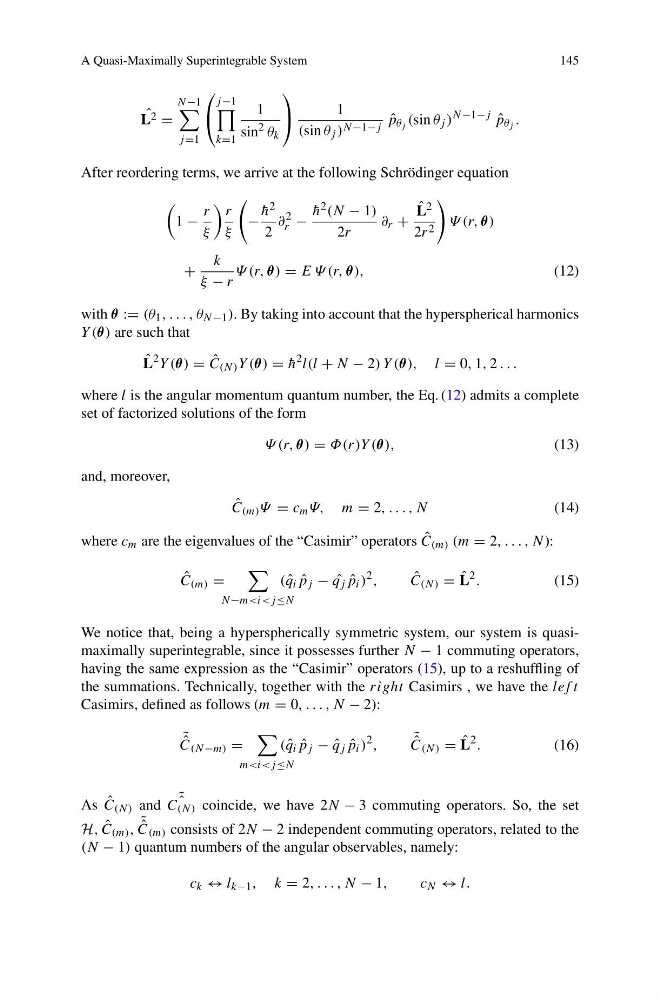
After reordering terms, we arrive at the following Schrödinger equation
1 −
r
ξ
r
ξ
−
¯
h 2
2
∂
2
r −
¯
h 2 (N − 1)
2r
∂ r +
ˆ
L 2
2r 2
Ψ (r, θ )
+
k
ξ − r
Ψ (r, θ ) = E Ψ (r, θ ),
(12)
with θ := (θ 1 , . . . , θ N −1 ). By taking into account that the hyperspherical harmonics
Y (θ) are such that
ˆ
L
2 Y (θ ) = ˆ
C (N ) Y (θ) = ¯
h
2 l(l + N − 2) Y (θ ), l = 0, 1, 2 . . .
where l is the angular momentum quantum number, the Eq. (12) admits a complete
set of factorized solutions of the form
Ψ (r, θ ) = Φ(r)Y (θ),
(13)
and, moreover,
ˆ
C (m) Ψ = c m Ψ, m = 2, . . . , N
(14)
where c m are the eigenvalues of the “Casimir” operators ˆ
C (m) (m = 2, . . . , N):
ˆ
C (m) =
N −m
q i ˆ
p j − ˆ
q j ˆ
p i )
2 ,
ˆ
C (N ) = ˆ
L
2 .
(15)
We notice that, being a hyperspherically symmetric system, our system is quasimaximally superintegrable, since it possesses further N − 1 commuting operators,
having the same expression as the “Casimir” operators (15), up to a reshuffling of
the summations. Technically, together with the right Casimirs , we have the lef t
Casimirs, defined as follows (m = 0, . . . , N − 2):
˜ ˆ
C (N −m) =
m
q i ˆ
p j − ˆ
q j ˆ
p i )
2 ,
˜ ˆ
C (N ) = ˆ
L
2 .
(16)
As ˆ
C (N ) and ˜ ˆ
C (N ) coincide, we have 2N − 3 commuting operators. So, the set
H, ˆ
C (m) , ˜ ˆ
C (m) consists of 2N − 2 independent commuting operators, related to the
(N − 1) quantum numbers of the angular observables, namely:
c k ↔ l k−1 , k = 2, . . . , N − 1,
c N ↔ l.
145
ˆ
L 2 =
N −1
j =1
⎛
⎝
j −1
k=1
1
sin
2 θ k
⎞
⎠
1
(sin θ j ) N −1−j ˆ
p θ j (sin θ j )
N −1−j
ˆ
p θ j .
After reordering terms, we arrive at the following Schrödinger equation
1 −
r
ξ
r
ξ
−
¯
h 2
2
∂
2
r −
¯
h 2 (N − 1)
2r
∂ r +
ˆ
L 2
2r 2
Ψ (r, θ )
+
k
ξ − r
Ψ (r, θ ) = E Ψ (r, θ ),
(12)
with θ := (θ 1 , . . . , θ N −1 ). By taking into account that the hyperspherical harmonics
Y (θ) are such that
ˆ
L
2 Y (θ ) = ˆ
C (N ) Y (θ) = ¯
h
2 l(l + N − 2) Y (θ ), l = 0, 1, 2 . . .
where l is the angular momentum quantum number, the Eq. (12) admits a complete
set of factorized solutions of the form
Ψ (r, θ ) = Φ(r)Y (θ),
(13)
and, moreover,
ˆ
C (m) Ψ = c m Ψ, m = 2, . . . , N
(14)
where c m are the eigenvalues of the “Casimir” operators ˆ
C (m) (m = 2, . . . , N):
ˆ
C (m) =
N −m
q i ˆ
p j − ˆ
q j ˆ
p i )
2 ,
ˆ
C (N ) = ˆ
L
2 .
(15)
We notice that, being a hyperspherically symmetric system, our system is quasimaximally superintegrable, since it possesses further N − 1 commuting operators,
having the same expression as the “Casimir” operators (15), up to a reshuffling of
the summations. Technically, together with the right Casimirs , we have the lef t
Casimirs, defined as follows (m = 0, . . . , N − 2):
˜ ˆ
C (N −m) =
m
q i ˆ
p j − ˆ
q j ˆ
p i )
2 ,
˜ ˆ
C (N ) = ˆ
L
2 .
(16)
As ˆ
C (N ) and ˜ ˆ
C (N ) coincide, we have 2N − 3 commuting operators. So, the set
H, ˆ
C (m) , ˜ ˆ
C (m) consists of 2N − 2 independent commuting operators, related to the
(N − 1) quantum numbers of the angular observables, namely:
c k ↔ l k−1 , k = 2, . . . , N − 1,
c N ↔ l.