

Tachyons and Representations of Sp(2, R)
133
[L a,b , L b,c ] = −e b L a,c
(1)
with e −1 = e 0 = −e 1 = −e 2 = −e 3 = 1.
Denote the Lie algebra of the Poincaré group by p. A basis for p is given by
the L 0,i and L i,j (i, j = 1, 2, 3) of so(1, 3), the Lie algebra of the Lorentz
group, together with a Lorentz vector operator P μ (μ = 0, 1, 2, 3), the components
of which mutually commute. (By “Lorentz vector operator” we mean that the P μ
satisfy the same commutation relations with the generators L μ,ν of so(1, 3) as the
L −1,μ (μ = 0, 1, 2, 3).)
We let U (p) be the universal enveloping algebra of p. Since U (p) is an integral
domain, it has no zero divisors. Hence it has a skew field (or “Lie field”) of fractions
which we denote by D(p). Similarly we denote the universal enveloping algebra of
g = so(2, 3) by U (g). For the same reason as for U (p), it also has a skew field of
fractions, i.e. Lie field, which we denote by D(g).
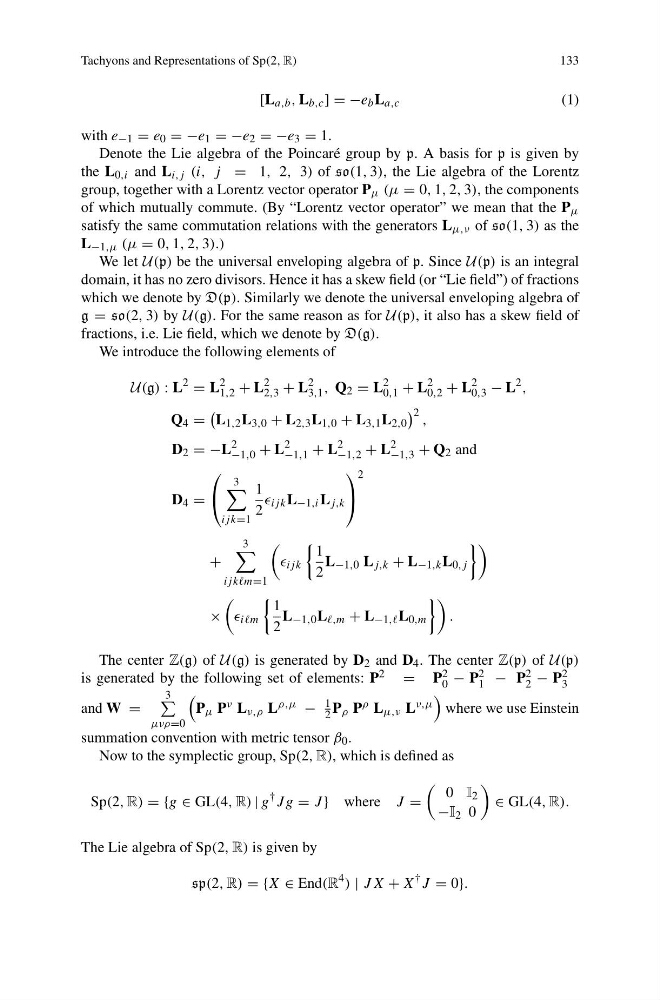
We introduce the following elements of
U (g) : L
2
= L
2
1,2 + L
2
2,3 + L
2
3,1 , Q 2 = L
2
0,1 + L
2
0,2 + L
2
0,3 − L
2 ,
Q 4 =
L 1,2 L 3,0 + L 2,3 L 1,0 + L 3,1 L 2,0
2 ,
D 2 = −L
2
−1,0 + L
2
−1,1 + L
2
−1,2 + L
2
−1,3 + Q 2 and
D 4 =
⎛
⎝
3
ij k=1
1
2
ij k L −1,i L j,k
⎞
⎠
2
+
3
ij kkm=1
ij k
1
2
L −1,0 L j,k + L −1,k L 0,j
×
iim
1
2
L −1,0 L ,m + L −1,, L 0,m
.
The center Z(g) of U (g) is generated by D 2 and D 4 . The center Z(p) of U (p)
is generated by the following set of elements: P 2 = P 2
0 − P 2
1 − P 2
2 − P 2
3
and W =
3
μνρ=0
P μ P ν L ν,ρ L ρ,μ −
1
2 P ρ P ρ L μ,ν L ν,μ
where we use Einstein
summation convention with metric tensor β 0 .
Now to the symplectic group, Sp(2, R), which is defined as
Sp(2, R) = {g ∈ GL(4, R) | g
† Jg = J } where J =
0 I 2
−I 2 0
∈ GL(4, R).
The Lie algebra of Sp(2, R) is given by
sp(2, R) = {X ∈ End(R
4 ) | J X + X
† J = 0}.
133
[L a,b , L b,c ] = −e b L a,c
(1)
with e −1 = e 0 = −e 1 = −e 2 = −e 3 = 1.
Denote the Lie algebra of the Poincaré group by p. A basis for p is given by
the L 0,i and L i,j (i, j = 1, 2, 3) of so(1, 3), the Lie algebra of the Lorentz
group, together with a Lorentz vector operator P μ (μ = 0, 1, 2, 3), the components
of which mutually commute. (By “Lorentz vector operator” we mean that the P μ
satisfy the same commutation relations with the generators L μ,ν of so(1, 3) as the
L −1,μ (μ = 0, 1, 2, 3).)
We let U (p) be the universal enveloping algebra of p. Since U (p) is an integral
domain, it has no zero divisors. Hence it has a skew field (or “Lie field”) of fractions
which we denote by D(p). Similarly we denote the universal enveloping algebra of
g = so(2, 3) by U (g). For the same reason as for U (p), it also has a skew field of
fractions, i.e. Lie field, which we denote by D(g).
We introduce the following elements of
U (g) : L
2
= L
2
1,2 + L
2
2,3 + L
2
3,1 , Q 2 = L
2
0,1 + L
2
0,2 + L
2
0,3 − L
2 ,
Q 4 =
L 1,2 L 3,0 + L 2,3 L 1,0 + L 3,1 L 2,0
2 ,
D 2 = −L
2
−1,0 + L
2
−1,1 + L
2
−1,2 + L
2
−1,3 + Q 2 and
D 4 =
⎛
⎝
3
ij k=1
1
2
ij k L −1,i L j,k
⎞
⎠
2
+
3
ij kkm=1
ij k
1
2
L −1,0 L j,k + L −1,k L 0,j
×
iim
1
2
L −1,0 L ,m + L −1,, L 0,m
.
The center Z(g) of U (g) is generated by D 2 and D 4 . The center Z(p) of U (p)
is generated by the following set of elements: P 2 = P 2
0 − P 2
1 − P 2
2 − P 2
3
and W =
3
μνρ=0
P μ P ν L ν,ρ L ρ,μ −
1
2 P ρ P ρ L μ,ν L ν,μ
where we use Einstein
summation convention with metric tensor β 0 .
Now to the symplectic group, Sp(2, R), which is defined as
Sp(2, R) = {g ∈ GL(4, R) | g
† Jg = J } where J =
0 I 2
−I 2 0
∈ GL(4, R).
The Lie algebra of Sp(2, R) is given by
sp(2, R) = {X ∈ End(R
4 ) | J X + X
† J = 0}.