

Quantum Superintegrable Systems
119
There are again two basic cases here:
1. a 8 = 0.
Then conditions (22) and (23) say that U 1 is a constant: U 1 (u 2 ) = d 1 .
Then condition (24) can be solved for U 2 (u 2 ) and the result substituted into
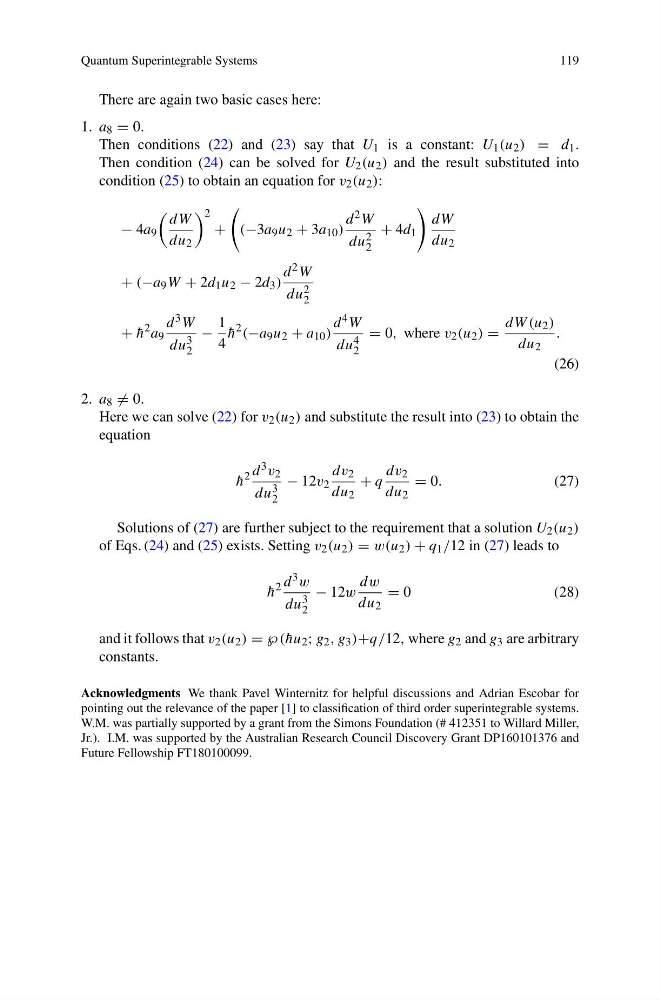
condition (25) to obtain an equation for v 2 (u 2 ):
− 4a 9
dW
du 2
2
+
(−3a 9 u 2 + 3a 10 )
d 2 W
du 2
2
+ 4d 1
dW
du 2
+ (−a 9 W + 2d 1 u 2 − 2d 3 )
d 2 W
du 2
2
+ ¯
h
2 a 9
d 3 W
du 3
2
−
1
4
¯
h
2 (−a 9 u 2 + a 10 )
d 4 W
du 4
2
= 0, where v 2 (u 2 ) =
dW (u 2 )
du 2
.
(26)
2. a 8 = 0.
Here we can solve (22) for v 2 (u 2 ) and substitute the result into (23) to obtain the
equation
¯
h
2 d 3 v 2
du 3
2
− 12v 2
dv 2
du 2
+ q
dv 2
du 2
= 0.
(27)
Solutions of (27) are further subject to the requirement that a solution U 2 (u 2 )
of Eqs. (24) and (25) exists. Setting v 2 (u 2 ) = w(u 2 ) + q 1 /12 in (27) leads to
¯
h
2 d 3 w
du 3
2
− 12w
dw
du 2
= 0
(28)
and it follows that v 2 (u 2 ) = ℘ ( ¯
hu 2 ; g 2 , g 3 )+q/12, where g 2 and g 3 are arbitrary
constants.
Acknowledgments We thank Pavel Winternitz for helpful discussions and Adrian Escobar for
pointing out the relevance of the paper [1] to classification of third order superintegrable systems.
W.M. was partially supported by a grant from the Simons Foundation (# 412351 to Willard Miller,
Jr.). I.M. was supported by the Australian Research Council Discovery Grant DP160101376 and
Future Fellowship FT180100099.
119
There are again two basic cases here:
1. a 8 = 0.
Then conditions (22) and (23) say that U 1 is a constant: U 1 (u 2 ) = d 1 .
Then condition (24) can be solved for U 2 (u 2 ) and the result substituted into
condition (25) to obtain an equation for v 2 (u 2 ):
− 4a 9
dW
du 2
2
+
(−3a 9 u 2 + 3a 10 )
d 2 W
du 2
2
+ 4d 1
dW
du 2
+ (−a 9 W + 2d 1 u 2 − 2d 3 )
d 2 W
du 2
2
+ ¯
h
2 a 9
d 3 W
du 3
2
−
1
4
¯
h
2 (−a 9 u 2 + a 10 )
d 4 W
du 4
2
= 0, where v 2 (u 2 ) =
dW (u 2 )
du 2
.
(26)
2. a 8 = 0.
Here we can solve (22) for v 2 (u 2 ) and substitute the result into (23) to obtain the
equation
¯
h
2 d 3 v 2
du 3
2
− 12v 2
dv 2
du 2
+ q
dv 2
du 2
= 0.
(27)
Solutions of (27) are further subject to the requirement that a solution U 2 (u 2 )
of Eqs. (24) and (25) exists. Setting v 2 (u 2 ) = w(u 2 ) + q 1 /12 in (27) leads to
¯
h
2 d 3 w
du 3
2
− 12w
dw
du 2
= 0
(28)
and it follows that v 2 (u 2 ) = ℘ ( ¯
hu 2 ; g 2 , g 3 )+q/12, where g 2 and g 3 are arbitrary
constants.
Acknowledgments We thank Pavel Winternitz for helpful discussions and Adrian Escobar for
pointing out the relevance of the paper [1] to classification of third order superintegrable systems.
W.M. was partially supported by a grant from the Simons Foundation (# 412351 to Willard Miller,
Jr.). I.M. was supported by the Australian Research Council Discovery Grant DP160101376 and
Future Fellowship FT180100099.