

51
5.2 Methods
5.2.1 Study Site
Nkayi district is located in the northwestern part of Zimbabwe. Soils in the area are
predominantly sandy. Soil organic carbon varies between 0.4% and 0.8% in the top
layers while the water holding capacity varies from 52 to 102 mm (Moyo 2001).
Maize is the major staple cereal while groundnuts are generally considered women
crops that can improve both household income and nutrition. Groundnut is a multipurpose crop that can be used to improve soil fertility as well as the quality of livestock feed, especially during the dry season. Nkayi has a short growing season and
limited water availability. Yields are not necessarily linked with higher nitrogen
input due to interactions between nitrogen-induced growth and its effects on water
use and water availability at different growth stages, especially during grain filling.
Historical changes in climate in the district show increasing temperature trends
and recent projections show increases of approximately 1–2 °C in the near future,
2–3 °C in the mid-century, 2–5 °C by end of century (Masikati et al. 2015).
Projections (medium confidence) show that rainfall change direction and amplitude
are uncertain, yet averages would remain within or close to baseline variability.
Seasonality seems to remain unchanged with possible rainfall reduction at the
beginning of the rainy season (Masikati et al. 2015). These projected changes will
have different impacts on plant production and crop yields as production may
increase or decrease depending on the interactions between crops, climate (CO 2 ,
temperature and rainfall) and soil type.
5.2.2 Climate Data
The best available historical weather record was gap-filled with AgMERRA data to
create a 30 yearlong daily climate data set for Nkayi district (Ruane et al. 2014). To
assess sensitivity of maize and groundnuts to different climatic factors; temperature
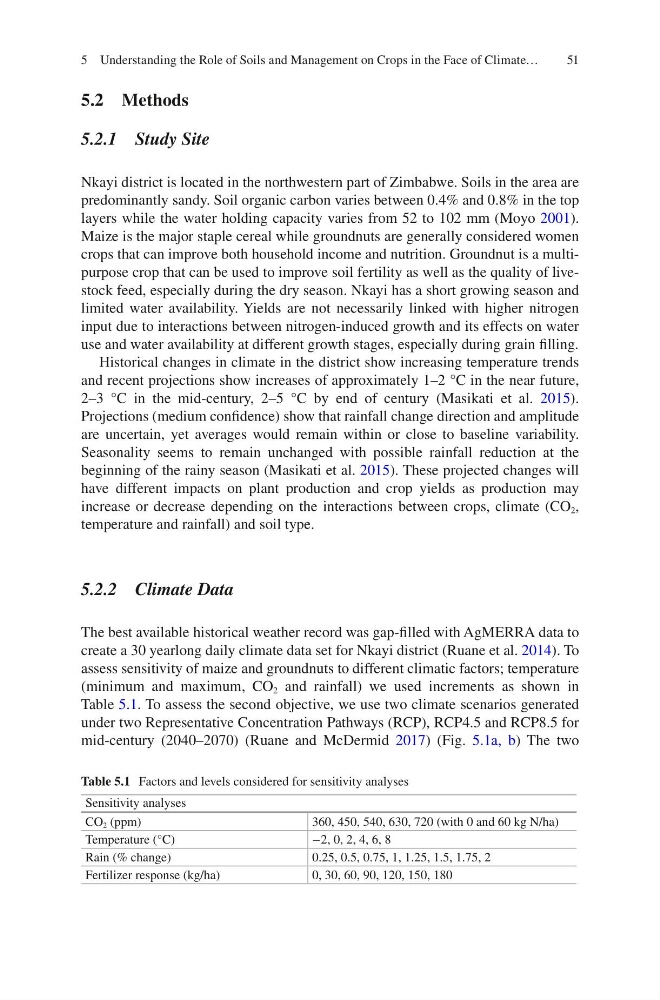
(minimum and maximum, CO 2 and rainfall) we used increments as shown in
Table 5.1. To assess the second objective, we use two climate scenarios generated
under two Representative Concentration Pathways (RCP), RCP4.5 and RCP8.5 for
mid-century (2040–2070) (Ruane and McDermid 2017) (Fig. 5.1a, b) The two
Table 5.1 Factors and levels considered for sensitivity analyses
Sensitivity analyses
CO 2 (ppm)
360, 450, 540, 630, 720 (with 0 and 60 kg N/ha)
Temperature (°C)
−2, 0, 2, 4, 6, 8
Rain (% change)
0.25, 0.5, 0.75, 1, 1.25, 1.5, 1.75, 2
Fertilizer response (kg/ha)
0, 30, 60, 90, 120, 150, 180
5 Understanding the Role of Soils and Management on Crops in the Face of Climate…
5.2 Methods
5.2.1 Study Site
Nkayi district is located in the northwestern part of Zimbabwe. Soils in the area are
predominantly sandy. Soil organic carbon varies between 0.4% and 0.8% in the top
layers while the water holding capacity varies from 52 to 102 mm (Moyo 2001).
Maize is the major staple cereal while groundnuts are generally considered women
crops that can improve both household income and nutrition. Groundnut is a multipurpose crop that can be used to improve soil fertility as well as the quality of livestock feed, especially during the dry season. Nkayi has a short growing season and
limited water availability. Yields are not necessarily linked with higher nitrogen
input due to interactions between nitrogen-induced growth and its effects on water
use and water availability at different growth stages, especially during grain filling.
Historical changes in climate in the district show increasing temperature trends
and recent projections show increases of approximately 1–2 °C in the near future,
2–3 °C in the mid-century, 2–5 °C by end of century (Masikati et al. 2015).
Projections (medium confidence) show that rainfall change direction and amplitude
are uncertain, yet averages would remain within or close to baseline variability.
Seasonality seems to remain unchanged with possible rainfall reduction at the
beginning of the rainy season (Masikati et al. 2015). These projected changes will
have different impacts on plant production and crop yields as production may
increase or decrease depending on the interactions between crops, climate (CO 2 ,
temperature and rainfall) and soil type.
5.2.2 Climate Data
The best available historical weather record was gap-filled with AgMERRA data to
create a 30 yearlong daily climate data set for Nkayi district (Ruane et al. 2014). To
assess sensitivity of maize and groundnuts to different climatic factors; temperature
(minimum and maximum, CO 2 and rainfall) we used increments as shown in
Table 5.1. To assess the second objective, we use two climate scenarios generated
under two Representative Concentration Pathways (RCP), RCP4.5 and RCP8.5 for
mid-century (2040–2070) (Ruane and McDermid 2017) (Fig. 5.1a, b) The two
Table 5.1 Factors and levels considered for sensitivity analyses
Sensitivity analyses
CO 2 (ppm)
360, 450, 540, 630, 720 (with 0 and 60 kg N/ha)
Temperature (°C)
−2, 0, 2, 4, 6, 8
Rain (% change)
0.25, 0.5, 0.75, 1, 1.25, 1.5, 1.75, 2
Fertilizer response (kg/ha)
0, 30, 60, 90, 120, 150, 180
5 Understanding the Role of Soils and Management on Crops in the Face of Climate…