

309
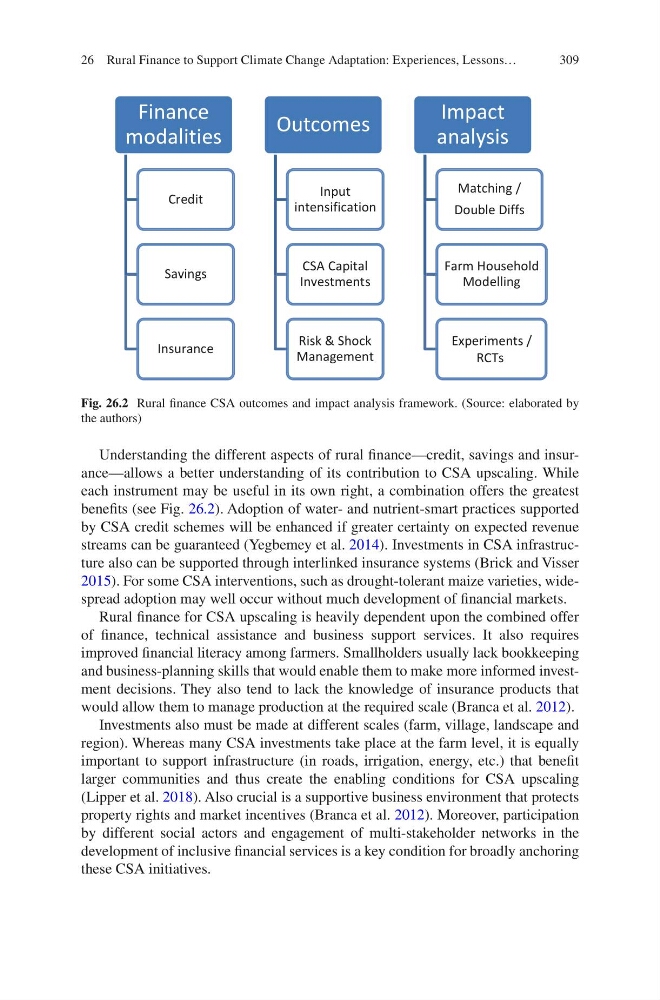
Understanding the different aspects of rural finance—credit, savings and insurance—allows a better understanding of its contribution to CSA upscaling. While
each instrument may be useful in its own right, a combination offers the greatest
benefits (see Fig. 26.2). Adoption of water- and nutrient-smart practices supported
by CSA credit schemes will be enhanced if greater certainty on expected revenue
streams can be guaranteed (Yegbemey et al. 2014). Investments in CSA infrastructure also can be supported through interlinked insurance systems (Brick and Visser
2015). For some CSA interventions, such as drought-tolerant maize varieties, widespread adoption may well occur without much development of financial markets.
Rural finance for CSA upscaling is heavily dependent upon the combined offer
of finance, technical assistance and business support services. It also requires
improved financial literacy among farmers. Smallholders usually lack bookkeeping
and business-planning skills that would enable them to make more informed investment decisions. They also tend to lack the knowledge of insurance products that
would allow them to manage production at the required scale (Branca et al. 2012).
Investments also must be made at different scales (farm, village, landscape and
region). Whereas many CSA investments take place at the farm level, it is equally
important to support infrastructure (in roads, irrigation, energy, etc.) that benefit
larger communities and thus create the enabling conditions for CSA upscaling
(Lipper et al. 2018). Also crucial is a supportive business environment that protects
property rights and market incentives (Branca et al. 2012). Moreover, participation
by different social actors and engagement of multi-stakeholder networks in the
development of inclusive financial services is a key condition for broadly anchoring
these CSA initiatives.
Finance
modalities
Credit
Savings
Insurance
Outcomes
Input
intensification
CSA Capital
Investments
Risk & Shock
Management
Impact
analysis
Matching /
Double Diffs
Farm Household
Modelling
Experiments /
RCTs
Fig. 26.2 Rural finance CSA outcomes and impact analysis framework. (Source: elaborated by
the authors)
26 Rural Finance to Support Climate Change Adaptation: Experiences, Lessons…
Understanding the different aspects of rural finance—credit, savings and insurance—allows a better understanding of its contribution to CSA upscaling. While
each instrument may be useful in its own right, a combination offers the greatest
benefits (see Fig. 26.2). Adoption of water- and nutrient-smart practices supported
by CSA credit schemes will be enhanced if greater certainty on expected revenue
streams can be guaranteed (Yegbemey et al. 2014). Investments in CSA infrastructure also can be supported through interlinked insurance systems (Brick and Visser
2015). For some CSA interventions, such as drought-tolerant maize varieties, widespread adoption may well occur without much development of financial markets.
Rural finance for CSA upscaling is heavily dependent upon the combined offer
of finance, technical assistance and business support services. It also requires
improved financial literacy among farmers. Smallholders usually lack bookkeeping
and business-planning skills that would enable them to make more informed investment decisions. They also tend to lack the knowledge of insurance products that
would allow them to manage production at the required scale (Branca et al. 2012).
Investments also must be made at different scales (farm, village, landscape and
region). Whereas many CSA investments take place at the farm level, it is equally
important to support infrastructure (in roads, irrigation, energy, etc.) that benefit
larger communities and thus create the enabling conditions for CSA upscaling
(Lipper et al. 2018). Also crucial is a supportive business environment that protects
property rights and market incentives (Branca et al. 2012). Moreover, participation
by different social actors and engagement of multi-stakeholder networks in the
development of inclusive financial services is a key condition for broadly anchoring
these CSA initiatives.
Finance
modalities
Credit
Savings
Insurance
Outcomes
Input
intensification
CSA Capital
Investments
Risk & Shock
Management
Impact
analysis
Matching /
Double Diffs
Farm Household
Modelling
Experiments /
RCTs
Fig. 26.2 Rural finance CSA outcomes and impact analysis framework. (Source: elaborated by
the authors)
26 Rural Finance to Support Climate Change Adaptation: Experiences, Lessons…