

303
• Behavioural pathway: Incentive mechanisms that influence behaviour towards
weather risks and enhance resilience of revenue streams generated by climatesmart practices (Dercon and Christiaensen 2011; Brick and Visser 2015).
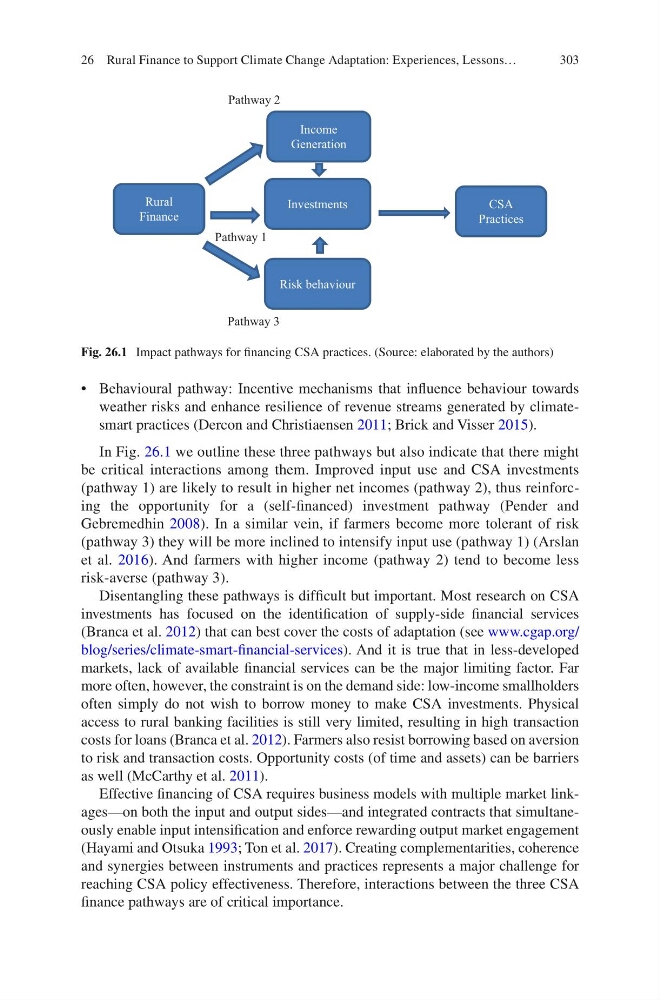
In Fig. 26.1 we outline these three pathways but also indicate that there might
be critical interactions among them. Improved input use and CSA investments
(pathway 1) are likely to result in higher net incomes (pathway 2), thus reinforcing the opportunity for a (self-financed) investment pathway (Pender and
Gebremedhin 2008). In a similar vein, if farmers become more tolerant of risk
(pathway 3) they will be more inclined to intensify input use (pathway 1) (Arslan
et al. 2016). And farmers with higher income (pathway 2) tend to become less
risk-averse (pathway 3).
Disentangling these pathways is difficult but important. Most research on CSA
investments has focused on the identification of supply-side financial services
(Branca et al. 2012) that can best cover the costs of adaptation (see www.cgap.org/
blog/series/climate-smart-financial-services). And it is true that in less-developed
markets, lack of available financial services can be the major limiting factor. Far
more often, however, the constraint is on the demand side: low-income smallholders
often simply do not wish to borrow money to make CSA investments. Physical
access to rural banking facilities is still very limited, resulting in high transaction
costs for loans (Branca et al. 2012). Farmers also resist borrowing based on aversion
to risk and transaction costs. Opportunity costs (of time and assets) can be barriers
as well (McCarthy et al. 2011).
Effective financing of CSA requires business models with multiple market linkages—on both the input and output sides—and integrated contracts that simultaneously enable input intensification and enforce rewarding output market engagement
(Hayami and Otsuka 1993; Ton et al. 2017). Creating complementarities, coherence
and synergies between instruments and practices represents a major challenge for
reaching CSA policy effectiveness. Therefore, interactions between the three CSA
finance pathways are of critical importance.
Pathway 1
Investments
Pathway 3
Pathway 2
Rural
Finance
Income
Generation
CSA
Practices
Risk behaviour
Fig. 26.1 Impact pathways for financing CSA practices. (Source: elaborated by the authors)
26 Rural Finance to Support Climate Change Adaptation: Experiences, Lessons…
• Behavioural pathway: Incentive mechanisms that influence behaviour towards
weather risks and enhance resilience of revenue streams generated by climatesmart practices (Dercon and Christiaensen 2011; Brick and Visser 2015).
In Fig. 26.1 we outline these three pathways but also indicate that there might
be critical interactions among them. Improved input use and CSA investments
(pathway 1) are likely to result in higher net incomes (pathway 2), thus reinforcing the opportunity for a (self-financed) investment pathway (Pender and
Gebremedhin 2008). In a similar vein, if farmers become more tolerant of risk
(pathway 3) they will be more inclined to intensify input use (pathway 1) (Arslan
et al. 2016). And farmers with higher income (pathway 2) tend to become less
risk-averse (pathway 3).
Disentangling these pathways is difficult but important. Most research on CSA
investments has focused on the identification of supply-side financial services
(Branca et al. 2012) that can best cover the costs of adaptation (see www.cgap.org/
blog/series/climate-smart-financial-services). And it is true that in less-developed
markets, lack of available financial services can be the major limiting factor. Far
more often, however, the constraint is on the demand side: low-income smallholders
often simply do not wish to borrow money to make CSA investments. Physical
access to rural banking facilities is still very limited, resulting in high transaction
costs for loans (Branca et al. 2012). Farmers also resist borrowing based on aversion
to risk and transaction costs. Opportunity costs (of time and assets) can be barriers
as well (McCarthy et al. 2011).
Effective financing of CSA requires business models with multiple market linkages—on both the input and output sides—and integrated contracts that simultaneously enable input intensification and enforce rewarding output market engagement
(Hayami and Otsuka 1993; Ton et al. 2017). Creating complementarities, coherence
and synergies between instruments and practices represents a major challenge for
reaching CSA policy effectiveness. Therefore, interactions between the three CSA
finance pathways are of critical importance.
Pathway 1
Investments
Pathway 3
Pathway 2
Rural
Finance
Income
Generation
CSA
Practices
Risk behaviour
Fig. 26.1 Impact pathways for financing CSA practices. (Source: elaborated by the authors)
26 Rural Finance to Support Climate Change Adaptation: Experiences, Lessons…