

280
24.2.2 Extension Program Managers’ Perceptions
of the Approach
In the surveys, the managers of extension program expressed widespread satisfaction with F2FE as a means to promote the adoption of innovations (Simpson et al.
2015). Median scores across the three countries on the overall effectiveness of the
approach ranged from 7.5 to 8 out of 10 in each of the 3 countries, with a score of 1
being not effective and 10 being extremely effective. Over 70% of respondents in
each country gave the approach a score of 7 or 8. The main benefits of the F2FE
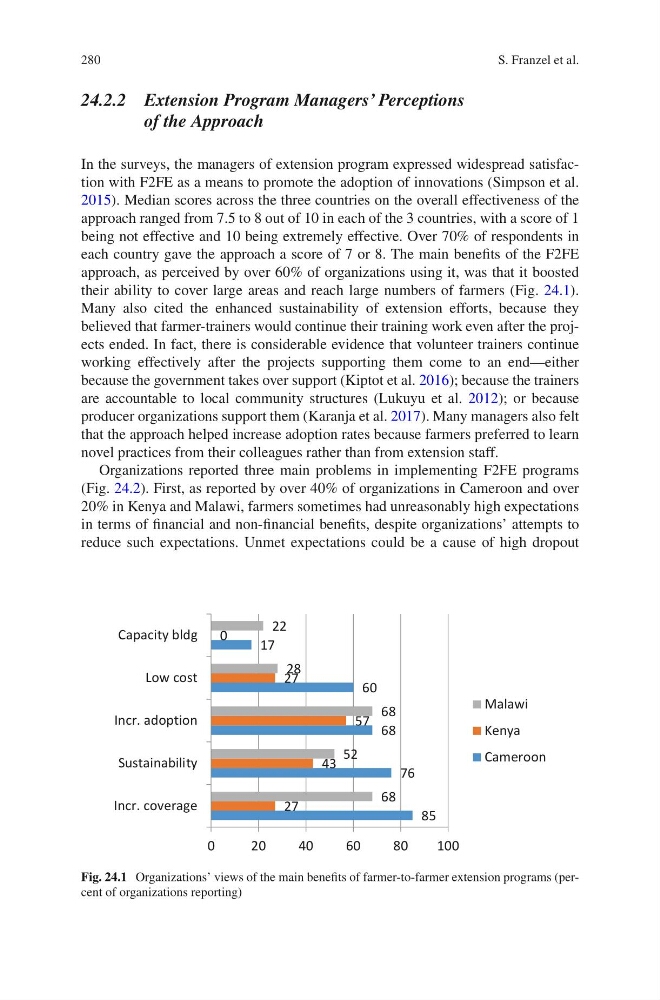
approach, as perceived by over 60% of organizations using it, was that it boosted
their ability to cover large areas and reach large numbers of farmers (Fig. 24.1).
Many also cited the enhanced sustainability of extension efforts, because they
believed that farmer-trainers would continue their training work even after the projects ended. In fact, there is considerable evidence that volunteer trainers continue
working effectively after the projects supporting them come to an end—either
because the government takes over support (Kiptot et al. 2016); because the trainers
are accountable to local community structures (Lukuyu et al. 2012); or because
producer organizations support them (Karanja et al. 2017). Many managers also felt
that the approach helped increase adoption rates because farmers preferred to learn
novel practices from their colleagues rather than from extension staff.
Organizations reported three main problems in implementing F2FE programs
(Fig. 24.2). First, as reported by over 40% of organizations in Cameroon and over
20% in Kenya and Malawi, farmers sometimes had unreasonably high expectations
in terms of financial and non-financial benefits, despite organizations’ attempts to
reduce such expectations. Unmet expectations could be a cause of high dropout
85
76
68
60
17
27
43
57
27
0
68
52
68
28
22
0
20
40
60
80
100
Incr. coverage
Sustainability
Incr. adoption
Low cost
Capacity bldg
Malawi
Kenya
Cameroon
Fig. 24.1 Organizations’ views of the main benefits of farmer-to-farmer extension programs (percent of organizations reporting)
S. Franzel et al.
24.2.2 Extension Program Managers’ Perceptions
of the Approach
In the surveys, the managers of extension program expressed widespread satisfaction with F2FE as a means to promote the adoption of innovations (Simpson et al.
2015). Median scores across the three countries on the overall effectiveness of the
approach ranged from 7.5 to 8 out of 10 in each of the 3 countries, with a score of 1
being not effective and 10 being extremely effective. Over 70% of respondents in
each country gave the approach a score of 7 or 8. The main benefits of the F2FE
approach, as perceived by over 60% of organizations using it, was that it boosted
their ability to cover large areas and reach large numbers of farmers (Fig. 24.1).
Many also cited the enhanced sustainability of extension efforts, because they
believed that farmer-trainers would continue their training work even after the projects ended. In fact, there is considerable evidence that volunteer trainers continue
working effectively after the projects supporting them come to an end—either
because the government takes over support (Kiptot et al. 2016); because the trainers
are accountable to local community structures (Lukuyu et al. 2012); or because
producer organizations support them (Karanja et al. 2017). Many managers also felt
that the approach helped increase adoption rates because farmers preferred to learn
novel practices from their colleagues rather than from extension staff.
Organizations reported three main problems in implementing F2FE programs
(Fig. 24.2). First, as reported by over 40% of organizations in Cameroon and over
20% in Kenya and Malawi, farmers sometimes had unreasonably high expectations
in terms of financial and non-financial benefits, despite organizations’ attempts to
reduce such expectations. Unmet expectations could be a cause of high dropout
85
76
68
60
17
27
43
57
27
0
68
52
68
28
22
0
20
40
60
80
100
Incr. coverage
Sustainability
Incr. adoption
Low cost
Capacity bldg
Malawi
Kenya
Cameroon
Fig. 24.1 Organizations’ views of the main benefits of farmer-to-farmer extension programs (percent of organizations reporting)
S. Franzel et al.