

271
Once the results of the questionnaires were presented to the MSPs, they made
changes to their meeting structures in order to address the knowledge gap: all actors
were invited to share their experiences with climate change adaptation projects, and
experts regularly presented research-based evidence on the CSA technologies favorable for each region. This transfer of knowledge was expected to enhance the technical capacity of the platforms’ members, which in turn was expected to translate
into attitudinal and behavioral change both within each member’s organization and
in the actions of the platforms as a whole.
While an end-line study was not available at the time this chapter was written,
limiting our ability to quantify the extent of participants’ learning over time, there is
evidence of the platforms’ impact. In event evaluation forms, participants indicated
that they shared their newly acquired knowledge with colleagues, politicians and
community members. The role of the MSPs in the dissemination of knowledge was
also publicly acknowledged by a representative of the Climate Change Department
in Uganda, who stated that the MSPs “have improved the understanding of climate
change and its impacts, thus enabling public institutions, individuals and non-state
actors to tap into the opportunities and co-benefits arising from mitigation and adaptation actions” (Semambo 2017).
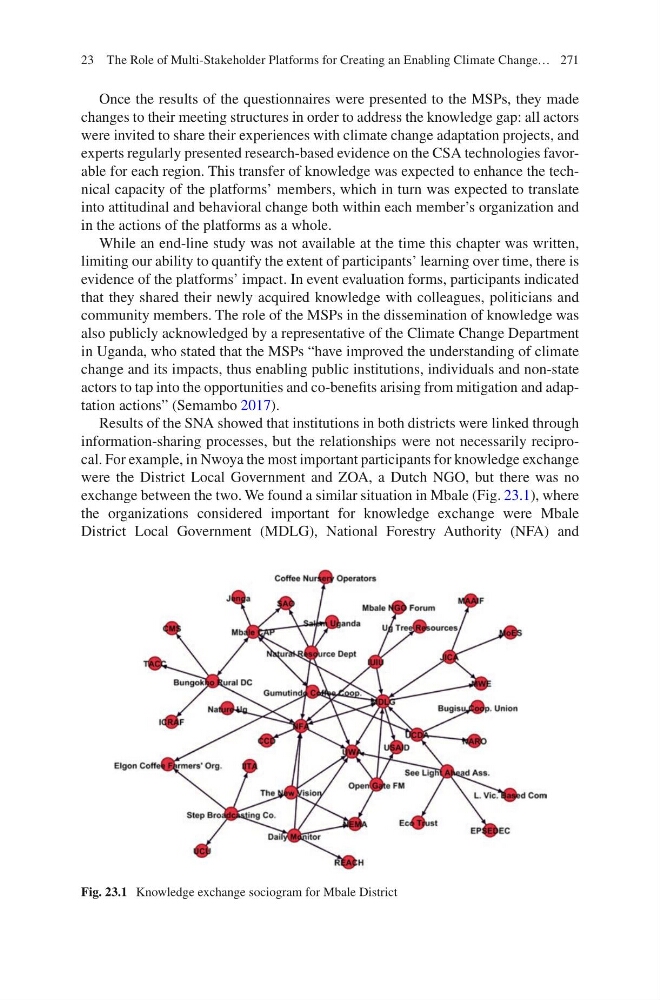
Results of the SNA showed that institutions in both districts were linked through
information-sharing processes, but the relationships were not necessarily reciprocal. For example, in Nwoya the most important participants for knowledge exchange
were the District Local Government and ZOA, a Dutch NGO, but there was no
exchange between the two. We found a similar situation in Mbale (Fig. 23.1), where
the organizations considered important for knowledge exchange were Mbale
District Local Government (MDLG), National Forestry Authority (NFA) and
Fig. 23.1 Knowledge exchange sociogram for Mbale District
23 The Role of Multi-Stakeholder Platforms for Creating an Enabling Climate Change…
Once the results of the questionnaires were presented to the MSPs, they made
changes to their meeting structures in order to address the knowledge gap: all actors
were invited to share their experiences with climate change adaptation projects, and
experts regularly presented research-based evidence on the CSA technologies favorable for each region. This transfer of knowledge was expected to enhance the technical capacity of the platforms’ members, which in turn was expected to translate
into attitudinal and behavioral change both within each member’s organization and
in the actions of the platforms as a whole.
While an end-line study was not available at the time this chapter was written,
limiting our ability to quantify the extent of participants’ learning over time, there is
evidence of the platforms’ impact. In event evaluation forms, participants indicated
that they shared their newly acquired knowledge with colleagues, politicians and
community members. The role of the MSPs in the dissemination of knowledge was
also publicly acknowledged by a representative of the Climate Change Department
in Uganda, who stated that the MSPs “have improved the understanding of climate
change and its impacts, thus enabling public institutions, individuals and non-state
actors to tap into the opportunities and co-benefits arising from mitigation and adaptation actions” (Semambo 2017).
Results of the SNA showed that institutions in both districts were linked through
information-sharing processes, but the relationships were not necessarily reciprocal. For example, in Nwoya the most important participants for knowledge exchange
were the District Local Government and ZOA, a Dutch NGO, but there was no
exchange between the two. We found a similar situation in Mbale (Fig. 23.1), where
the organizations considered important for knowledge exchange were Mbale
District Local Government (MDLG), National Forestry Authority (NFA) and
Fig. 23.1 Knowledge exchange sociogram for Mbale District
23 The Role of Multi-Stakeholder Platforms for Creating an Enabling Climate Change…