

250
21.3 Value Chains for Nutritious Foods: Lessons
from the Field
Increasing the availability of nutritious foods is necessary to deal with substantial
micronutrient malnutrition. In 2014, 32% of children below the age of 5 in subSaharan Africa were stunted (IFPRI 2016). Unfortunately, household-based interventions to improve the diet are often expensive (e.g., de Brauw et al. 2015). Such
interventions are also complex. In Ethiopia, for example, increasing knowledge
about nutrition was successful in improving dietary diversity, but only when households had sufficient market access (Hirvonen et al. 2017). Despite the challenges,
value chain interventions have the potential to be cost-effective as they involve the
private sector and, if successfully expanded, can reach a much larger set of beneficiaries than interventions focusing on individual households.
One intervention which would increase food security and diet diversity and that
has potential for upscaling is the distribution, through input dealers, of nutritious
crops that are more resilient to climate shocks. Beans are nutritious, but their productivity gains have lagged behind grain crops (Joshi and Rao 2017). In Malawi, the
International Center for Tropical Agriculture (CIAT) and the Pan-Africa Bean
Research Alliance (PABRA) have collaborated to study access to improved bean
varieties. Though there is evidence of higher yields and dietary diversity for those
who adopt the improved varieties, their initial use is associated with access to extension and mobile phones (Katungi et al. 2017).
Given the positive relationship between production diversity and dietary diversity
shown in subsistence-oriented contexts, crop diversification could meet the dual needs
for a more resilient crop mix (in the case of pests, disease, or extreme weather) and a
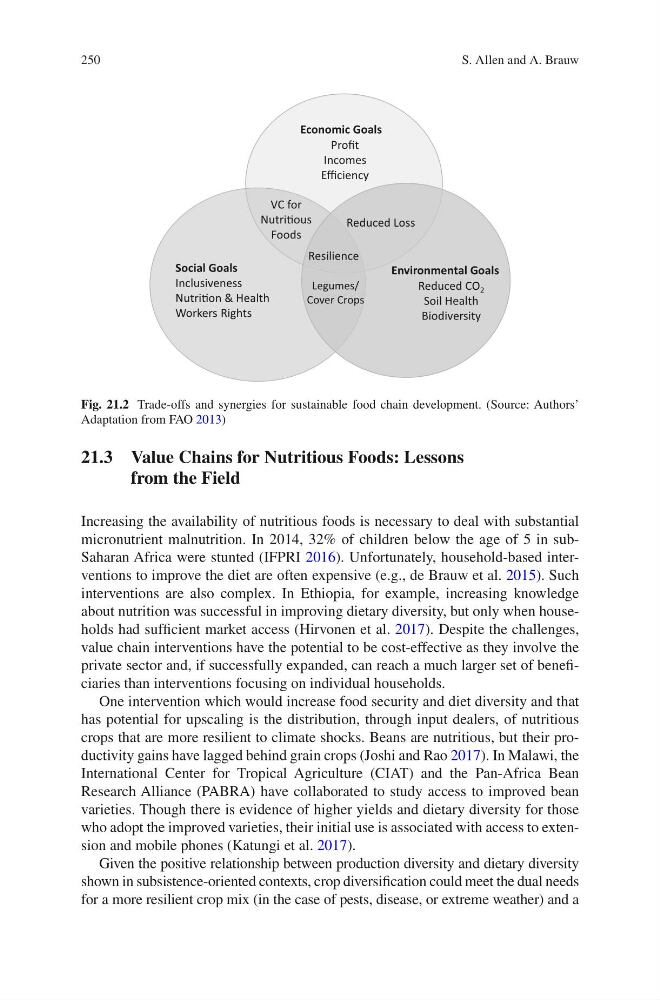
Economic Goals
Profit
Incomes
Efficiency
Social Goals
Inclusiveness
NutriƟon & Health
Workers Rights
Environmental Goals
Reduced CO 2
Soil Health
Biodiversity
Reduced Loss
VC for
NutriƟous
Foods
Resilience
Legumes/
Cover Crops
Fig. 21.2 Trade-offs and synergies for sustainable food chain development. (Source: Authors’
Adaptation from FAO 2013)
S. Allen and A. Brauw
21.3 Value Chains for Nutritious Foods: Lessons
from the Field
Increasing the availability of nutritious foods is necessary to deal with substantial
micronutrient malnutrition. In 2014, 32% of children below the age of 5 in subSaharan Africa were stunted (IFPRI 2016). Unfortunately, household-based interventions to improve the diet are often expensive (e.g., de Brauw et al. 2015). Such
interventions are also complex. In Ethiopia, for example, increasing knowledge
about nutrition was successful in improving dietary diversity, but only when households had sufficient market access (Hirvonen et al. 2017). Despite the challenges,
value chain interventions have the potential to be cost-effective as they involve the
private sector and, if successfully expanded, can reach a much larger set of beneficiaries than interventions focusing on individual households.
One intervention which would increase food security and diet diversity and that
has potential for upscaling is the distribution, through input dealers, of nutritious
crops that are more resilient to climate shocks. Beans are nutritious, but their productivity gains have lagged behind grain crops (Joshi and Rao 2017). In Malawi, the
International Center for Tropical Agriculture (CIAT) and the Pan-Africa Bean
Research Alliance (PABRA) have collaborated to study access to improved bean
varieties. Though there is evidence of higher yields and dietary diversity for those
who adopt the improved varieties, their initial use is associated with access to extension and mobile phones (Katungi et al. 2017).
Given the positive relationship between production diversity and dietary diversity
shown in subsistence-oriented contexts, crop diversification could meet the dual needs
for a more resilient crop mix (in the case of pests, disease, or extreme weather) and a
Economic Goals
Profit
Incomes
Efficiency
Social Goals
Inclusiveness
NutriƟon & Health
Workers Rights
Environmental Goals
Reduced CO 2
Soil Health
Biodiversity
Reduced Loss
VC for
NutriƟous
Foods
Resilience
Legumes/
Cover Crops
Fig. 21.2 Trade-offs and synergies for sustainable food chain development. (Source: Authors’
Adaptation from FAO 2013)
S. Allen and A. Brauw