

223
from the survey data, and if true would be a clear case of adding extra value to already
gathered environmental resources. It also implies that total greenhouse gas emissions
were not increased through increased shea production, as non- beneficiaries gathered
an equal amount of fuel wood but sold it instead of using it for shea production. Local
informants believed that this fuel wood was not being sold to shea butter producers,
but this was not established quantitatively. If it was in fact sold to producers, this fact
could undermine our conclusion regarding emissions.
The households below the calorie line showed a much higher adoption rate of
shea and shea butter sales amongst the beneficiary group compared to nonbeneficiaries. This partly reflects the fact that shea butter is highly labour intensive
and does not immediately generate a large amount of income. As a result, shea does
not attract wealthier families who have opportunities elsewhere. The difficulty of
shea production may be a blessing as well as a curse: it does not offer an easy path
out of poverty, but due to the initial low cash investment and high labour cost, it may
be a commodity which is well suited to improving incomes and food security for the
very poor and vulnerable.
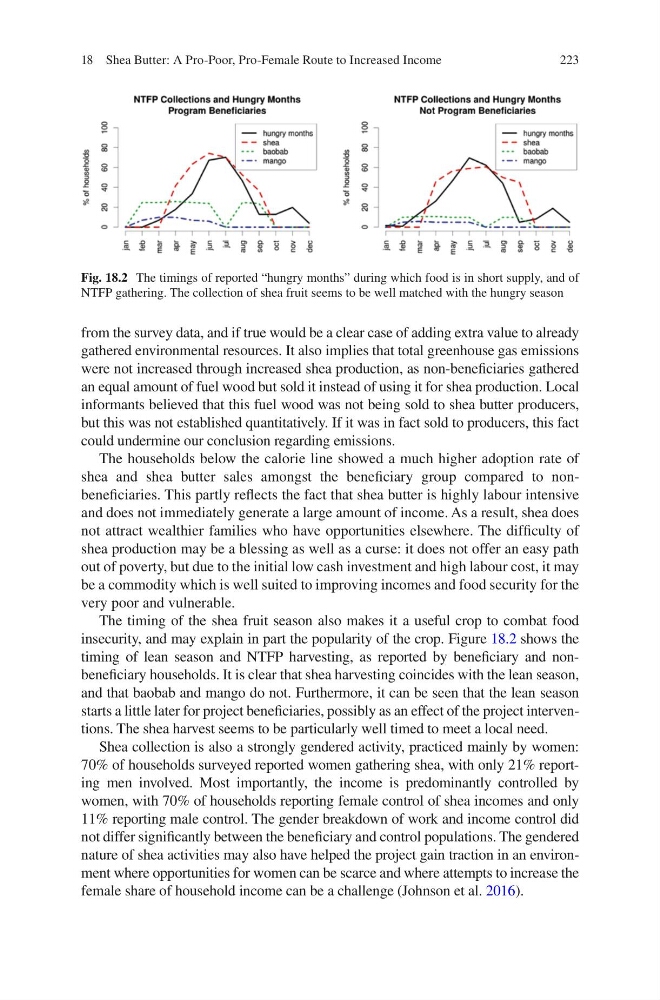
The timing of the shea fruit season also makes it a useful crop to combat food
insecurity, and may explain in part the popularity of the crop. Figure 18.2 shows the
timing of lean season and NTFP harvesting, as reported by beneficiary and nonbeneficiary households. It is clear that shea harvesting coincides with the lean season,
and that baobab and mango do not. Furthermore, it can be seen that the lean season
starts a little later for project beneficiaries, possibly as an effect of the project interventions. The shea harvest seems to be particularly well timed to meet a local need.
Shea collection is also a strongly gendered activity, practiced mainly by women:
70% of households surveyed reported women gathering shea, with only 21% reporting men involved. Most importantly, the income is predominantly controlled by
women, with 70% of households reporting female control of shea incomes and only
11% reporting male control. The gender breakdown of work and income control did
not differ significantly between the beneficiary and control populations. The gendered
nature of shea activities may also have helped the project gain traction in an environment where opportunities for women can be scarce and where attempts to increase the
female share of household income can be a challenge (Johnson et al. 2016).
Fig. 18.2 The timings of reported “hungry months” during which food is in short supply, and of
NTFP gathering. The collection of shea fruit seems to be well matched with the hungry season
18 Shea Butter: A Pro-Poor, Pro-Female Route to Increased Income
from the survey data, and if true would be a clear case of adding extra value to already
gathered environmental resources. It also implies that total greenhouse gas emissions
were not increased through increased shea production, as non- beneficiaries gathered
an equal amount of fuel wood but sold it instead of using it for shea production. Local
informants believed that this fuel wood was not being sold to shea butter producers,
but this was not established quantitatively. If it was in fact sold to producers, this fact
could undermine our conclusion regarding emissions.
The households below the calorie line showed a much higher adoption rate of
shea and shea butter sales amongst the beneficiary group compared to nonbeneficiaries. This partly reflects the fact that shea butter is highly labour intensive
and does not immediately generate a large amount of income. As a result, shea does
not attract wealthier families who have opportunities elsewhere. The difficulty of
shea production may be a blessing as well as a curse: it does not offer an easy path
out of poverty, but due to the initial low cash investment and high labour cost, it may
be a commodity which is well suited to improving incomes and food security for the
very poor and vulnerable.
The timing of the shea fruit season also makes it a useful crop to combat food
insecurity, and may explain in part the popularity of the crop. Figure 18.2 shows the
timing of lean season and NTFP harvesting, as reported by beneficiary and nonbeneficiary households. It is clear that shea harvesting coincides with the lean season,
and that baobab and mango do not. Furthermore, it can be seen that the lean season
starts a little later for project beneficiaries, possibly as an effect of the project interventions. The shea harvest seems to be particularly well timed to meet a local need.
Shea collection is also a strongly gendered activity, practiced mainly by women:
70% of households surveyed reported women gathering shea, with only 21% reporting men involved. Most importantly, the income is predominantly controlled by
women, with 70% of households reporting female control of shea incomes and only
11% reporting male control. The gender breakdown of work and income control did
not differ significantly between the beneficiary and control populations. The gendered
nature of shea activities may also have helped the project gain traction in an environment where opportunities for women can be scarce and where attempts to increase the
female share of household income can be a challenge (Johnson et al. 2016).
Fig. 18.2 The timings of reported “hungry months” during which food is in short supply, and of
NTFP gathering. The collection of shea fruit seems to be well matched with the hungry season
18 Shea Butter: A Pro-Poor, Pro-Female Route to Increased Income