

209
tion of a larger sample, multivariate statistics may offer a valid alternative to the use
of linear regressions. Furthermore, to avoid desirability bias (i.e., farmers trying to
give perceived-as-desirable answers to the interviewer), future research may combine survey questions with direct participant observation of farmers’ innovative and
proactive actions over time, as well as their interactions with stakeholders in their
environments.
17.4 Implications for Development
Our findings suggest that there are opportunities for development efforts to promote
innovation among farmers. It is important to note that current psychological theories see entrepreneurial orientation not as a personality trait (Rauch and Frese 2007)
fixed early in life but as a mindset that can develop over time—that can, in other
words, be learned (Baum et al. 2014; Campos et al. 2017). At least two learnable
dimensions of farmers’ entrepreneurial orientation—proactiveness and innovativeness—may play a role in the adoption and scaling of agricultural innovations when
tailored to certain types of farmers (York and Venkataraman 2010; Bruton et al.
2013). The development of a proactive and innovative mindset can be encouraged
through workshops and other training activities for farmers. MSPs can thereby act
as spaces for engaging in entrepreneurship training and thus supporting the development of entrepreneurial ecosystems (Bruton and Ahlstrom 2003; Dentoni and
Klerkx 2015; Seuneke et al. 2013). In particular, smallholder farmers may benefit
from tailored trainings on innovativeness, while larger farmers would benefit from
capacity-building activities focusing on proactiveness. Therefore, if confirmed on
studies at a larger scale, these findings suggest that training focused on shifting the
mindsets of farmers can lay the groundwork for agricultural innovation.
Appendix 1
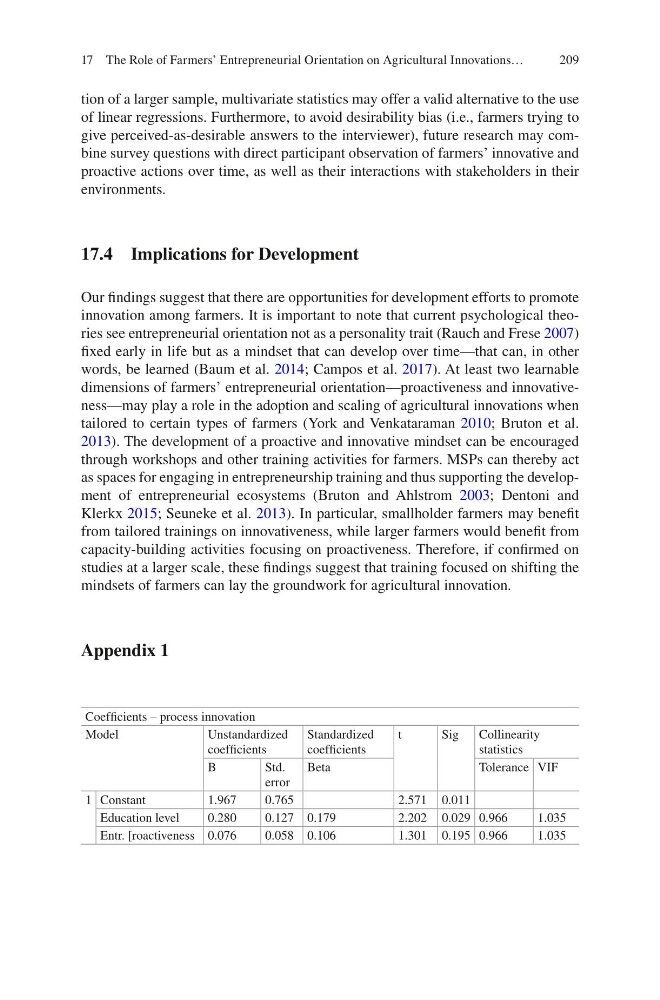
Coefficients – process innovation
Model
Unstandardized
coefficients
Standardized
coefficients
t
Sig
Collinearity
statistics
B
Std.
error
Beta
Tolerance VIF
1 Constant
1.967
0.765
2.571 0.011
Education level
0.280
0.127 0.179
2.202 0.029 0.966
1.035
Entr. [roactiveness 0.076
0.058 0.106
1.301 0.195 0.966
1.035
17 The Role of Farmers’ Entrepreneurial Orientation on Agricultural Innovations…
tion of a larger sample, multivariate statistics may offer a valid alternative to the use
of linear regressions. Furthermore, to avoid desirability bias (i.e., farmers trying to
give perceived-as-desirable answers to the interviewer), future research may combine survey questions with direct participant observation of farmers’ innovative and
proactive actions over time, as well as their interactions with stakeholders in their
environments.
17.4 Implications for Development
Our findings suggest that there are opportunities for development efforts to promote
innovation among farmers. It is important to note that current psychological theories see entrepreneurial orientation not as a personality trait (Rauch and Frese 2007)
fixed early in life but as a mindset that can develop over time—that can, in other
words, be learned (Baum et al. 2014; Campos et al. 2017). At least two learnable
dimensions of farmers’ entrepreneurial orientation—proactiveness and innovativeness—may play a role in the adoption and scaling of agricultural innovations when
tailored to certain types of farmers (York and Venkataraman 2010; Bruton et al.
2013). The development of a proactive and innovative mindset can be encouraged
through workshops and other training activities for farmers. MSPs can thereby act
as spaces for engaging in entrepreneurship training and thus supporting the development of entrepreneurial ecosystems (Bruton and Ahlstrom 2003; Dentoni and
Klerkx 2015; Seuneke et al. 2013). In particular, smallholder farmers may benefit
from tailored trainings on innovativeness, while larger farmers would benefit from
capacity-building activities focusing on proactiveness. Therefore, if confirmed on
studies at a larger scale, these findings suggest that training focused on shifting the
mindsets of farmers can lay the groundwork for agricultural innovation.
Appendix 1
Coefficients – process innovation
Model
Unstandardized
coefficients
Standardized
coefficients
t
Sig
Collinearity
statistics
B
Std.
error
Beta
Tolerance VIF
1 Constant
1.967
0.765
2.571 0.011
Education level
0.280
0.127 0.179
2.202 0.029 0.966
1.035
Entr. [roactiveness 0.076
0.058 0.106
1.301 0.195 0.966
1.035
17 The Role of Farmers’ Entrepreneurial Orientation on Agricultural Innovations…