

170
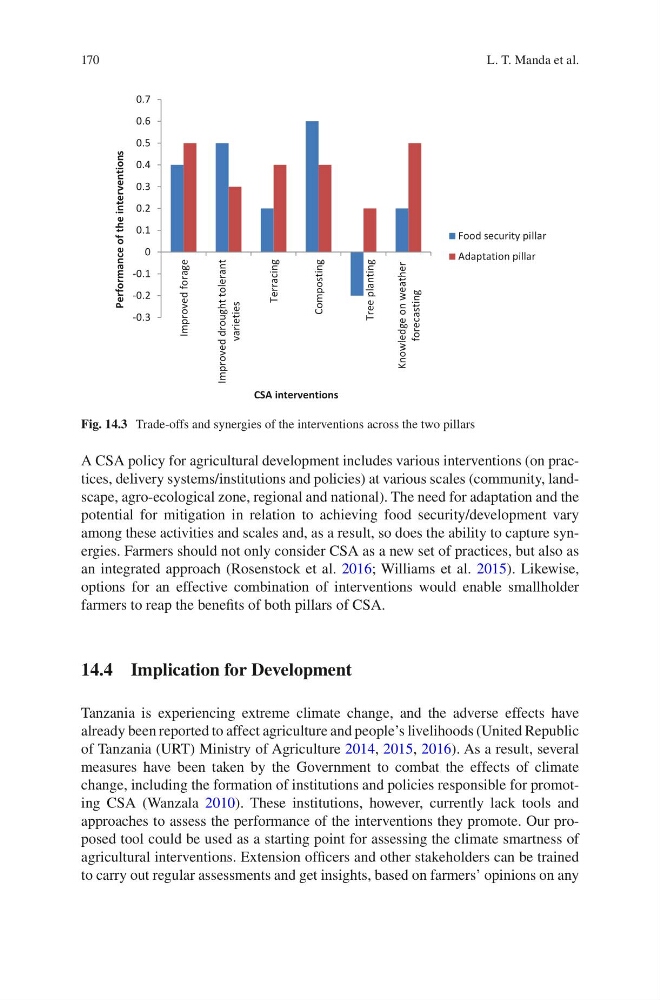
A CSA policy for agricultural development includes various interventions (on practices, delivery systems/institutions and policies) at various scales (community, landscape, agro-ecological zone, regional and national). The need for adaptation and the
potential for mitigation in relation to achieving food security/development vary
among these activities and scales and, as a result, so does the ability to capture synergies. Farmers should not only consider CSA as a new set of practices, but also as
an integrated approach (Rosenstock et al. 2016; Williams et al. 2015). Likewise,
options for an effective combination of interventions would enable smallholder
farmers to reap the benefits of both pillars of CSA.
14.4 Implication for Development
Tanzania is experiencing extreme climate change, and the adverse effects have
already been reported to affect agriculture and people’s livelihoods (United Republic
of Tanzania (URT) Ministry of Agriculture 2014, 2015, 2016). As a result, several
measures have been taken by the Government to combat the effects of climate
change, including the formation of institutions and policies responsible for promoting CSA (Wanzala 2010). These institutions, however, currently lack tools and
approaches to assess the performance of the interventions they promote. Our proposed tool could be used as a starting point for assessing the climate smartness of
agricultural interventions. Extension officers and other stakeholders can be trained
to carry out regular assessments and get insights, based on farmers’ opinions on any
-0.3
-0.2
-0.1
0
0.1
0.2
0.3
0.4
0.5
0.6
0.7
Improved forage
Improved drought tolerant
varieties
Terracing
Composting
Tree planting
Knowledge on weather
forecasting
Performance of the interventions
CSA interventions
Food security pillar
Adaptation pillar
Fig. 14.3 Trade-offs and synergies of the interventions across the two pillars
L. T. Manda et al.
A CSA policy for agricultural development includes various interventions (on practices, delivery systems/institutions and policies) at various scales (community, landscape, agro-ecological zone, regional and national). The need for adaptation and the
potential for mitigation in relation to achieving food security/development vary
among these activities and scales and, as a result, so does the ability to capture synergies. Farmers should not only consider CSA as a new set of practices, but also as
an integrated approach (Rosenstock et al. 2016; Williams et al. 2015). Likewise,
options for an effective combination of interventions would enable smallholder
farmers to reap the benefits of both pillars of CSA.
14.4 Implication for Development
Tanzania is experiencing extreme climate change, and the adverse effects have
already been reported to affect agriculture and people’s livelihoods (United Republic
of Tanzania (URT) Ministry of Agriculture 2014, 2015, 2016). As a result, several
measures have been taken by the Government to combat the effects of climate
change, including the formation of institutions and policies responsible for promoting CSA (Wanzala 2010). These institutions, however, currently lack tools and
approaches to assess the performance of the interventions they promote. Our proposed tool could be used as a starting point for assessing the climate smartness of
agricultural interventions. Extension officers and other stakeholders can be trained
to carry out regular assessments and get insights, based on farmers’ opinions on any
-0.3
-0.2
-0.1
0
0.1
0.2
0.3
0.4
0.5
0.6
0.7
Improved forage
Improved drought tolerant
varieties
Terracing
Composting
Tree planting
Knowledge on weather
forecasting
Performance of the interventions
CSA interventions
Food security pillar
Adaptation pillar
Fig. 14.3 Trade-offs and synergies of the interventions across the two pillars
L. T. Manda et al.