

159
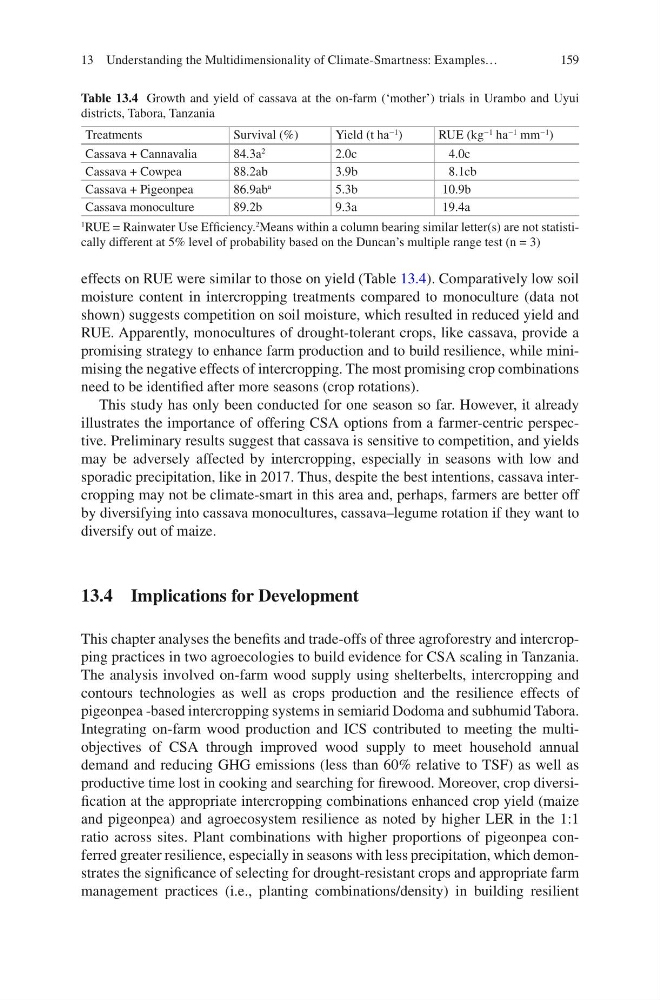
effects on RUE were similar to those on yield (Table 13.4). Comparatively low soil
moisture content in intercropping treatments compared to monoculture (data not
shown) suggests competition on soil moisture, which resulted in reduced yield and
RUE. Apparently, monocultures of drought-tolerant crops, like cassava, provide a
promising strategy to enhance farm production and to build resilience, while minimising the negative effects of intercropping. The most promising crop combinations
need to be identified after more seasons (crop rotations).
This study has only been conducted for one season so far. However, it already
illustrates the importance of offering CSA options from a farmer-centric perspective. Preliminary results suggest that cassava is sensitive to competition, and yields
may be adversely affected by intercropping, especially in seasons with low and
sporadic precipitation, like in 2017. Thus, despite the best intentions, cassava intercropping may not be climate-smart in this area and, perhaps, farmers are better off
by diversifying into cassava monocultures, cassava–legume rotation if they want to
diversify out of maize.
13.4 Implications for Development
This chapter analyses the benefits and trade-offs of three agroforestry and intercropping practices in two agroecologies to build evidence for CSA scaling in Tanzania.
The analysis involved on-farm wood supply using shelterbelts, intercropping and
contours technologies as well as crops production and the resilience effects of
pigeonpea -based intercropping systems in semiarid Dodoma and subhumid Tabora.
Integrating on-farm wood production and ICS contributed to meeting the multiobjectives of CSA through improved wood supply to meet household annual
demand and reducing GHG emissions (less than 60% relative to TSF) as well as
productive time lost in cooking and searching for firewood. Moreover, crop diversification at the appropriate intercropping combinations enhanced crop yield (maize
and pigeonpea) and agroecosystem resilience as noted by higher LER in the 1:1
ratio across sites. Plant combinations with higher proportions of pigeonpea conferred greater resilience, especially in seasons with less precipitation, which demonstrates the significance of selecting for drought-resistant crops and appropriate farm
management practices (i.e., planting combinations/density) in building resilient
Table 13.4 Growth and yield of cassava at the on-farm (‘mother’) trials in Urambo and Uyui
districts, Tabora, Tanzania
Treatments
Survival (%)
Yield (t ha
−1
)
RUE (kg
−1 ha
−1 mm
−1 )
Cassava + Cannavalia
84.3a
2
2.0c
4.0c
Cassava + Cowpea
88.2ab
3.9b
8.1cb
Cassava + Pigeonpea
86.9ab
a
5.3b
10.9b
Cassava monoculture
89.2b
9.3a
19.4a
1
RUE = Rainwater Use Efficiency.
2 Means within a column bearing similar letter(s) are not statistically different at 5% level of probability based on the Duncan’s multiple range test (n = 3)
13 Understanding the Multidimensionality of Climate-Smartness: Examples…
effects on RUE were similar to those on yield (Table 13.4). Comparatively low soil
moisture content in intercropping treatments compared to monoculture (data not
shown) suggests competition on soil moisture, which resulted in reduced yield and
RUE. Apparently, monocultures of drought-tolerant crops, like cassava, provide a
promising strategy to enhance farm production and to build resilience, while minimising the negative effects of intercropping. The most promising crop combinations
need to be identified after more seasons (crop rotations).
This study has only been conducted for one season so far. However, it already
illustrates the importance of offering CSA options from a farmer-centric perspective. Preliminary results suggest that cassava is sensitive to competition, and yields
may be adversely affected by intercropping, especially in seasons with low and
sporadic precipitation, like in 2017. Thus, despite the best intentions, cassava intercropping may not be climate-smart in this area and, perhaps, farmers are better off
by diversifying into cassava monocultures, cassava–legume rotation if they want to
diversify out of maize.
13.4 Implications for Development
This chapter analyses the benefits and trade-offs of three agroforestry and intercropping practices in two agroecologies to build evidence for CSA scaling in Tanzania.
The analysis involved on-farm wood supply using shelterbelts, intercropping and
contours technologies as well as crops production and the resilience effects of
pigeonpea -based intercropping systems in semiarid Dodoma and subhumid Tabora.
Integrating on-farm wood production and ICS contributed to meeting the multiobjectives of CSA through improved wood supply to meet household annual
demand and reducing GHG emissions (less than 60% relative to TSF) as well as
productive time lost in cooking and searching for firewood. Moreover, crop diversification at the appropriate intercropping combinations enhanced crop yield (maize
and pigeonpea) and agroecosystem resilience as noted by higher LER in the 1:1
ratio across sites. Plant combinations with higher proportions of pigeonpea conferred greater resilience, especially in seasons with less precipitation, which demonstrates the significance of selecting for drought-resistant crops and appropriate farm
management practices (i.e., planting combinations/density) in building resilient
Table 13.4 Growth and yield of cassava at the on-farm (‘mother’) trials in Urambo and Uyui
districts, Tabora, Tanzania
Treatments
Survival (%)
Yield (t ha
−1
)
RUE (kg
−1 ha
−1 mm
−1 )
Cassava + Cannavalia
84.3a
2
2.0c
4.0c
Cassava + Cowpea
88.2ab
3.9b
8.1cb
Cassava + Pigeonpea
86.9ab
a
5.3b
10.9b
Cassava monoculture
89.2b
9.3a
19.4a
1
RUE = Rainwater Use Efficiency.
2 Means within a column bearing similar letter(s) are not statistically different at 5% level of probability based on the Duncan’s multiple range test (n = 3)
13 Understanding the Multidimensionality of Climate-Smartness: Examples…