

115
10.3 Perennial Foods and FAOSTAT Yield Stabilities
To explore the usefulness of FAOSTAT data sets for assessing the ability of perennial foods to support the resilience of food systems in eastern and southern Africa,
we extracted annual yield time series for the years 1961–2014 for a range of 12
annual and perennial crops (or groups of crop species) from ten countries in the
region (Table 10.1). The crops chosen are representative of food production and, in
the case of the chosen perennials, are either NOC (cashew, coconut and the pooled
FAOSTAT crops mango, mangosteens and guava [these last crops are considered a
single crop in FAOSTAT reporting] are all entries on the AOCC’s crop list; AOCC
2018) or are proxies for NOC for which production data are not yet available. The
non-orphan perennials chosen as proxies were coffee, date and orange. This is
because, like the majority of perennial NOC considered by the AOCC (2018), the
crop product is based on fruit production. These crops can support diets directly or
provide incomes to buy food.
We converted yield data for these crops into fractional year-on-year yield changes
and applied a logarithmic transformation for scaling purposes, based on the
approaches outlined in Dawson et al. (2018a) (see also this reference for some of the
caveats in the use of FAOSTAT data sets that we do not describe fully here, but that
include the different levels of accuracy in reporting for different types of crop; a
measure to take this into account in our analysis involved the exclusion of country–
crop combinations if there were many identical yield values given over the time
series). This analysis provides a measure of yield stability over the last half-century
for individual country–crop combinations that can be summed across nations to
provide overall estimates of the stability of annual and perennial crop production.
Jan Feb Mar Apr May Jun Jul Aug Sep Oct Nov Dec
% of food insecure
households
No. of perennial fruit
species with mature fruit
80
40
8
4
0
0
Avocado (C+)
Chocolate berry (C+)
Custard apple (C++)
Guava (A+/C+++)
Jack tree (C+)
Lemon (C+++)
Loquat (A+++)
Mango (A+++/C++)
Orange (C+++)
Papaya (A++/C+++)
Passion fruit (A++/C++)
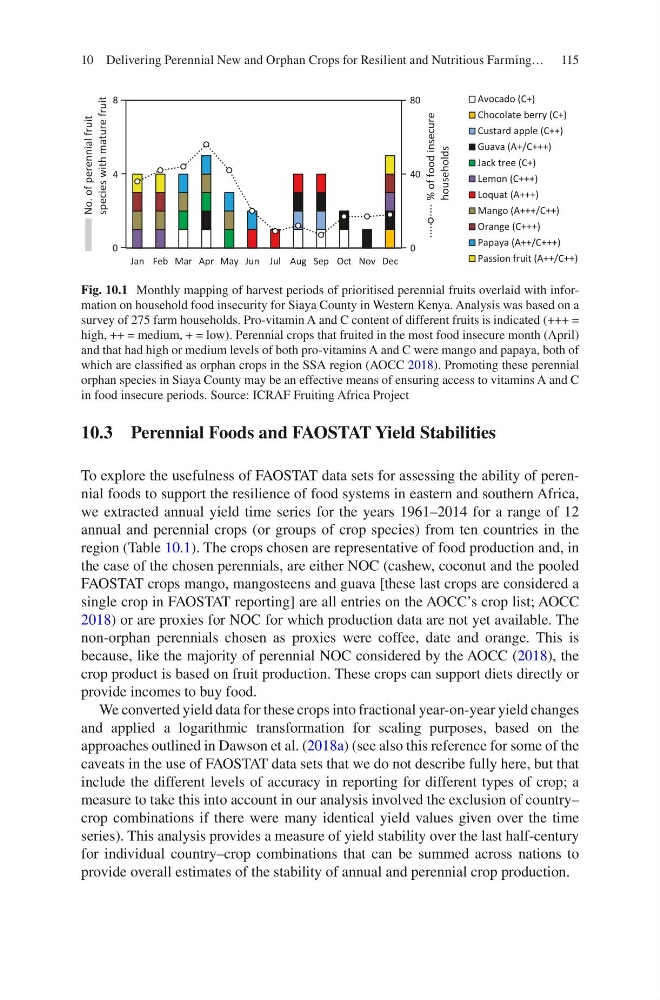
Fig. 10.1 Monthly mapping of harvest periods of prioritised perennial fruits overlaid with information on household food insecurity for Siaya County in Western Kenya. Analysis was based on a
survey of 275 farm households. Pro-vitamin A and C content of different fruits is indicated (+++ =
high, ++ = medium, + = low). Perennial crops that fruited in the most food insecure month (April)
and that had high or medium levels of both pro-vitamins A and C were mango and papaya, both of
which are classified as orphan crops in the SSA region (AOCC 2018). Promoting these perennial
orphan species in Siaya County may be an effective means of ensuring access to vitamins A and C
in food insecure periods. Source: ICRAF Fruiting Africa Project
10 Delivering Perennial New and Orphan Crops for Resilient and Nutritious Farming…
10.3 Perennial Foods and FAOSTAT Yield Stabilities
To explore the usefulness of FAOSTAT data sets for assessing the ability of perennial foods to support the resilience of food systems in eastern and southern Africa,
we extracted annual yield time series for the years 1961–2014 for a range of 12
annual and perennial crops (or groups of crop species) from ten countries in the
region (Table 10.1). The crops chosen are representative of food production and, in
the case of the chosen perennials, are either NOC (cashew, coconut and the pooled
FAOSTAT crops mango, mangosteens and guava [these last crops are considered a
single crop in FAOSTAT reporting] are all entries on the AOCC’s crop list; AOCC
2018) or are proxies for NOC for which production data are not yet available. The
non-orphan perennials chosen as proxies were coffee, date and orange. This is
because, like the majority of perennial NOC considered by the AOCC (2018), the
crop product is based on fruit production. These crops can support diets directly or
provide incomes to buy food.
We converted yield data for these crops into fractional year-on-year yield changes
and applied a logarithmic transformation for scaling purposes, based on the
approaches outlined in Dawson et al. (2018a) (see also this reference for some of the
caveats in the use of FAOSTAT data sets that we do not describe fully here, but that
include the different levels of accuracy in reporting for different types of crop; a
measure to take this into account in our analysis involved the exclusion of country–
crop combinations if there were many identical yield values given over the time
series). This analysis provides a measure of yield stability over the last half-century
for individual country–crop combinations that can be summed across nations to
provide overall estimates of the stability of annual and perennial crop production.
Jan Feb Mar Apr May Jun Jul Aug Sep Oct Nov Dec
% of food insecure
households
No. of perennial fruit
species with mature fruit
80
40
8
4
0
0
Avocado (C+)
Chocolate berry (C+)
Custard apple (C++)
Guava (A+/C+++)
Jack tree (C+)
Lemon (C+++)
Loquat (A+++)
Mango (A+++/C++)
Orange (C+++)
Papaya (A++/C+++)
Passion fruit (A++/C++)
Fig. 10.1 Monthly mapping of harvest periods of prioritised perennial fruits overlaid with information on household food insecurity for Siaya County in Western Kenya. Analysis was based on a
survey of 275 farm households. Pro-vitamin A and C content of different fruits is indicated (+++ =
high, ++ = medium, + = low). Perennial crops that fruited in the most food insecure month (April)
and that had high or medium levels of both pro-vitamins A and C were mango and papaya, both of
which are classified as orphan crops in the SSA region (AOCC 2018). Promoting these perennial
orphan species in Siaya County may be an effective means of ensuring access to vitamins A and C
in food insecure periods. Source: ICRAF Fruiting Africa Project
10 Delivering Perennial New and Orphan Crops for Resilient and Nutritious Farming…