

Exploring Non-covalent Interactions by Jet-Cooled Electronic …
69
secondary structures. The intrinsic nature of this delicate interplay of the non-covalent
interactions can be better understood or tested by studying some judiciously chosen
model complexes in an isolated condition, i.e., in the absence of any other interactions present there. Interestingly, heterocyclic aromatic molecules are the major
building blocks of the biomolecules and materials. We have described here some of
the heterocyclic complexes among many reported in the literature.
3.1.1 Indole…Pyridine Complex
Indole is one of the essential aromatic heterocycles due to its presence in the
side chain of the tryptophan residue of proteins. Additionally, indole is a vital
component of many important drugs approved in the market. Pyridine derivatives
also have prodigious medicinal importance. A molecular-level understanding of the
optimum binding motif and strength of various non-covalent interactions present in
the heterodimers of aromatic heterocycles is extremely important for drug discovery.
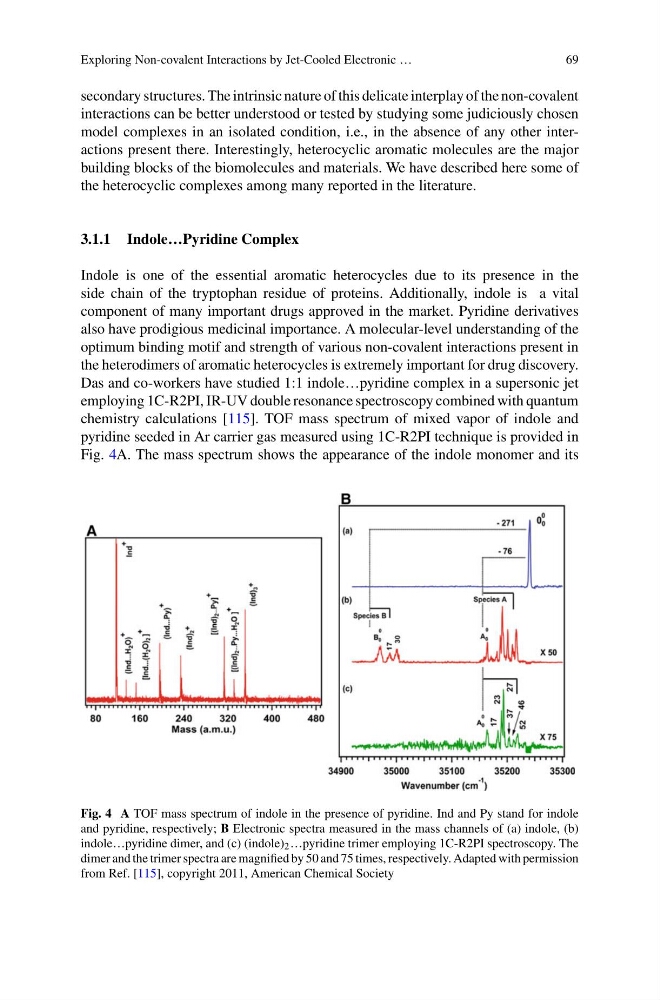
Das and co-workers have studied 1:1 indole…pyridine complex in a supersonic jet
employing 1C-R2PI, IR-UV double resonance spectroscopy combined with quantum
chemistry calculations [115]. TOF mass spectrum of mixed vapor of indole and
pyridine seeded in Ar carrier gas measured using 1C-R2PI technique is provided in
Fig. 4A. The mass spectrum shows the appearance of the indole monomer and its
Fig. 4 A TOF mass spectrum of indole in the presence of pyridine. Ind and Py stand for indole
and pyridine, respectively; B Electronic spectra measured in the mass channels of (a) indole, (b)
indole…pyridine dimer, and (c) (indole) 2 …pyridine trimer employing 1C-R2PI spectroscopy. The
dimer and the trimer spectra are magnified by 50 and 75 times, respectively. Adapted with permission
from Ref. [115], copyright 2011, American Chemical Society
69
secondary structures. The intrinsic nature of this delicate interplay of the non-covalent
interactions can be better understood or tested by studying some judiciously chosen
model complexes in an isolated condition, i.e., in the absence of any other interactions present there. Interestingly, heterocyclic aromatic molecules are the major
building blocks of the biomolecules and materials. We have described here some of
the heterocyclic complexes among many reported in the literature.
3.1.1 Indole…Pyridine Complex
Indole is one of the essential aromatic heterocycles due to its presence in the
side chain of the tryptophan residue of proteins. Additionally, indole is a vital
component of many important drugs approved in the market. Pyridine derivatives
also have prodigious medicinal importance. A molecular-level understanding of the
optimum binding motif and strength of various non-covalent interactions present in
the heterodimers of aromatic heterocycles is extremely important for drug discovery.
Das and co-workers have studied 1:1 indole…pyridine complex in a supersonic jet
employing 1C-R2PI, IR-UV double resonance spectroscopy combined with quantum
chemistry calculations [115]. TOF mass spectrum of mixed vapor of indole and
pyridine seeded in Ar carrier gas measured using 1C-R2PI technique is provided in
Fig. 4A. The mass spectrum shows the appearance of the indole monomer and its
Fig. 4 A TOF mass spectrum of indole in the presence of pyridine. Ind and Py stand for indole
and pyridine, respectively; B Electronic spectra measured in the mass channels of (a) indole, (b)
indole…pyridine dimer, and (c) (indole) 2 …pyridine trimer employing 1C-R2PI spectroscopy. The
dimer and the trimer spectra are magnified by 50 and 75 times, respectively. Adapted with permission
from Ref. [115], copyright 2011, American Chemical Society