

64
P. Panwaria and A. Das
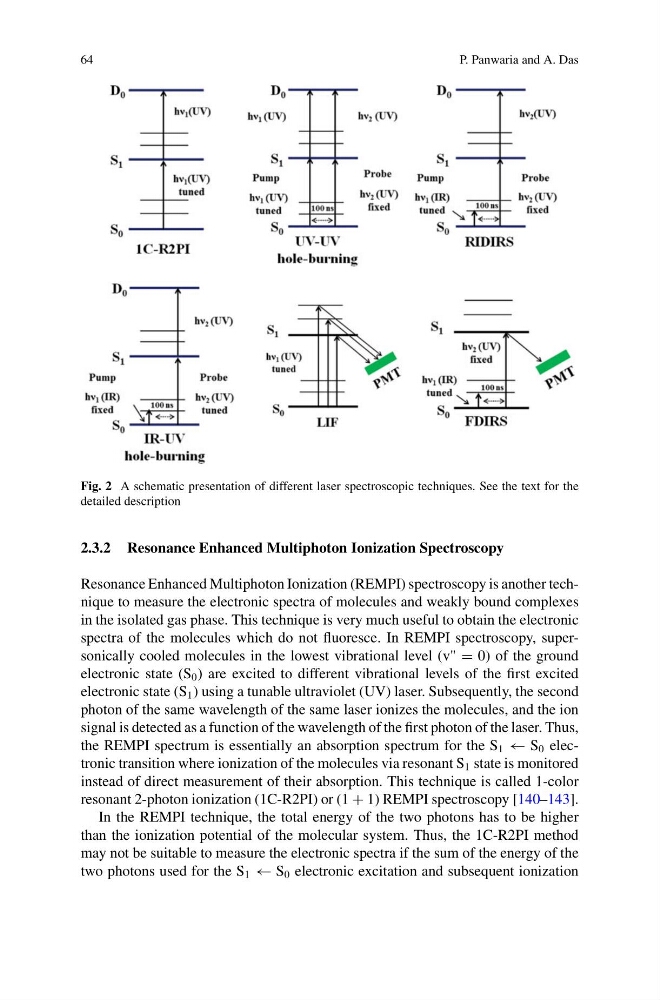
Fig. 2 A schematic presentation of different laser spectroscopic techniques. See the text for the
detailed description
2.3.2 Resonance Enhanced Multiphoton Ionization Spectroscopy
Resonance Enhanced Multiphoton Ionization (REMPI) spectroscopy is another technique to measure the electronic spectra of molecules and weakly bound complexes
in the isolated gas phase. This technique is very much useful to obtain the electronic
spectra of the molecules which do not fluoresce. In REMPI spectroscopy, supersonically cooled molecules in the lowest vibrational level (v" = 0) of the ground
electronic state (S 0 ) are excited to different vibrational levels of the first excited
electronic state (S 1 ) using a tunable ultraviolet (UV) laser. Subsequently, the second
photon of the same wavelength of the same laser ionizes the molecules, and the ion
signal is detected as a function of the wavelength of the first photon of the laser. Thus,
the REMPI spectrum is essentially an absorption spectrum for the S 1 ← S 0 electronic transition where ionization of the molecules via resonant S 1 state is monitored
instead of direct measurement of their absorption. This technique is called 1-color
resonant 2-photon ionization (1C-R2PI) or (1 + 1) REMPI spectroscopy [140–143].
In the REMPI technique, the total energy of the two photons has to be higher
than the ionization potential of the molecular system. Thus, the 1C-R2PI method
may not be suitable to measure the electronic spectra if the sum of the energy of the
two photons used for the S 1 ← S 0 electronic excitation and subsequent ionization
P. Panwaria and A. Das
Fig. 2 A schematic presentation of different laser spectroscopic techniques. See the text for the
detailed description
2.3.2 Resonance Enhanced Multiphoton Ionization Spectroscopy
Resonance Enhanced Multiphoton Ionization (REMPI) spectroscopy is another technique to measure the electronic spectra of molecules and weakly bound complexes
in the isolated gas phase. This technique is very much useful to obtain the electronic
spectra of the molecules which do not fluoresce. In REMPI spectroscopy, supersonically cooled molecules in the lowest vibrational level (v" = 0) of the ground
electronic state (S 0 ) are excited to different vibrational levels of the first excited
electronic state (S 1 ) using a tunable ultraviolet (UV) laser. Subsequently, the second
photon of the same wavelength of the same laser ionizes the molecules, and the ion
signal is detected as a function of the wavelength of the first photon of the laser. Thus,
the REMPI spectrum is essentially an absorption spectrum for the S 1 ← S 0 electronic transition where ionization of the molecules via resonant S 1 state is monitored
instead of direct measurement of their absorption. This technique is called 1-color
resonant 2-photon ionization (1C-R2PI) or (1 + 1) REMPI spectroscopy [140–143].
In the REMPI technique, the total energy of the two photons has to be higher
than the ionization potential of the molecular system. Thus, the 1C-R2PI method
may not be suitable to measure the electronic spectra if the sum of the energy of the
two photons used for the S 1 ← S 0 electronic excitation and subsequent ionization