

62
P. Panwaria and A. Das
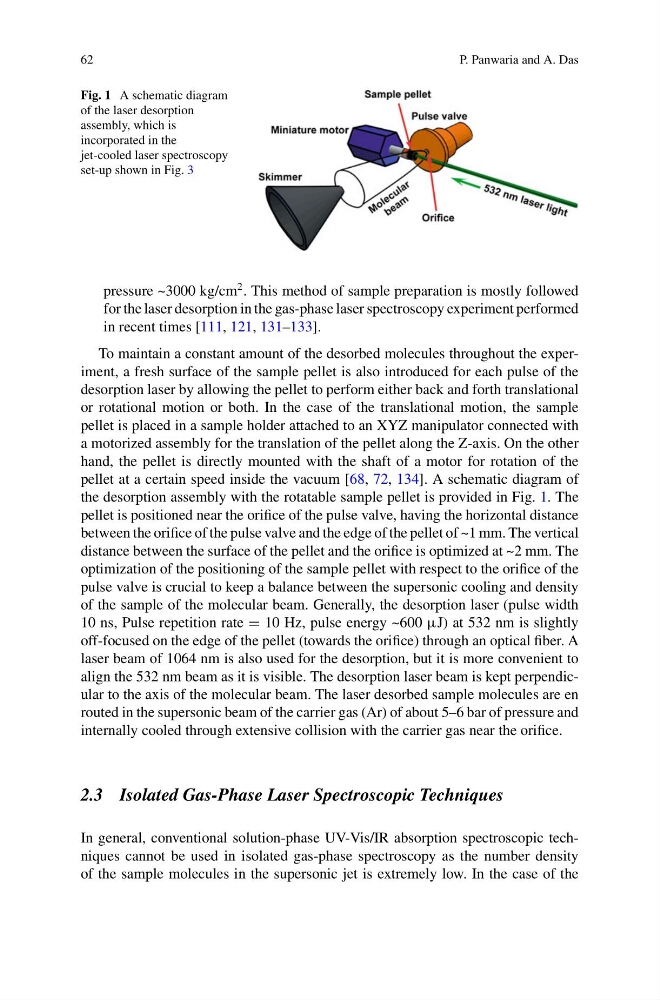
Fig. 1 A schematic diagram
of the laser desorption
assembly, which is
incorporated in the
jet-cooled laser spectroscopy
set-up shown in Fig. 3
pressure ~3000 kg/cm
2 . This method of sample preparation is mostly followed
for the laser desorption in the gas-phase laser spectroscopy experiment performed
in recent times [111, 121, 131–133].
To maintain a constant amount of the desorbed molecules throughout the experiment, a fresh surface of the sample pellet is also introduced for each pulse of the
desorption laser by allowing the pellet to perform either back and forth translational
or rotational motion or both. In the case of the translational motion, the sample
pellet is placed in a sample holder attached to an XYZ manipulator connected with
a motorized assembly for the translation of the pellet along the Z-axis. On the other
hand, the pellet is directly mounted with the shaft of a motor for rotation of the
pellet at a certain speed inside the vacuum [68, 72, 134]. A schematic diagram of
the desorption assembly with the rotatable sample pellet is provided in Fig. 1. The
pellet is positioned near the orifice of the pulse valve, having the horizontal distance
between the orifice of the pulse valve and the edge of the pellet of ~1 mm. The vertical
distance between the surface of the pellet and the orifice is optimized at ~2 mm. The
optimization of the positioning of the sample pellet with respect to the orifice of the
pulse valve is crucial to keep a balance between the supersonic cooling and density
of the sample of the molecular beam. Generally, the desorption laser (pulse width
10 ns, Pulse repetition rate = 10 Hz, pulse energy ~600 μJ) at 532 nm is slightly
off-focused on the edge of the pellet (towards the orifice) through an optical fiber. A
laser beam of 1064 nm is also used for the desorption, but it is more convenient to
align the 532 nm beam as it is visible. The desorption laser beam is kept perpendicular to the axis of the molecular beam. The laser desorbed sample molecules are en
routed in the supersonic beam of the carrier gas (Ar) of about 5–6 bar of pressure and
internally cooled through extensive collision with the carrier gas near the orifice.
2.3 Isolated Gas-Phase Laser Spectroscopic Techniques
In general, conventional solution-phase UV-Vis/IR absorption spectroscopic techniques cannot be used in isolated gas-phase spectroscopy as the number density
of the sample molecules in the supersonic jet is extremely low. In the case of the
P. Panwaria and A. Das
Fig. 1 A schematic diagram
of the laser desorption
assembly, which is
incorporated in the
jet-cooled laser spectroscopy
set-up shown in Fig. 3
pressure ~3000 kg/cm
2 . This method of sample preparation is mostly followed
for the laser desorption in the gas-phase laser spectroscopy experiment performed
in recent times [111, 121, 131–133].
To maintain a constant amount of the desorbed molecules throughout the experiment, a fresh surface of the sample pellet is also introduced for each pulse of the
desorption laser by allowing the pellet to perform either back and forth translational
or rotational motion or both. In the case of the translational motion, the sample
pellet is placed in a sample holder attached to an XYZ manipulator connected with
a motorized assembly for the translation of the pellet along the Z-axis. On the other
hand, the pellet is directly mounted with the shaft of a motor for rotation of the
pellet at a certain speed inside the vacuum [68, 72, 134]. A schematic diagram of
the desorption assembly with the rotatable sample pellet is provided in Fig. 1. The
pellet is positioned near the orifice of the pulse valve, having the horizontal distance
between the orifice of the pulse valve and the edge of the pellet of ~1 mm. The vertical
distance between the surface of the pellet and the orifice is optimized at ~2 mm. The
optimization of the positioning of the sample pellet with respect to the orifice of the
pulse valve is crucial to keep a balance between the supersonic cooling and density
of the sample of the molecular beam. Generally, the desorption laser (pulse width
10 ns, Pulse repetition rate = 10 Hz, pulse energy ~600 μJ) at 532 nm is slightly
off-focused on the edge of the pellet (towards the orifice) through an optical fiber. A
laser beam of 1064 nm is also used for the desorption, but it is more convenient to
align the 532 nm beam as it is visible. The desorption laser beam is kept perpendicular to the axis of the molecular beam. The laser desorbed sample molecules are en
routed in the supersonic beam of the carrier gas (Ar) of about 5–6 bar of pressure and
internally cooled through extensive collision with the carrier gas near the orifice.
2.3 Isolated Gas-Phase Laser Spectroscopic Techniques
In general, conventional solution-phase UV-Vis/IR absorption spectroscopic techniques cannot be used in isolated gas-phase spectroscopy as the number density
of the sample molecules in the supersonic jet is extremely low. In the case of the