

652
S. P. Singh and S. Siddhanta
chosen to match the intrinsic vibrational resonance of the analytes. One of the main
practical differences between both techniques is that in CARS only C-H stretch is
seen while in SRS the overall fingerprint region is detected [66]. Even though CARS
signals are easily detected the signal to noise ratio of the SRS spectrum is better
due to the resonance effects. These methods have been employed in a wide range
of applications ranging from agriculture, food technology, pharmaceutics, environmental monitoring, disease diagnosis, geology, material sciences, forensic analysis,
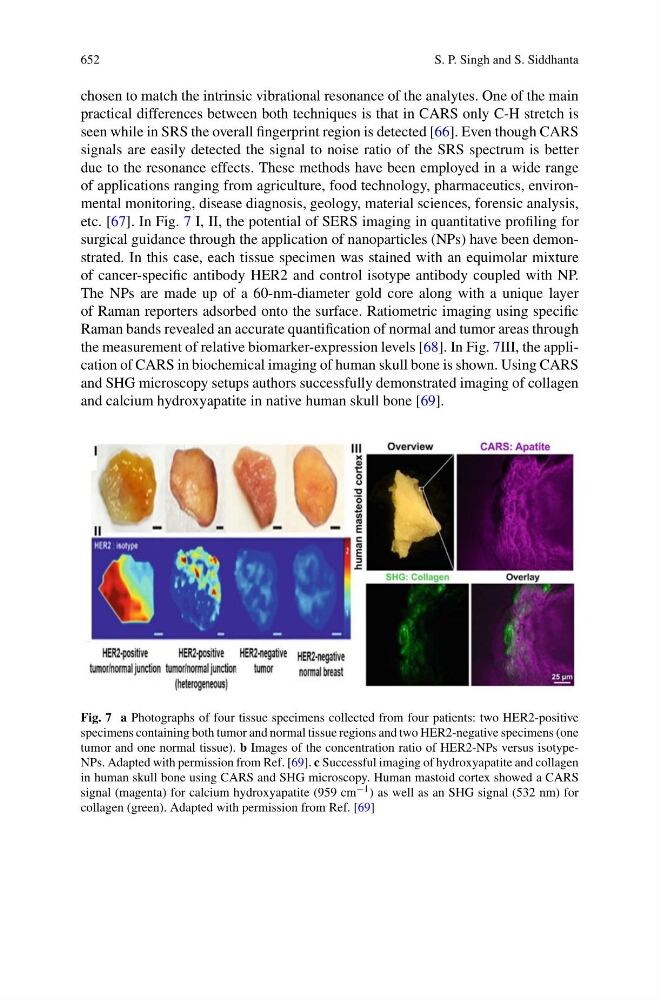
etc. [67]. In Fig. 7 I, II, the potential of SERS imaging in quantitative profiling for
surgical guidance through the application of nanoparticles (NPs) have been demonstrated. In this case, each tissue specimen was stained with an equimolar mixture
of cancer-specific antibody HER2 and control isotype antibody coupled with NP.
The NPs are made up of a 60-nm-diameter gold core along with a unique layer
of Raman reporters adsorbed onto the surface. Ratiometric imaging using specific
Raman bands revealed an accurate quantification of normal and tumor areas through
the measurement of relative biomarker-expression levels [68]. In Fig. 7III, the application of CARS in biochemical imaging of human skull bone is shown. Using CARS
and SHG microscopy setups authors successfully demonstrated imaging of collagen
and calcium hydroxyapatite in native human skull bone [69].
Fig. 7 a Photographs of four tissue specimens collected from four patients: two HER2-positive
specimens containing both tumor and normal tissue regions and two HER2-negative specimens (one
tumor and one normal tissue). b Images of the concentration ratio of HER2-NPs versus isotypeNPs. Adapted with permission from Ref. [69]. c Successful imaging of hydroxyapatite and collagen
in human skull bone using CARS and SHG microscopy. Human mastoid cortex showed a CARS
signal (magenta) for calcium hydroxyapatite (959 cm −1 ) as well as an SHG signal (532 nm) for
collagen (green). Adapted with permission from Ref. [69]